
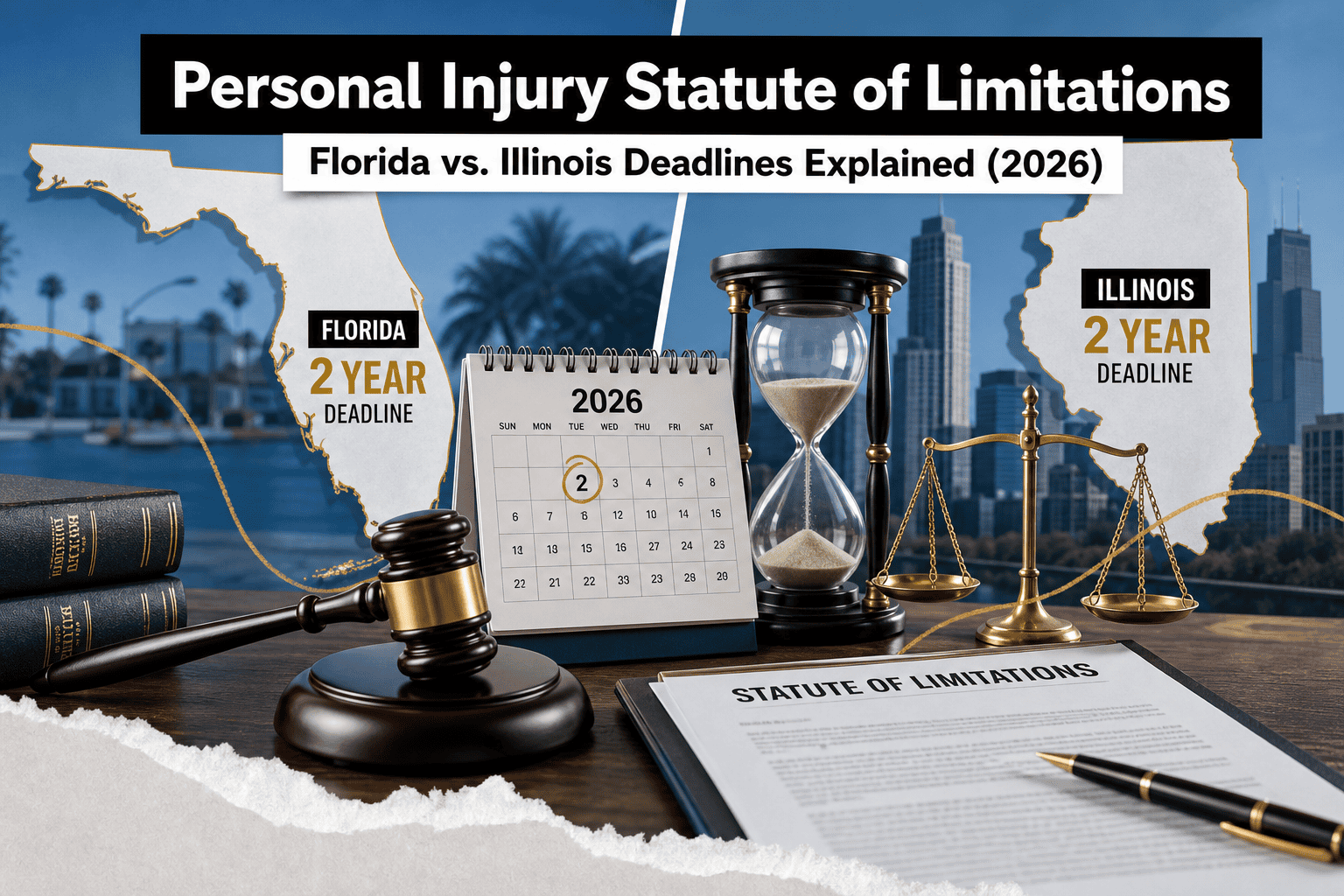
Ask ten people how long they have to file a personal injury claim, and you’ll probably get ten different answers, most of them outdated. Deadlines get remembered from a friend’s old case, a Google search from years ago, or a rule that simply isn’t true anymore. Heading into 2026, here’s what actually applies in Florida and Illinois, including a few exceptions that catch people off guard.
That’s why here at Demesmin & Dover Law Firm, we believe in making things clear, this way you know exactly which deadline applies to your situation.
Florida’s Standard Deadline in 2026
Two Years, Confirmed Current
Under Florida Statute 95.11, most personal injury claims in Florida must be filed within two years of the date of the injury. This is worth stating plainly heading into 2026: this deadline has not changed again since Florida cut it from four years down to two as part of 2023 tort reform. If your injury happened on or after March 24, 2023, the two-year clock applies. Injuries from before that date generally still fall under the old four-year window.
A Common Misconception Worth Clearing Up
A fair number of people still operate under the assumption that Florida gives four years to file, since that was the rule for decades before the 2023 change. Heading into a new year is a good moment to double check this, especially if your injury happened a few years ago and you’re not sure which version of the rule applies to your specific date.
Illinois’s Standard Deadline in 2026
Also Two Years, and Unchanged
Under 735 ILCS 5/13-202, Illinois gives most personal injury claims two years from the date of the injury to file suit. Unlike Florida, Illinois has held this standard steady, so there’s no recent legislative shift to account for here heading into 2026.
The Government Claims Exception Most People Miss
This is where the two states genuinely diverge, and it’s one of the most consequential exceptions in either state’s system.
Florida’s Rules for Suing the Government
Under Florida Statute 768.28, claims against a state agency, county, or municipality require written pre-suit notice to both the relevant agency and the Florida Department of Financial Services within three years of the incident, followed by a mandatory waiting period before a lawsuit can be filed. Importantly, that three-year notice window doesn’t override the underlying two-year statute of limitations for the negligence claim itself. In practice, this means government claims in Florida still need to move on essentially the same two-year timeline as any other injury claim, just with an added notice and waiting-period requirement layered on top.
Illinois’s Much Shorter Government Deadline
Illinois takes a sharply different approach. Under 745 ILCS 10/8-101, part of the Local Governmental and Governmental Employees Tort Immunity Act, claims against a local public entity, a city, county, park district, or school district, generally must be filed within just one year of the injury, half the standard personal injury deadline. This shorter window catches a lot of people off guard, especially when an accident involves a city vehicle, a pothole, or a public property hazard, and they don’t realize a completely different, much tighter clock is running.
Other Exceptions Worth Knowing in Both States
Claims Involving Minors
Both states generally pause the statute of limitations while an injured person is under 18, meaning the standard clock doesn’t start running until they turn 18. Illinois’s tort immunity deadline for claims against the government follows a similar tolling principle for minors as well.
Wrongful Death Claims
Both states generally apply their own two-year window to wrongful death claims, but that clock typically starts from the date of death rather than the date of the original injury.
The Discovery Rule
For injuries that aren’t immediately apparent, certain medical conditions, for example, both states allow some claims to be measured from the date the injury was discovered, or reasonably should have been discovered. This exception applies narrowly and doesn’t cover the vast majority of car accident or slip and fall cases, where the injury is obvious right away.
Why Getting This Right Matters More at the Start of a New Year
Deadlines Are Absolute
In both states, missing the statute of limitations doesn’t weaken a claim. It ends it. Courts generally don’t make exceptions for ongoing medical treatment, active negotiations with an insurance company, or simply not knowing the deadline had changed.
A Fresh Year Is a Good Time to Check Old Claims
If you were injured in the last few years and never resolved the matter, 2026 is a reasonable moment to confirm exactly where your deadline actually stands, particularly if a government entity might be involved, since that Illinois one-year window in particular can expire long before most people even start looking into their options.
What This Means for You
- Confirm the exact date of your injury. That date starts the clock in almost every scenario.
- Find out immediately if a government entity was involved. Illinois’s one-year deadline is easy to miss if you assume the standard two-year rule applies.
- Don’t assume Florida still allows four years. That rule changed in 2023 and hasn’t changed back.
- Don’t wait until a deadline is close to seek advice. Evidence gathering, medical documentation, and negotiation all take time that shrinks fast as a filing deadline approaches.
Talk to an Attorney in Florida or Illinois Before Your Deadline Passes
Whether your case is in Florida or Illinois, and whether a private party or a government entity is involved, these deadlines leave far less room for error than most people expect.
The team at Demesmin & Dover Law Firm helps clients in both Florida and Illinois confirm exactly which statute of limitations applies to their case, including the shorter government claim deadlines that catch so many people off guard. Contact Demesmin & Dover today for a free consultation, there’s no fee unless we win your case.