You pay your premium every month like clockwork. Then you finally need to use the coverage you’ve been paying for, and suddenly the insurance company is finding every reason not to pay, or paying far less than you expected. If that feels like a newer problem than it used to be, the data backs up that instinct.
That’s why here at Demesmin & Dover Law Firm, we believe in making things clear, this way you know exactly what you’re dealing with when an insurer pushes back on your claim.
What the Newest National Data Actually Shows
A detailed 2026 analysis gives the clearest answer yet to a question a lot of drivers have been asking.
Claims Closing Without Payment Are Way Up
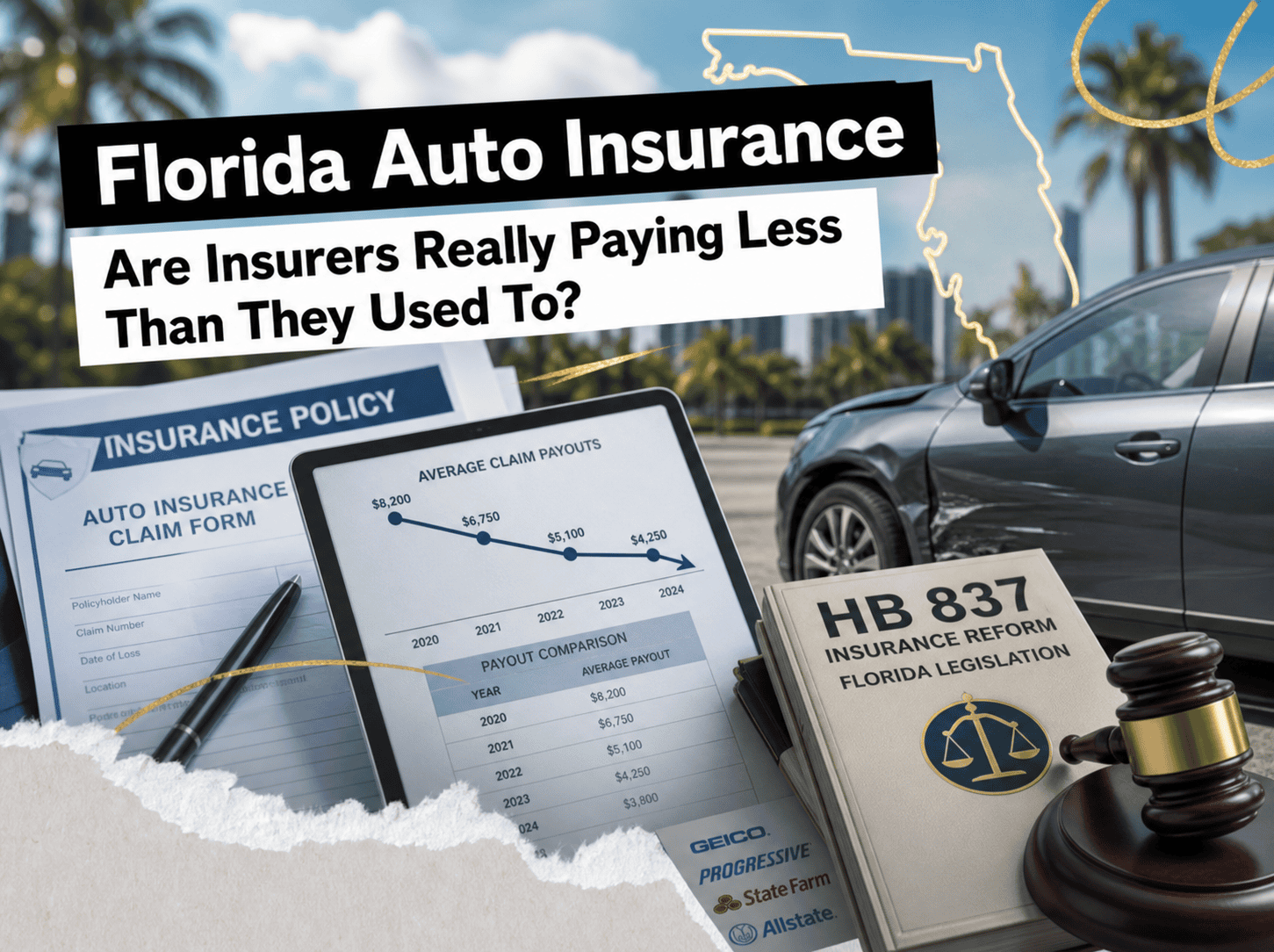
According to Wall Street Journal reporting published via Yahoo Finance, auto insurers closed 45% of resolved liability and medical claims without making any payment in 2025, up sharply from 35% a decade earlier. The analysis was built on insurers’ own annual filings with the National Association of Insurance Commissioners covering 2016 through 2025, not estimates or industry press releases.
Insurers Are Keeping More of Every Premium Dollar
Here’s the part that should catch every driver’s attention. That same reporting found personal auto insurers paid out about 61 cents in claims for every dollar they collected in premiums in 2025, according to S&P Global Market Intelligence, the industry’s lowest net loss ratio since 2020. In plain terms, insurers are collecting more and paying out a smaller share of it than they have in years.
It’s Not Every Type of Claim Equally
Collision and comprehensive claims, the kind that cover damage to your own vehicle, have held relatively steady, with just under 25% closing without payment in 2025, similar to where that rate has sat for a decade. Liability and medical claims, the kind involving injuries to you or someone else, are where the real shift is happening, and those cases are typically the most expensive, the most complicated, and the most likely to involve an attorney.
Why This Is Happening
Insurers and consumer advocates tell very different versions of this story.
The Industry’s Explanation
Insurers point to rising fraud, including fabricated claims they say are increasingly aided by artificial intelligence, along with more claimants involving attorneys earlier in the process instead of negotiating directly. Companies describe this as adding necessary “guardrails” to claims handling.
The Consumer Advocate’s Explanation
Consumer Federation of America insurance director Douglas Heller offered a blunter read on the same numbers, telling the Journal that the industry uses claim lowballing and denials to squeeze extra profit from customers who lack the resources, or in some states the legal standing, to push back.
Both Sides Agree Litigation Is Rising, But Disagree on Why
Insurers say more people are lawyering up before even attempting to settle directly. Consumer attorneys counter that litigation is rising precisely because insurers are rejecting more legitimate claims in the first place, leaving people with no other real option.
How Florida’s No-Fault System Fits Into This
Florida adds its own layer on top of these national trends, and it starts with how claims work in the first place.
PIP Comes First, Regardless of Fault
Florida is a no-fault state, which means that after most crashes, you first file a claim with your own insurer under your Personal Injury Protection coverage, regardless of who caused the accident. Florida drivers are required to carry at least $10,000 in property damage liability and $10,000 in PIP coverage. PIP generally covers 80% of reasonable medical expenses up to that policy limit, along with a portion of lost wages.
Bodily Injury Coverage Isn’t Automatic
Unlike PIP and property damage liability, bodily injury liability coverage isn’t universally required for standard Florida drivers, and uninsured motorist coverage is optional as well. That gap matters, because it means a driver hurt by an at-fault driver with minimal or no bodily injury coverage may need to pursue a separate claim, sometimes against their own uninsured motorist coverage if they have it, or directly against the at-fault driver, once the more serious costs of an injury exceed what PIP alone can cover.
What This Looks Like for Florida Drivers’ Wallets
Florida’s insurance market has its own separate pricing story layered on top of the national claims trend.
Rates Spiked, Then Started Coming Down
Florida drivers lived through a brutal stretch of rate increases, including a 31.7% average hike in 2023 alone. More recently, market data compiled by Florida All Risk shows the state’s top auto insurance groups posted an average rate decrease of 6.5% heading into 2025, alongside a personal auto liability loss ratio of just 53.3% in 2024, reportedly the lowest in the entire country. Estimates of the actual average cost of full coverage in Florida vary quite a bit depending on the methodology, ranging from roughly $2,100 a year according to Experian’s July 2026 data to well over $3,000 a year in other industry surveys, but nearly every source agrees on one thing: Florida remains one of the more expensive states in the country for car insurance.
What a Low Loss Ratio Actually Means for You
A loss ratio is simply the share of premium dollars an insurer pays back out in claims. A ratio as low as 53.3% means Florida insurers were paying out a smaller portion of what they collected than insurers in almost any other state, even as premiums remained among the highest in the nation. Rates coming down slightly doesn’t undo years of steep increases, and it doesn’t necessarily mean claims are getting paid more fairly. It just means the market has started to stabilize from the insurer’s side of the ledger.
What This Means If You’re Fighting a Denied or Lowballed Claim
None of this happens in a vacuum, and it changes how you should approach a dispute with your insurer, whether it’s a PIP claim, a liability claim, or something in between.
-
Don’t assume a denial is final. Given how often claims are closing without payment industry-wide, a denial reflects current claims-handling trends as much as it reflects the actual facts of your case.
-
Request the specific reason for any denial in writing. Vague explanations are harder to challenge than specific ones, and insurers are required to provide a basis for their decision.
-
Understand where PIP’s limits actually end. Once your medical costs and lost wages start approaching the $10,000 PIP cap, it’s worth understanding what other coverage, whether your own uninsured motorist policy or a claim against the at-fault driver, might come into play.
-
Keep every piece of documentation. Medical records, repair estimates, and correspondence all matter more when an insurer is being aggressive about limiting payouts.
-
Understand that involving an attorney is a rational response, not an overreaction. Given how much more likely liability and medical claims are to close without payment, professional help at this stage isn’t jumping the gun, it’s matching the moment.
Talk to a Florida Car Accident Attorney Who Knows These Tactics
Insurance companies are paying out a smaller share of every premium dollar than they have in years, and Florida drivers are feeling that shift firsthand, on top of an already complicated no-fault system that limits what your own PIP coverage will pay in the first place.
The team at Demesmin & Dover Law Firm has experience pushing back against denied and lowballed claims, and understanding exactly how Florida insurers build their case for paying less. Contact Demesmin & Dover today for a free consultation, there’s no fee unless we win your case.