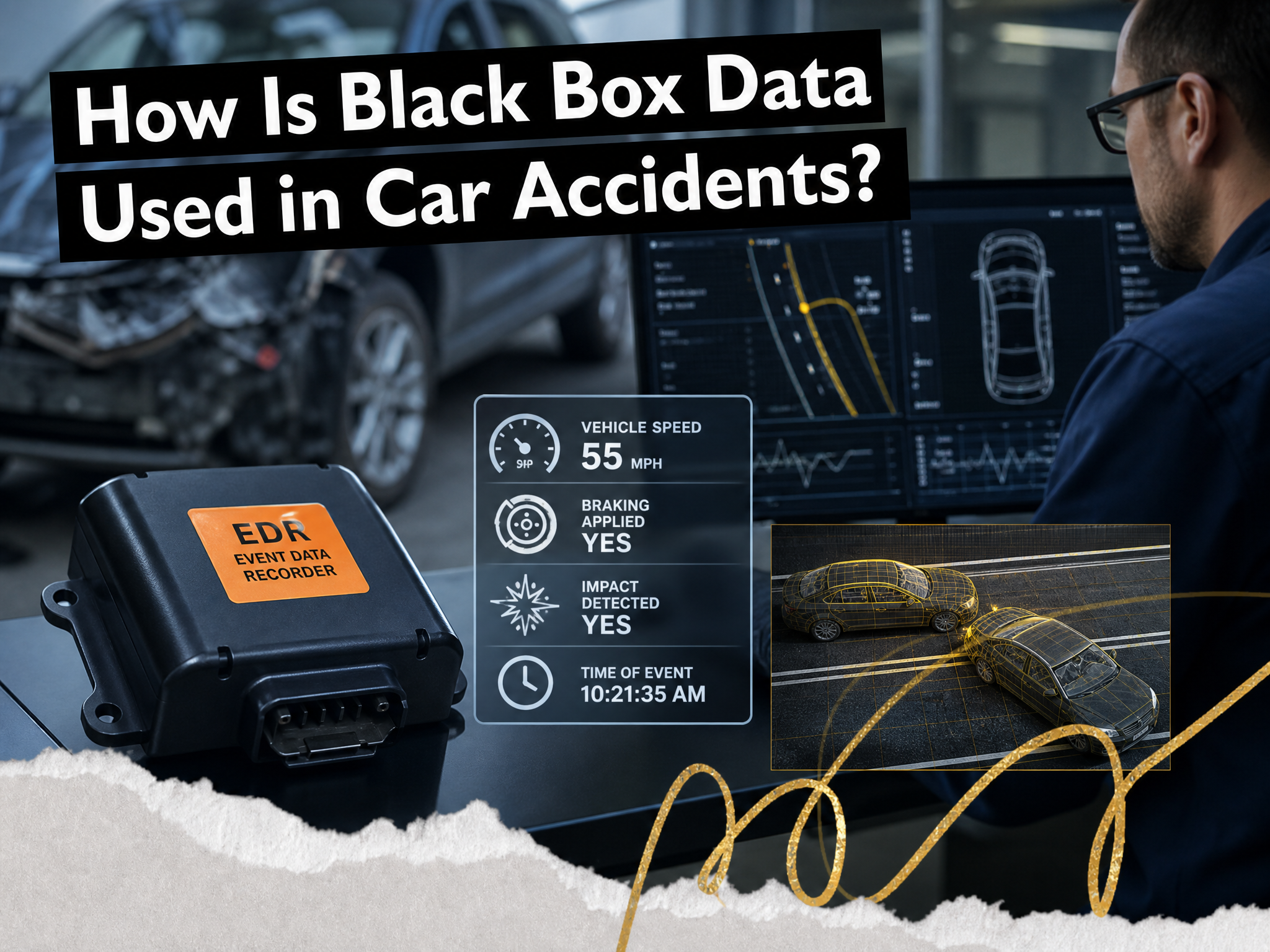
Let’s say you got rear ended last week, and the other driver is telling their insurance company that you stopped short. You know that’s not what happened, but now it’s your word against theirs. Here’s the thing though: your car may have already settled the argument for you. Black box data, also called Event Data Recorder or EDR data, is recorded by a small module in most newer vehicles that captures key details like speed, braking, and seatbelt use just before, during, and after a crash. In a car accident claim, that can be some of the clearest evidence of what actually happened.
That’s why here at Demesmin & Dover Law Firm, we believe in making things clear, especially for accident victims and people dealing with insurance claims in Florida and Illinois, where this data can quietly make or break a case.
And just so you know what you’re actually looking for, the “black box” usually isn’t black at all. It’s typically a small silver or gray module tucked under the center console, nowhere near as dramatic as the name makes it sound.
What Exactly Is a Black Box?
Your car’s black box is officially called an Event Data Recorder, or EDR. It’s not like the black box on a plane. It doesn’t record audio or video, and it isn’t constantly transmitting anything. It just quietly logs a short loop of driving data, and the moment a crash happens, it locks in a snapshot of that data.
It’s Probably Already in Your Car
According to NHTSA, these devices are federally regulated under 49 CFR Part 563, which sets rules for what they record and how that data has to be stored and retrieved. Consumer Reports has reported that roughly 96% of new vehicles on the road already have one. So unless your car is unusually old, there’s a good chance yours has one right now.
What It Actually Records in Motor Vehicle Crashes
An EDR typically captures speed, braking, throttle position, whether your seatbelt was buckled, and whether the airbags deployed. Per Edmunds, most EDRs record in a continuous loop, overwriting old data until a crash locks in about 5 seconds of information from right before, during, and after impact. NHTSA has proposed stretching that window to 20 seconds in newer vehicles, so the data is only going to get more detailed going forward.
When Does Black Box Data Actually Matter in a Car Accident Case?
Black box data becomes relevant any time fault or the severity of a crash is in dispute. A few common situations:
- A rear end or T-bone collision where both drivers are pointing fingers at each other
- A claim where the insurance company argues you were going faster than you say you were
- A dispute over whether your seatbelt was buckled, which can affect how an insurer values an injury claim
In each of these, the black box isn’t offering an opinion. It’s offering the physics of the crash itself, which is a lot harder to argue with than two people’s memories of a stressful moment.
Who Actually Owns This Data?
This is the part most people get wrong. A lot of drivers assume that once there’s an accident, the insurance company or the police can just pull this information whenever they want. That’s not how it works.
The Federal Baseline
Under the federal Driver Privacy Act of 2015, EDR data legally belongs to the vehicle’s owner or lessee, not the manufacturer, not the insurer, and not law enforcement. Getting access generally requires the owner’s consent, a court order, or a specific legal exception, like an active investigation.
How Illinois Handles It
Illinois courts have been accepting EDR evidence in both civil and criminal cases for years, and they generally treat it as reliable when it’s collected and handled properly. The ownership rule stays consistent with the federal standard. It’s your data, and someone needs your consent or a court order to get it.
How Florida Handles It
Florida hasn’t passed its own specific EDR privacy statute, but Florida courts have arrived at a similar place through case law. The data generally can’t be accessed by anyone other than the vehicle’s owner without proper authorization. If the vehicle is a rental car, the renter is usually treated as the temporary owner for the purpose of accessing that data during the rental period.
Why Timing Matters More Than People Think
Here’s the part that catches most people off guard. This data does not sit around forever waiting to be collected.
The Data Can Disappear
If a vehicle keeps getting driven, or if it gets repaired or sent to auction before anyone pulls the module, that crash snapshot can be gone for good. It isn’t something you can retrieve yourself either. Reading it takes a specialized tool connected directly to the vehicle’s diagnostic port.
Acting Quickly Protects the Evidence
The safest move is sending a formal preservation request as soon as possible, so the vehicle doesn’t get repaired, sold, or moved before the data is pulled. Waiting even a few weeks can mean the difference between having proof and having nothing.
The Difficulties of Actually Getting Black Box Data
Knowing the black box exists is one thing. Actually getting usable data out of it is another problem entirely, and it doesn’t always work out the way you’d hope.
The Module Itself Can Be Damaged or Destroyed
In a severe enough crash, the EDR can take damage right along with the rest of the car. Fire, flooding, or a high impact crash can corrupt or wipe the data before anyone ever gets the chance to read it. Sometimes the very crash you need proof of is the same event that destroys the evidence.
It Can Be Removed or Replaced During Repairs
The EDR is often built into the same module that controls the airbags, so when a car gets repaired after an accident, that unit can be replaced entirely, especially if the airbags deployed and need to be swapped out. Once that module is gone, whatever it recorded typically goes with it. This is exactly why preserving the vehicle before repairs start matters so much.
Access Isn’t Always Straightforward
Even when the module is intact, reading it isn’t guaranteed to be simple. It requires specialized equipment that’s compatible with your specific make and model, and not every shop or investigator has the right tool on hand. On top of that, if the vehicle has already been sold, salvaged, or sent to auction, tracking it down again can be its own uphill battle.
Data Can Be Overwritten Without a Crash Ever Being the Cause
Since EDRs record in a continuous loop, simply continuing to drive the car after a minor incident, or even certain diagnostic scans performed by a mechanic, can overwrite the very data you were counting on. It doesn’t always take a repair shop or a salvage yard to lose it.
Do You Need an Attorney to Get This Data?
In most cases, yes. Getting EDR data released, especially from another driver’s vehicle, a rental company, or a commercial fleet, typically requires a formal legal request, a subpoena, or a court order. An attorney can also make sure the vehicle is preserved before anything is lost, and that the data is retrieved and authenticated properly so it actually holds up if your case ends up in court.
Talk to an Attorney Before the Evidence Disappears
Black box data can be some of the most objective evidence in a car accident claim, but only if someone acts before it’s overwritten or the vehicle gets repaired.
The team at Demesmin & Dover Law Firm knows how to move quickly to preserve and obtain black box evidence for Florida and Illinois accident victims. Contact Demesmin & Dover today for a free consultation, there’s no fee unless we win your case.