
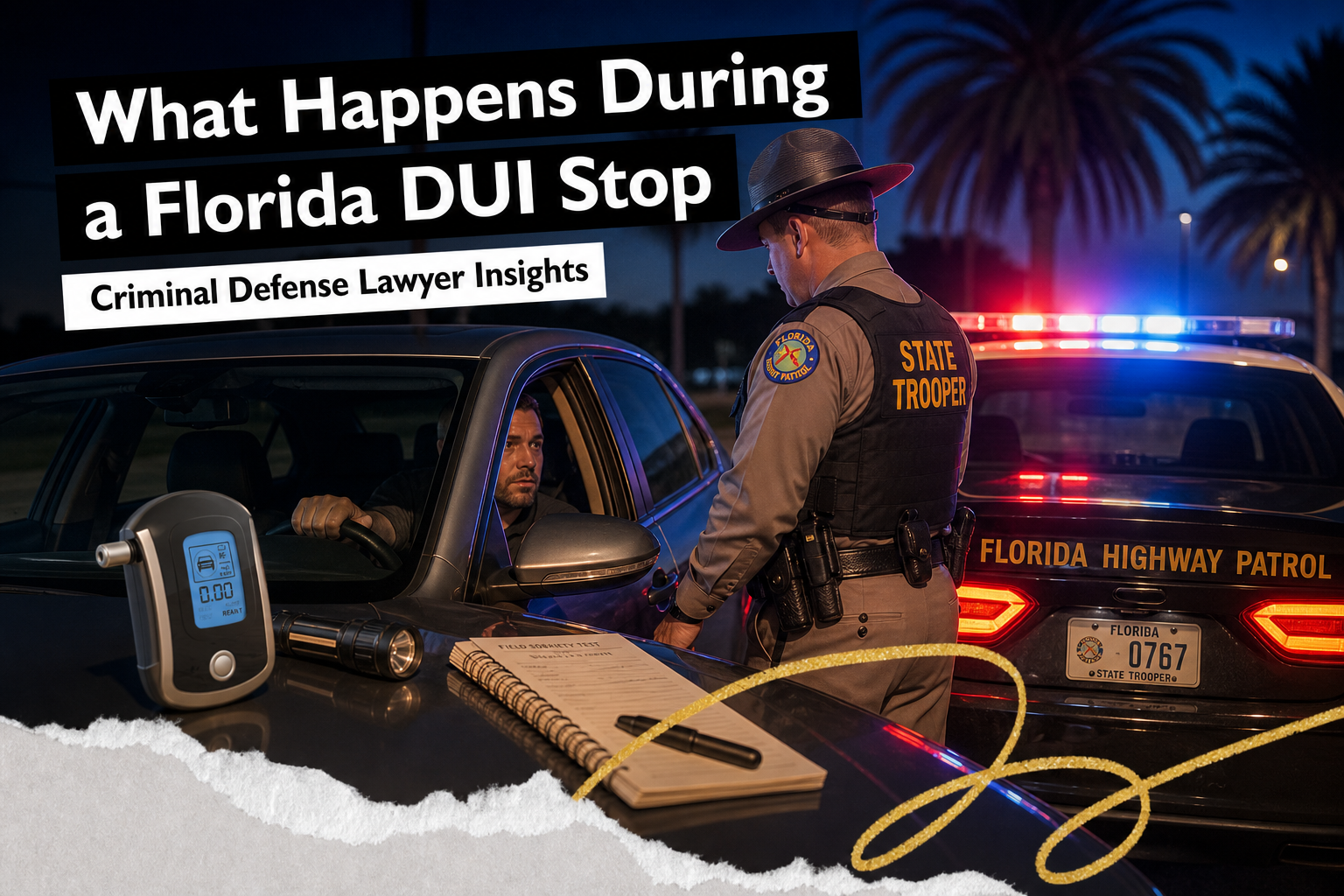
Getting pulled over is nerve wracking on a normal day. When an officer starts asking questions that feel like they’re building toward something more than a speeding ticket, that nervousness turns into something else entirely. Knowing exactly how a Florida DUI stop unfolds, step by step, makes it a lot easier to stay calm and protect yourself if it happens to you.
That’s why here at Demesmin & Dover Law Firm, we believe in making things clear, this way you know exactly what you’re dealing with from the moment those lights go on behind you.
What Has to Happen Before an Officer Can Even Pull You Over
Florida officers can’t stop a driver on a hunch. They need probable cause, a reasonable basis for believing a violation occurred, before initiating any stop.
How Most DUI Stops Actually Begin
Most Florida DUI arrests start as something else entirely: a routine stop for a moving violation that escalates once the officer suspects impairment. Weaving between lanes, erratic speed changes, or another visible traffic violation is typically what gives an officer the legal grounds to pull someone over in the first place.
Why the Sequence Matters
Each stage of a stop carries its own legal weight. The officer observes a violation, forms probable cause based on that observation, initiates the stop, and begins gathering evidence through conversation. Everything said from that point forward becomes part of the record, and can be used as evidence later. A stop that lacked valid probable cause to begin with can undermine the entire case that follows.
What Happens Once an Officer Suspects Impairment
A traffic stop turns into a DUI investigation the moment an officer starts noticing signs like red eyes, slurred speech, or the smell of alcohol. That suspicion may start an investigation, but the driver is presumed innocent unless and until proven guilty in the criminal justice system.
The Typical Sequence
-
The stop itself. A moving violation or other infraction gives the officer legal cause to pull the vehicle over.
-
Observation. The officer documents signs of intoxication to build probable cause for further investigation.
-
Field sobriety and chemical testing. This stage carries real legal weight of its own, and refusing it triggers separate consequences under Florida law.
-
The arrest decision. Once there’s enough evidence of impairment, the stop moves into a formal DUI arrest.
-
Booking. The process shifts from a roadside investigation into the formal justice system.
What “Under the Influence” Actually Means
Under Florida Statute 316.193, a person is guilty of DUI if they’re driving or in actual physical control of a vehicle while their normal faculties are impaired by alcohol or drugs, or if their blood or breath alcohol level is 0.08 or higher. That 0.08 threshold is what most people think of as Florida’s legal limit, but prosecutors can also build a case around impairment alone, even with no chemical test at all.
What Refusing a Breath Test Actually Does
Refusing a breathalyzer doesn’t prevent an arrest, and it comes with its own separate penalties under Florida’s implied consent law, codified at Florida Statute 316.1932. Under this statute, obtaining a Florida driver’s license means you’ve already agreed in advance to submit to a lawful breath, blood, or urine test if an officer has probable cause to believe you’re impaired.
The Clock Starts Immediately
A first refusal results in an automatic administrative license suspension of one year, separate from any criminal DUI charges, meaning that suspension can happen even if you’re never convicted. A second refusal extends that suspension to 18 months and can itself be charged as a separate misdemeanor. The refusal itself is also admissible as evidence in a later criminal proceeding.
You Have 10 Days to Challenge It
According to the Florida Department of Highway Safety and Motor Vehicles, drivers can request a formal or informal review of an administrative suspension, but that request has to be made within 10 days of the arrest or the notice of suspension, whichever comes later. Missing that window generally means the suspension stands, regardless of how the underlying criminal case eventually turns out.
What a First DUI Conviction Actually Costs
Under Florida Statute 316.193, a first DUI conviction can bring a fine between $500 and $1,000, up to six months in jail time, and a license suspension, with harsher penalties kicking in for a BAC of 0.15 or higher, a minor passenger in the vehicle, prior offenses, or a crash involving injury. These penalties escalate quickly, and the risk of probation is one reason many criminal cases are resolved through plea bargaining instead of going to trial, which is part of why getting ahead of a case early matters so much.
What Can Hurt Your DUI Case in the Moment
Officers are trained to watch every movement and listen to every word during a stop, from the first question to the last. That attention means small missteps can carry real consequences later in court.
What to Avoid Saying or Doing
-
Volunteering details about where you’ve been or how much you had to drink, even casually
-
Arguing with the officer instead of staying composed
-
Making sudden movements that could raise suspicion
-
Not understanding which rights actually apply during roadside questioning
A calm, minimal response protects a driver far more effectively than an anxious, over-explained one. You have the right to remain silent beyond providing your license and registration, and understanding that right before a stop happens, not during one, makes it much easier to actually use it.
Do You Need an Attorney During or After a DUI Stop?
Contacting an attorney as soon as possible after an arrest protects your rights and your options going forward, and it matters most in the first 10 days, given how tight that administrative suspension deadline is. An attorney familiar with Florida DUI procedure can explain exactly what an arrest means for your license and your record, identify issues with the stop itself, including whether valid probable cause existed in the first place, and help you understand whether a diversion option might be available. Some Florida jurisdictions, including Miami-Dade County, offer a first-time DUI diversion program known as Back on Track, which can lead to a reduced charge for eligible defendants who haven’t been involved in a crash. Availability and eligibility rules vary significantly by county and by the specific circumstances of the arrest, so it’s worth asking an attorney directly what options exist wherever your case is being handled.
Talk to Fort Lauderdale DUI Lawyers Before You Say Anything Else
Every stage of a DUI stop, from the initial traffic violation to a breath test refusal, carries legal consequences that are easy to misunderstand in the moment, and those consequences only grow with repeat offenses.
Demesmin & Dover Law Firm, based in Fort Lauderdale, helps drivers across South Florida, including Miami, Boca Raton, Palm Beach, Broward County, and Miami-Dade County, understand their rights during a DUI stop and defends clients after an arrest. Contact Demesmin & Dover today for a free consultation, there’s no fee unless we win your case.