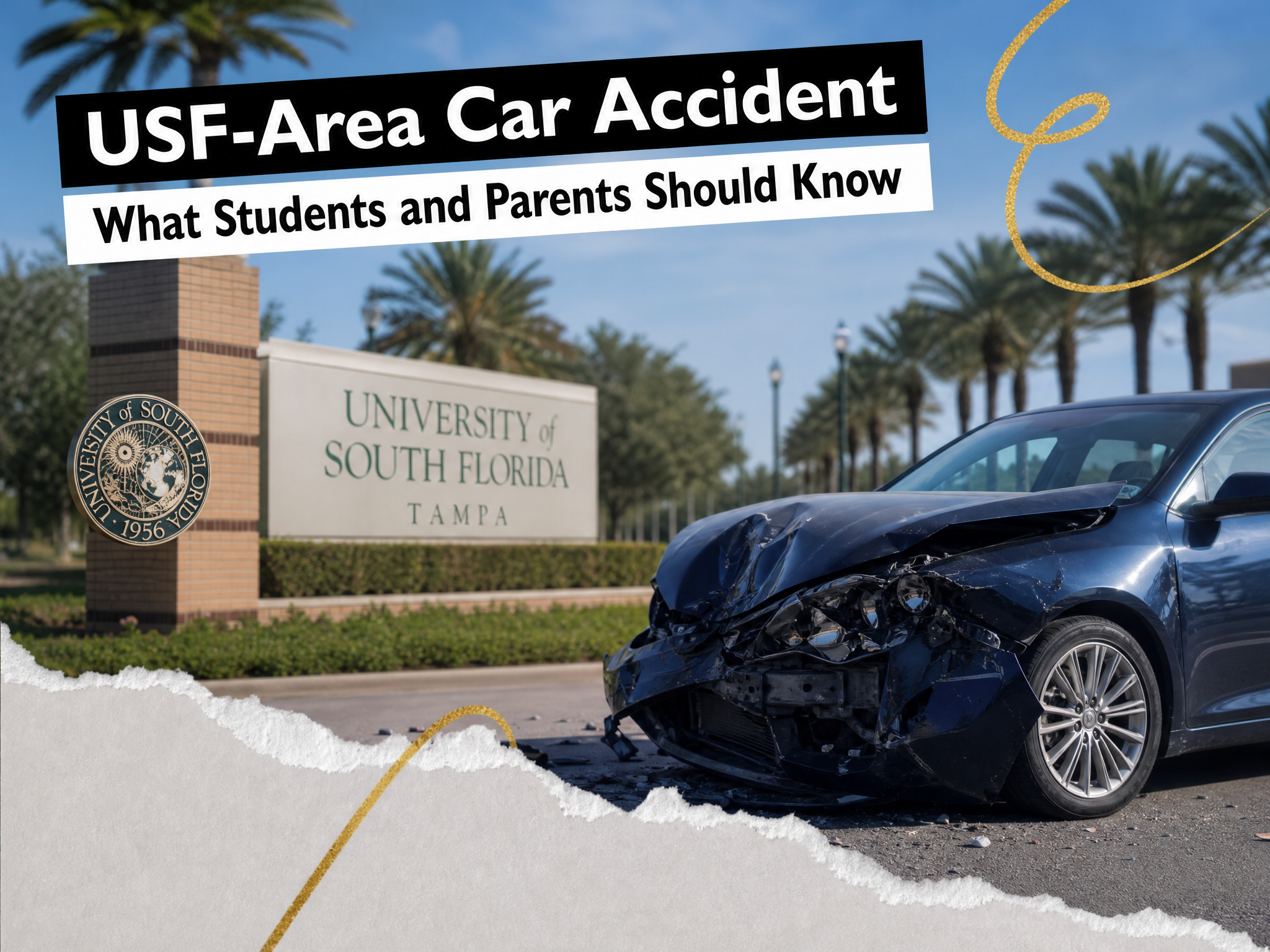
If your student just moved to Tampa for USF, there’s a decent chance you’ve already had the parking permit conversation, the dorm shopping list conversation, and maybe even the roommate conversation. Here’s one that gets skipped a lot more often than it should: a car accident near the University of South Florida usually happens on the busy, accident-prone roads around campus, where heavy traffic, young or inexperienced drivers, and a constant mix of pedestrians and vehicles raise the risk.
Driving around USF’s campus comes with real risk, and knowing what to expect can save students and parents a lot of stress if something goes wrong. That’s why here at Demesmin & Dover Law Firm, we believe in making things clear, this way both students and parents know exactly what they’re dealing with before an accident happens, not after. Ahead, we’ll walk through the roads and intersections around USF that deserve extra caution, why student drivers face added risk, what to do after a crash, how insurance and legal issues can come into play, and when it may be time to speak with an attorney.
Why the Roads Around USF Are Riskier Than You’d Think
USF sits right in the middle of some of Tampa’s busiest, most accident prone corridors. Fowler Avenue, Bruce B. Downs Boulevard, and Nebraska Avenue all border or cut through campus, and they show up again and again in local crash data.
The Numbers Tell the Story
Across Hillsborough County, there were 26,260 traffic crashes in 2024 alone, resulting in more than 17,000 injuries and 181 deaths, according to the Florida Department of Highway Safety and Motor Vehicles. The intersection of Bruce B. Downs Boulevard and Fletcher Avenue, just steps from campus, has been identified as one of the most crash prone intersections in the entire county.
Roads and Intersections Near USF Worth Extra Caution
A handful of roads around campus show up again and again in local crash reports. Students and parents alike should know these by name, not just by reputation:
E Fowler Avenue – runs along the southern edge of campus and consistently ranks among the busiest, most crash prone corridors in Tampa
Bruce B. Downs Boulevard – a major artery bordering campus, with the intersection at Fletcher Avenue flagged as one of the highest crash intersections in Hillsborough County
N 56th Street (Temple Terrace Highway) – runs along the eastern side of campus and has seen serious crashes involving cars, buses, and scooters
E Busch Boulevard – heavy commercial traffic combined with frequent lane changes makes this a common site for rear end and lane change collisions
N Nebraska Avenue – several of its intersections with Fowler and Busch have been identified locally as high red light violation zones
I-75 on ramps and off ramps near Fowler Avenue – merging traffic at highway speeds close to campus creates its own set of risks, especially during rush hour
None of this means these roads should be avoided entirely, since there often isn’t a practical way around them if you’re getting to and from campus. It just means extra attention matters more on these specific stretches than on a quiet residential street.
It’s Not Just Cars
USF’s campus is dense with pedestrians, cyclists, and scooter riders moving between classes, dorms, and off campus housing. Riders on scooters or motorcycles are especially vulnerable in a traffic collision, and motorcyclists are more than twice as likely to suffer severe injuries. That means there is a mix of foot traffic and heavy vehicle traffic on roads like Fowler Avenue, which is exactly the kind of environment where distracted driving turns into something serious fast.
Why Student Drivers Face Higher Risk
It isn’t just the roads. The drivers themselves, especially newly licensed or relatively inexperienced ones, carry more risk behind the wheel than older, more experienced drivers.
The Data on Young Drivers
The CDC reports that the fatal crash rate for drivers ages 16 to 19 is almost three times as high as it is for drivers 20 and older, per mile driven. The National Safety Council points out that car crashes remain the leading cause of preventable death for teens in the U.S., and that driver inexperience is the root cause behind most of these crashes. About 93% of crashes involve driver error or impairment, which helps explain why inexperienced teens are more likely to be injured.
What Actually Raises the Risk
A few factors show up consistently in the research on young and newly licensed drivers:
Driving at night, when the fatal crash rate is roughly three times higher than for adult drivers
Having other young passengers in the car, which increases crash risk with each additional passenger
Distracted driving, particularly phone use, which is a factor in a large share of college-age crashes
Driving under the influence, which significantly impairs judgment and coordination and can make already risky circumstances far more dangerous
Drowsy driving, which can be as dangerous as driving under the influence and contributes to 15% of fatal crashes
Simple inexperience behind the wheel, especially during the first year of driving independently
speeding, which raises both the likelihood of a crash and the severity of resulting injuries
None of this means a student is destined to get into an accident. It just means the odds shift, and both students and parents benefit from knowing that going in.
What Students Should Know Before They Get Behind the Wheel in Tampa
A little preparation goes a long way, especially for students who are driving somewhere unfamiliar for the first time.
Know the High Risk Areas
Fowler Avenue, Bruce B. Downs Boulevard, and the intersections around them see heavy traffic almost all day. Give yourself extra time and extra caution in these areas, because traffic conditions can change quickly around these roads, so avoid rushing between classes or events and stay aware of other drivers.
If a crash does happen, document the location and basic circumstances while the details are still fresh.
Use Campus Resources
USF’s Parking and Transportation Services actually offers free motorist assistance on the Tampa campus, including help with things like dead batteries or lockouts, so students don’t have to handle every roadside issue alone.
Have a Plan for After an Accident
Know where to pull over safely, keep insurance information easily accessible, and know who to call, both for immediate help and afterward; once they are safe, students should notify police and their insurance company. Seek medical evaluation even if injuries are not immediately apparent, and go to a hospital for prompt medical care if needed. In Florida, initial medical care generally needs to happen within 14 days after an accident. A lot of the stress after an accident comes from not knowing what to do in the moment.
What Parents Should Know
If your student is driving in Tampa, there are a few things worth talking through before they ever get behind the wheel near campus.
Talk About the Specific Risks, Not Just General Safety
A generic “drive safe” conversation doesn’t cover much. Talking specifically about distracted driving, nighttime driving, and the pressure that can come from having friends in the car tends to land better, since those are the exact factors research points to as the biggest risk multipliers for young drivers. Speeding is also a common cause of crashes that can lead to serious injury, and it contributes to nearly 30% of fatalities in car accidents, which is why following speed limits matters.
Make Sure Your Insurance Company Coverage Actually Fits the Situation
Florida is a no fault insurance state, which affects how claims get handled after an accident. It’s worth confirming your student’s coverage actually reflects where and how often they’re driving, especially if they’ve moved to a new city for school.
Know What to Do If You Get the Call
If your student calls you after an accident, staying calm and walking them through the basics, checking on their safety first, then documentation, then who to contact, can make a stressful situation much more manageable for both of you.
What Students Should Actually Do at the Scene
It helps to walk through these steps with your student before an accident ever happens, so they’re not trying to figure it out for the first time while shaken up on the side of Fowler Avenue.
Stay at the scene. Leaving before the other driver or police arrive can turn a minor accident into a much bigger legal problem.
Call 911, even for a minor accident. A police report creates an official record, which matters later if there’s any dispute about what happened.
Check for injuries first, before anything else. Adrenaline can mask pain, so even if nothing feels wrong right away, it’s worth getting checked out. If any person is hurt, accept prompt medical care, including going to the hospital if needed.
Exchange information with the other person involved. Get their name, phone number, insurance information, and license plate, and note any other vehicles affected.
Take photos of everything. Vehicle damage from multiple angles, the surrounding road, any skid marks, traffic signals, and street signs. These details can help a car accident lawyer investigate the incident, identify involved parties, and gather evidence for a claim.
Avoid saying “it was my fault,” even to be polite. Stick to the facts when talking to police or the other driver, and let the investigation sort out fault.
Call a parent or emergency contact before dealing with insurance. Talking it through with someone first, before giving a recorded statement to an insurance company, helps avoid saying something that gets used against them later. A lawyer can also assist in communicating with the insurance company at this stage.
Don’t accept a quick settlement offer on the spot. Insurance adjusters sometimes move fast precisely because a rattled college student is less likely to push back. Before any early settlement, it’s important to try speaking with a lawyer.
Do You Need a Car Accident Lawyer After a USF-Area Accident?
If your student, or you, are dealing with an accident near campus, it’s worth having someone review what happened before accepting any settlement offer from an insurance company. This is especially true if another driver was involved, since fault, medical costs, and vehicle damage all need to be properly documented and valued.
If you’re not sure where to start, the team at Demesmin & Dover Law Firm can walk you through what your options actually look like, at no cost, before you decide anything.
Talk to an Attorney Who Knows the USF Area
Accidents near USF happen on some of the busiest, most heavily trafficked roads in Tampa, and a motor vehicle collision there can make getting fair treatment from an insurance company afterward far from straightforward.
The accident attorneys and legal team at Demesmin & Dover Law Firm handle claims on your behalf throughout the Tampa Bay area, including the roads and intersections surrounding USF, and you do not pay unless they recover financial compensation. Contact Demesmin & Dover today for a free consultation if you need help with car accident or truck accidents claims, to pursue compensation, collect damages, or go to court.