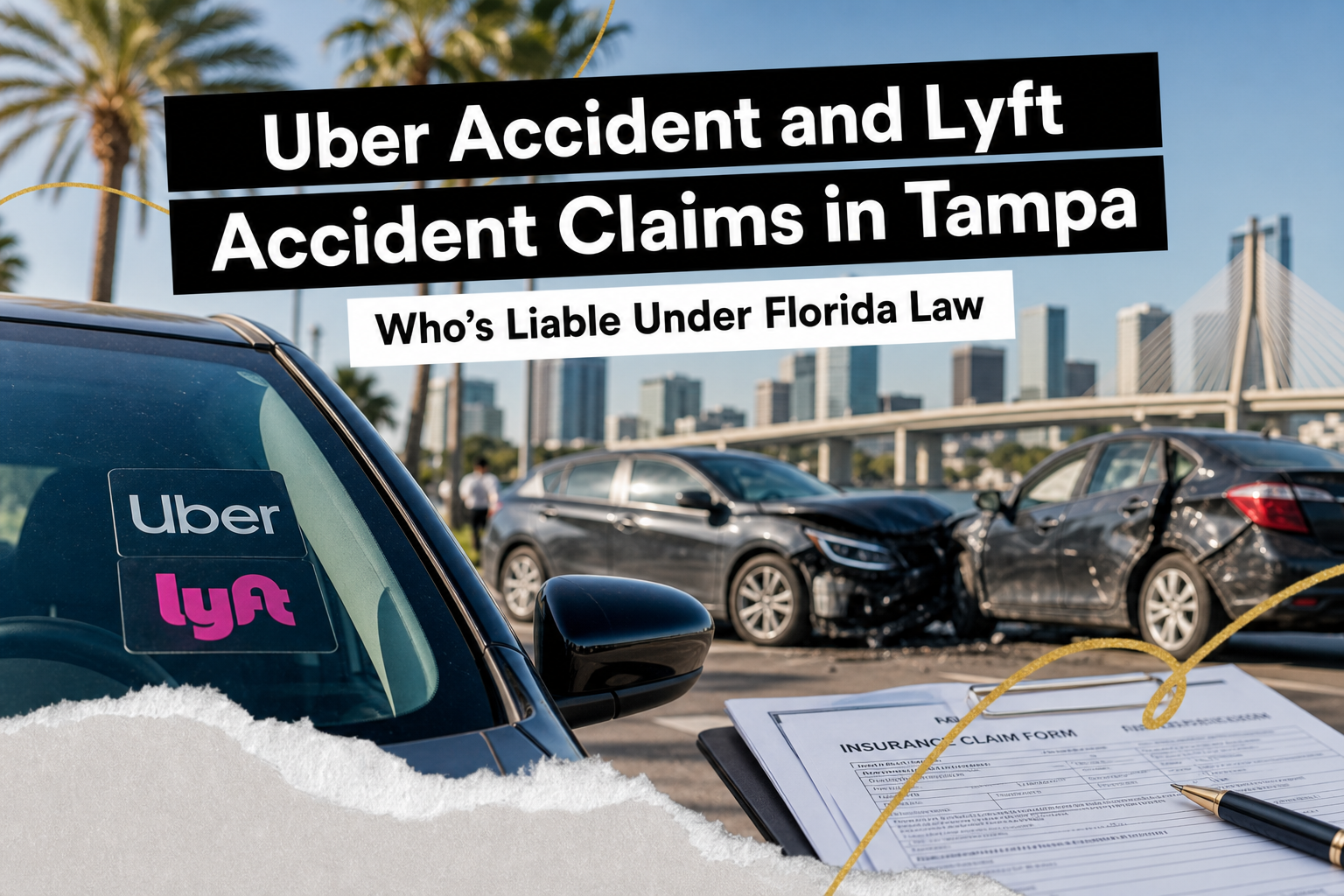
Getting into an accident while riding in an Uber or Lyft, or getting hit by one, raises a question most people never have to think through until it happens to them. Who actually pays for this? It’s not as simple as a normal two car accident, because there are three or more parties in the mix: you, the rideshare driver, the rideshare company, and possibly another driver entirely.
That’s why here at Demesmin & Dover Law Firm, we believe in making things clear, this way you know exactly what you’re dealing with if you’ve been hurt in a rideshare accident in Tampa.
Why Rideshare Accidents Work Differently
A normal car accident claim usually comes down to one driver’s personal auto insurance policy. Rideshare accidents involve a patchwork of coverage that changes depending on exactly what the driver was doing on the app at the moment of the crash.
Florida’s Rideshare Insurance Claim Process
Florida regulates this directly. Under Florida Statute 627.748, transportation network companies like Uber and Lyft, along with their drivers, are required to carry specific levels of insurance coverage, and the required amount changes based on what “period” of the ride the driver is in at the time of the accident.
The Three Periods of Coverage
This is the part that actually determines who pays.
- Offline, app off. If the driver’s app isn’t on at all, they’re just a private citizen driving their own car. Their personal auto insurance is the only coverage in play, the same as any other driver on the road.
- App on, waiting for a ride request. Once the driver logs into the app but hasn’t accepted a ride yet, Florida law requires at least $50,000 for death and bodily injury per person, $100,000 per incident, and $25,000 in property damage coverage, either through the driver’s own policy or Uber and Lyft’s contingent coverage.
- En route or on a trip. Once a driver accepts a ride, picks someone up, or is actively transporting a passenger, Florida law requires $1 million in liability coverage. This is the same $1 million policy Uber and Lyft both maintain nationwide.
Recent Data on Rideshare Safety
Numbers on rideshare-specific crashes are harder to come by than for regular traffic accidents, since neither Uber, Lyft, nor most state agencies break out rideshare involvement the way they track general crash data. Still, the data that is available paints a useful picture.
National Fatality Trends
According to an Insurify analysis of Uber and Lyft’s most recent safety reports, published in 2025, Uber’s reported fatality rate rose to 0.87 per 100 million vehicle miles traveled during its most recent reporting period, up from 0.62 the period before, while Lyft’s rate rose to 0.94 from 0.74. Both rates remain below the National Highway Traffic Safety Administration’s national average of 1.36 fatalities per 100 million vehicle miles traveled during the same span, but the upward trend for both companies is worth noting. The same analysis found that other drivers, not the rideshare vehicle itself, were responsible for 95% of fatal crashes involving an Uber vehicle. Broader traffic risks still matter for anyone involved in a rideshare crash: speeding contributed to 29% of U.S. traffic fatalities in 2024, DUI accidents kill someone in the U.S. every 32 minutes, distracted driving by Uber drivers increases crash risks and can lead to serious injuries, and fatigued drivers working long hours cause many accidents.
Statewide Florida Crash Volume
Rideshare crashes aren’t broken out separately in Florida’s official crash statistics, but the overall traffic picture they sit inside of gives useful context. Statewide FLHSMV data reported in early 2026 showed more than 358,000 total crashes across Florida in 2025, with nearly 3,000 proving fatal. In a market like Tampa, where rideshare use is heavy around the airport, downtown nightlife, and Amalie Arena events, that traffic volume is exactly the environment where rideshare vehicles show up in crash data alongside everyone else.
Who’s Actually Liable in a Tampa Rideshare Accident?
Liability comes down to what role you played in the accident and what the driver was doing on the app.
You Were a Passenger
If you were riding in an Uber or Lyft and got into an accident, Florida’s $1 million coverage requirement during an active trip generally applies, regardless of whether your driver or another driver caused the crash. This coverage is meant to protect you as the passenger either way.
Another Driver Hit You
If you were in your own vehicle and a rideshare driver hit you, which policy applies depends entirely on what period that driver was in. A driver waiting for a ride request has far less coverage available than one actively transporting a passenger, which is exactly why documenting the driver’s app status at the time of the crash matters so much.
You Were a Pedestrian or Cyclist: Rights of Injury Victims
The same period-based coverage applies here too. If an Uber or Lyft driver hits you while en route to or during a trip, the $1 million policy is generally in play. If they were off the app entirely, you’re dealing with their personal auto policy instead.
What to Do After a Rideshare Accident in Tampa
A few extra steps matter in a rideshare accident that don’t come up in a typical crash.
- Call 911 and get checked out first. If anyone is hurt, call 911 for emergency help and seek medical attention right away; passengers should also wear seat belts on every trip as a basic safety precaution, and prompt medical treatment within 14 days can help preserve PIP benefits.
- Screenshot the app. If you were a passenger, screenshot your trip details immediately, since this documents that you were on an active, paid trip at the time of the crash.
- Get the driver’s app status. If you weren’t a passenger, try to determine whether the other driver was logged into a rideshare app and what stage of a ride they were in.
- Report the accident to Uber or Lyft directly, in addition to calling police, since both companies have their own internal accident reporting process that can affect how an insurance claim is handled.
- Get a police report. With multiple insurance policies potentially in play, an official report becomes even more important for sorting out what happened.
- Keep your own documentation. Take photos of the scene, collect contact information and phone numbers from everyone involved, and get details for any witnesses; that documentation, along with medical records, can matter just as much here as in any other crash, arguably more, since you may be dealing with more than one insurance company at once.
Do You Need a Car Accident Lawyer for a Rideshare Accident Claim?
Rideshare companies and their insurers are well practiced at pointing to the specific period of coverage that limits their exposure. A car accident lawyer can sort out which policy applies, deal with the insurer, and pursue maximum compensation through an injury claim. Making sure the right one pays out is a lot more complicated than a standard two-car accident claim, especially when fault and negligence are disputed and proper legal representation matters.
Talk to a Tampa Rideshare Accident Attorney
Between the multiple insurance policies, the period-based coverage rules, and rideshare companies that don’t make claims easy, these cases require a different approach than a typical Tampa car accident.
The team at Demesmin & Dover Law Firm has experience handling Uber and Lyft accident claims throughout the Tampa Bay area, including sorting out which insurance policy actually applies to your situation. Contact Demesmin & Dover today for a free consultation, there’s no fee unless we win your case.