Getting hurt at work comes with a strange kind of paperwork whiplash. One minute you’re filling out an incident report, the next you’re being handed a claim number and told to “let the process work.” Here’s the fast version of what that process actually involves, then the full
breakdown.
Quick Answer: A workplace injury claim is a request for workers’ compensation benefits, medical care and a portion of lost wages, paid through your employer’s insurance regardless of who was at fault. In Florida, you must report the injury within 30 days and generally have 2 years to file a formal claim. In Illinois, notice is due within 45 days, and you generally have 3 years to file. You should call an attorney the moment your claim is denied, delayed, underpaid, or if anyone other than your employer contributed to the accident.
That’s the summary. Here’s what’s actually happening behind that claim number.
Why Workplace Injuries Are Still This Common
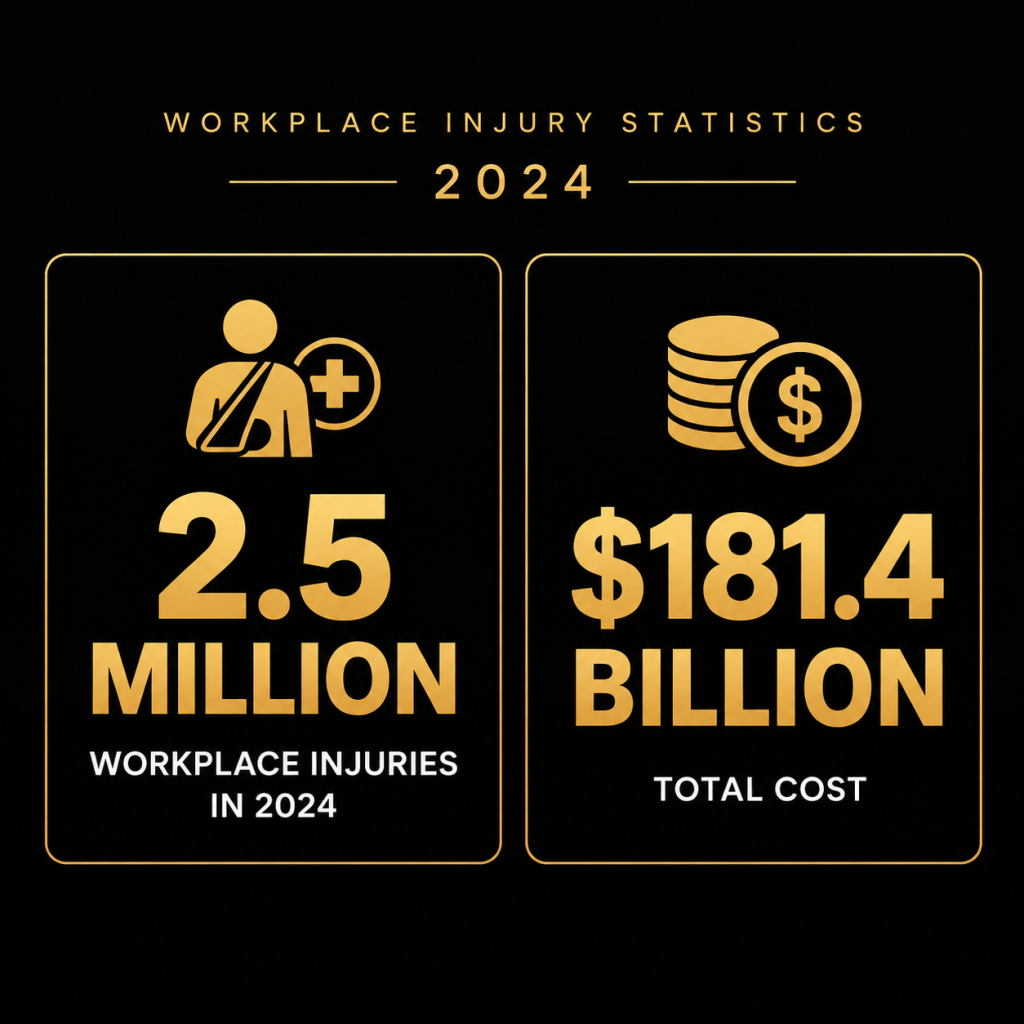
In 2024, private industry employers reported 2.5 million nonfatal workplace injuries and illnesses, according to the U.S. Bureau of Labor Statistics, the lowest figure the agency has recorded since it started tracking this data in 2003. That sounds like good news, and it is, until you remember it’s still 2.5 million people. The National Safety Council’s Injury Facts data puts the total cost of work injuries in 2024 at $181.4 billion, and 4,337 preventable work deaths occurred that year.
Behind every one of those numbers is someone who, at some point, had to decide whether to just accept whatever the insurance company offered or ask more questions.
How Workers’ Compensation Actually Works
Workers’ comp is a trade-off, and understanding the trade is the whole ballgame.
The Benefits You’re Entitled To
If your injury happened in the course of your employment, you’re generally entitled to:
- Medical treatment for the injury, with no upfront cost to you
- Wage replacement (roughly two-thirds of your average weekly wage) while you’re out of work
- Compensation for permanent impairment once you reach maximum medical improvement (MMI)
- Protection from being fired for filing a claim
You don’t have to prove your employer did anything wrong to get these benefits. That’s the entire point of the system.
The Exclusive Remedy Rule: Why You Can’t Just Sue Your Boss
Here’s the part that frustrates people the most, and the part almost nobody explains well. In exchange for guaranteed, no-fault benefits, you generally give up the right to sue your employer for negligence. This is called the exclusive remedy rule, and it’s the deal at the center of the entire workers’ comp system: employers fund a safety net, employees give up the right to a bigger negligence lawsuit against them.
It feels unfair when your employer was clearly careless. But it’s the trade every state built this system around, and it’s not personal to your case.
There is a narrow exception. If your employer’s conduct rises to the level of intentional wrongdoing, not just carelessness, but actions the employer knew were virtually certain to cause injury, that exception can open the door to a direct claim. It’s a high bar, and it’s exactly the kind of question worth putting in front of an attorney rather than deciding on your own.
The Second Claim Most Injured Workers Never Find
This is the one that costs people real money, and none of the FAQ pages out there walk you through it clearly.
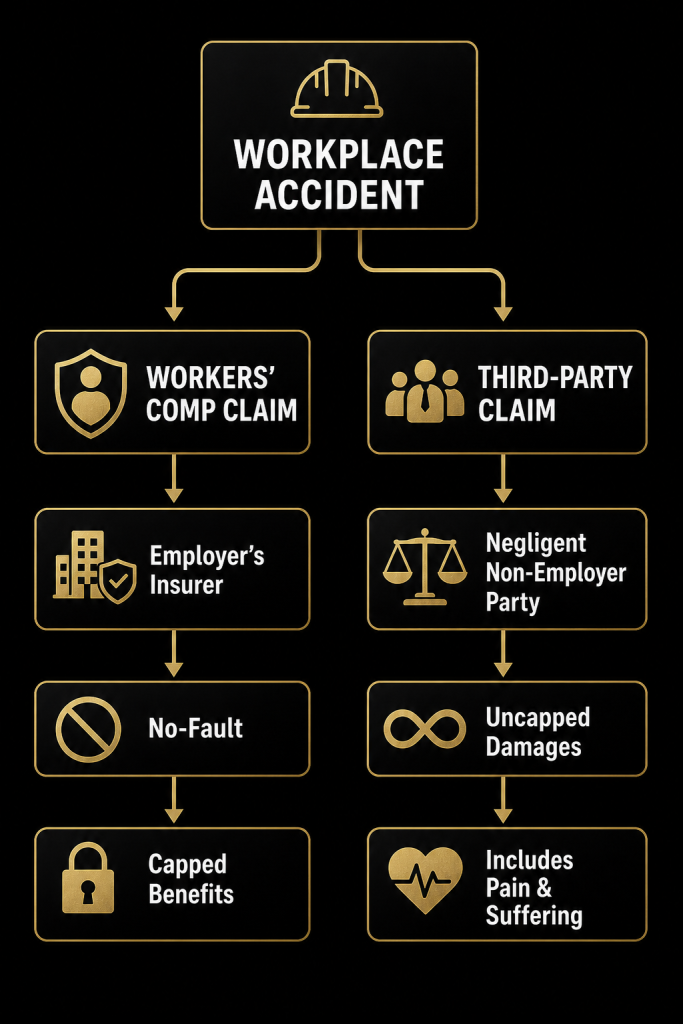
A single workplace accident can generate two separate legal claims:
- A workers’ comp claim against your employer’s insurer (no-fault, but capped, and it doesn’t include pain and suffering).
- A third-party negligence claim against anyone other than your employer whose carelessness contributed to your injury.
That second claim is the one people miss
Common scenarios include:
- A subcontractor or another company’s employee caused the accident on a job site
- Defective equipment or machinery malfunctioned
- You were injured in a vehicle accident while driving for work, and the other driver was at fault
- A property owner (not your employer) maintained an unsafe area where you were working
A third-party claim isn’t capped the way workers’ comp is, and it can include compensation for pain and suffering, which workers’ comp never covers. If you only file the workers’ comp claim and never ask whether a third party was involved, you may be leaving a significant part of your compensation on the table entirely.
Your Deadlines: Florida vs. Illinois
Demesmin & Dover represents injured workers in both Florida and Illinois, and the deadlines are genuinely different. Do not assume one state’s rule applies to the other.
If You Were Hurt on the Job in Florida
- Report to your employer within 30 days of the injury or when you first knew it was work-related. Miss this and your employer’s insurer has a built-in defense to deny the whole claim.
- Your employer then has 7 days to report it to their insurance carrier.
You generally have 2 years to file a formal claim (Petition for
Benefits), measured from the date of accident or the date of your last
benefit payment.
If You Were Hurt on the Job in Illinois
- Notify your employer within 45 days of the accident, in writing is safest.
- You generally have 3 years from the date of the accident (or 2 years from your last compensation payment, whichever is later) to file a formal Application for Adjustment of Claim with the Illinois Workers’ Compensation Commission.
Different states, different clocks, same lesson either way: report it fast, in writing, and don’t wait to see how you feel next week.
Why Workplace Injury Claims Get Denied or Underpaid
Insurance companies don’t deny claims out of spite. They deny them because denial is cheaper, and they have a predictable playbook.
- Disputing the injury is work-related. Especially common with repetitive stress injuries, back injuries, or anything that developed gradually rather than from one clear incident.
- Late reporting. Even a few days past the deadline gives the insurer an opening to argue prejudice.
- Independent medical exams (IMEs) that downplay the injury. The insurer’s doctor isn’t your doctor, and their report often reads very differently than your treating physician’s.
- Disputes over how much work you can actually do. A “light duty” release that doesn’t match your real physical limits can cut off your wage benefits early.
- Lowball settlement offers that don’t account for future treatment or permanent impairment.
Industries and Injuries Where Claims Get Complicated
Some injuries sail through the process. Others turn into a fight almost immediately.
Higher-friction industries:
- Construction (falls, scaffolding, equipment malfunctions)
- Warehousing and logistics (repetitive strain, forklift accidents, overexertion)
- Healthcare (patient handling injuries, exposure incidents)
- Transportation and delivery (vehicle accidents, loading injuries)
Injuries that tend to draw the most pushback from insurers:
- Back and neck injuries (easy to claim “pre-existing”)
- Repetitive strain and carpal tunnel (hard to pin to one incident)
- Psychological injury claims
- Injuries that developed over time rather than from a single accident
If your injury falls into one of these categories, expect more resistance, not because your claim is weaker, but because it’s more work for the insurer to evaluate honestly.

When You Actually Need an Attorney
Not every claim needs a lawyer, and a firm that tells you otherwise isn’t being straight with you. Call one when:
- Your claim has been denied, in whole or in part
- You suspect a third party (not your employer) contributed to the accident
- Your employer is disputing that the injury happened at work
- You’ve been asked to see an IME doctor and don’t trust the process
- Your benefits stopped or were reduced without a clear explanation
- You’re being pressured to accept a lump-sum settlement
- You experienced retaliation after reporting the injury
- Your injury is serious enough that you’re worried about long-term or permanent impairment
If none of that applies and your employer’s insurer is paying promptly and treating you fairly, you may genuinely be fine on your own. That’s rare, but it happens.
What an Attorney Does That You Genuinely Can’t Do Alone
- Identifies every claim you actually have, including the third-party claim most people never think to look for.
- Handles all communication with the insurance adjuster, so an offhand comment doesn’t get used to shrink your benefits.
- Pushes back on a lowball IME with your treating physician’s records and, when needed, an independent expert.
- Calculates what your claim is actually worth, including future medical needs and permanent impairment, not just what’s already been billed.
- Files the appeal or petition on time when a claim is denied or delayed, in either state’s system.
What to Do Immediately After a Workplace Accident
- Report it to your employer right away, in writing if possible. Don’t wait to see if it “gets better.”
- Get medical treatment, and be specific with the doctor about how the injury happened.
- Write down what happened while it’s fresh, what you were doing, what equipment was involved, who else was present.
- Get contact information for any witnesses.
- Ask directly whether anyone other than your employer was involved, another company’s employee, a piece of defective equipment, a third-party driver.
- Keep copies of everything, the incident report, medical bills, correspondence from the insurer.
- Don’t sign a settlement or give a recorded statement to the insurance company before talking to an attorney.

FAQ
Do I need to prove my employer was at fault to get workers’ comp?
No. Workers’ compensation is a no-fault system. You’re entitled to benefits if the injury happened in the course of your employment, regardless of who caused it.
Can I sue my employer directly for a workplace injury?
Generally no, under the exclusive remedy rule, workers’ comp is your remedy against your employer. A narrow exception exists for intentional misconduct, which is worth having an attorney evaluate.
What if someone other than my employer caused my accident?
You may have a separate third-party negligence claim in addition to your workers’ comp claim, against a subcontractor, equipment manufacturer, or another negligent party. This claim isn’t capped the way workers’ comp is and can include pain and suffering.
How long do I have to report a workplace injury in Florida?
30 days from the date of injury or when you knew it was work-related. In Illinois, the deadline is 45 days.
How long do I have to file a formal claim?
Generally 2 years in Florida, and generally 3 years in Illinois (or 2 years from your last benefit payment, whichever is later).
Can my employer fire me for filing a workers’ comp claim?
No. Both Florida and Illinois prohibit retaliation against employees for filing a legitimate workers’ compensation claim.
What if my claim was denied?
You have the right to appeal. An attorney can help gather additional medical evidence and represent you through the hearing process in either state’s system.
How much does hiring a workplace injury attorney cost?
Most workplace injury attorneys, including our firm, work on a contingency fee basis. You don’t pay unless we recover compensation for you.
Get Help From Demesmin & Dover
Whether you were hurt on a job site in Florida or Illinois, the claims process is built to move at the insurance company’s pace, not yours. Demesmin & Dover represents injured workers in both states, and we’re available 24/7 because injuries don’t wait for a convenient time to happen.
Call now: 866-954-MORE (6673) or Start your free case review.