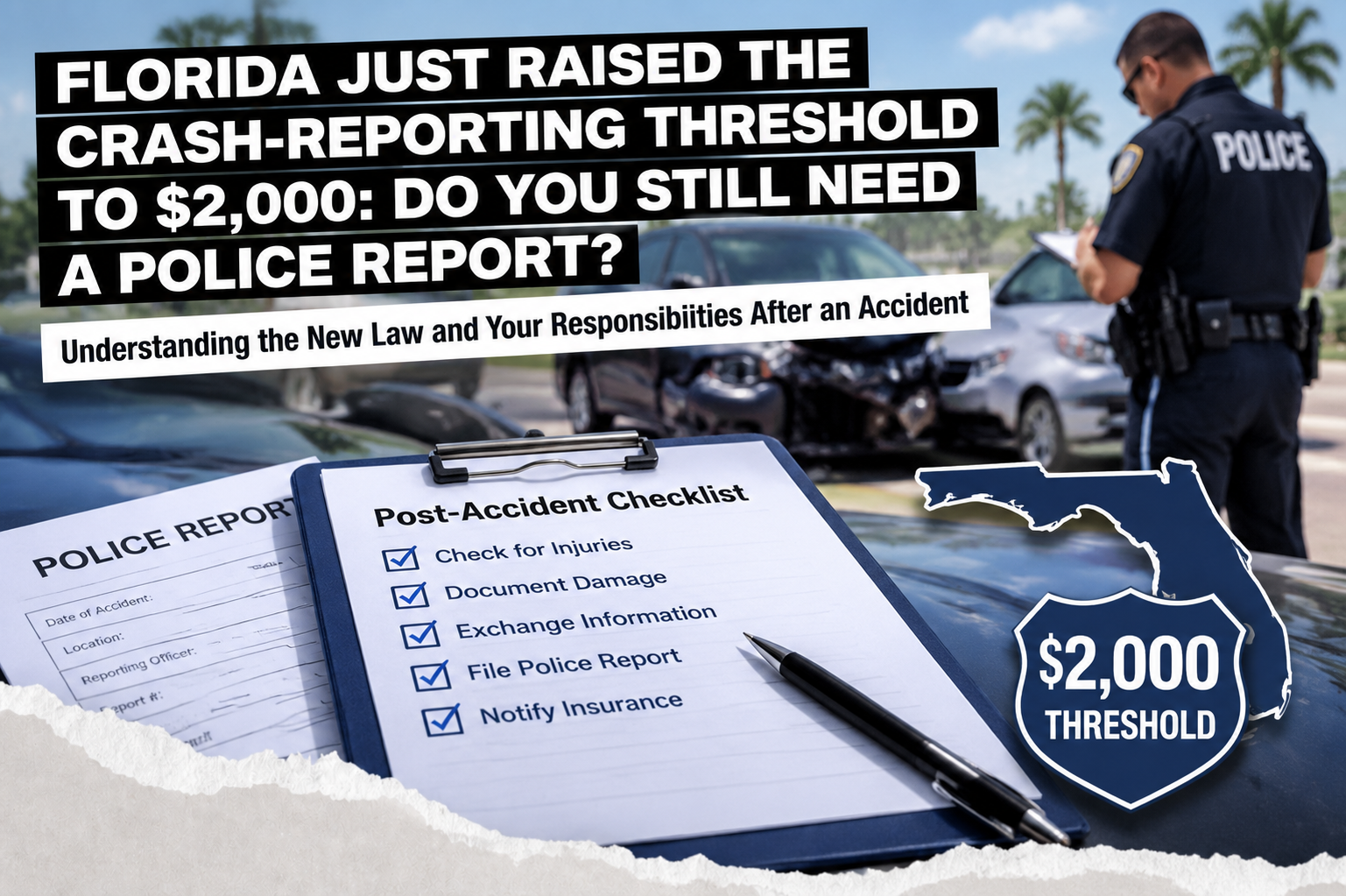
Florida just gave drivers a permission slip. As of October 1, 2026, a minor crash with no injuries no longer requires you to call the police unless the damage looks like $2,000 or more. Your injury claim, however, did not get a permission slip. Here’s the short version, then what to do about it.
Quick Answer: Since October 1, 2026, Florida law requires you to notify police right away after a crash only if someone is hurt or killed, or if the apparent property damage is at least $2,000 (up from $500). If no officer writes a report, you must submit a written report to the state within 10 days. Even so, you should still call: damage is hard to estimate at the roadside, injuries can appear days later, and insurers want documentation. And if you were hurt, you must get medical care within 14 days to keep your Personal Injury Protection (PIP) benefits.
That’s the answer. The rest of this article is about why the legal minimum is not the smart minimum.
What Changed and When
Senate Bill 488 (Chapter 2026-39, Laws of Florida) was approved by the Governor on April 21, 2026 and took effect October 1, 2026. It amends Fla. Stat. § 316.065, which controls when a driver must notify law enforcement of a crash.
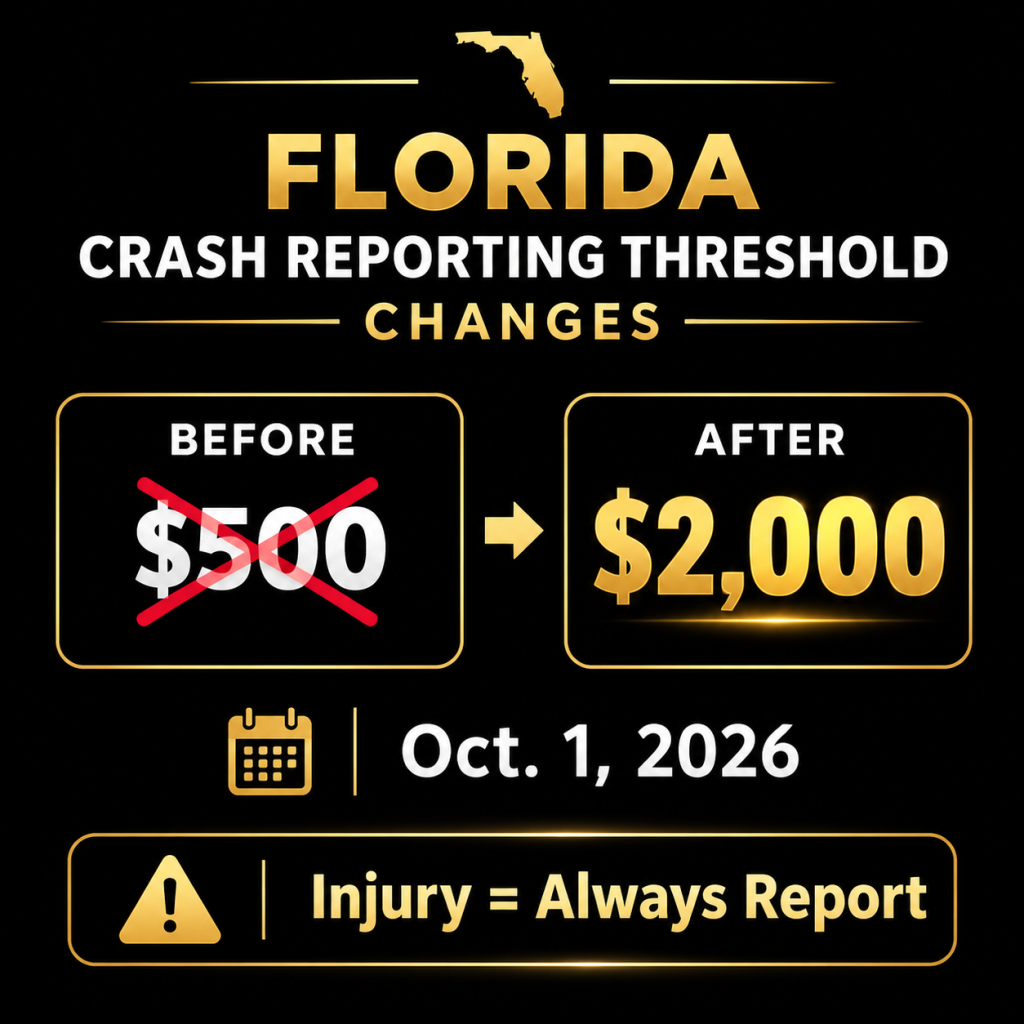
- Before: notify police if the crash caused injury, death, or apparent property damage of $500 or more.
- Now: notify police if the crash caused injury, death, or apparent property damage of $2,000 or more.
Fun fact: the change rides along in a broad transportation bill that also deals with motor carrier licensing, REAL ID definitions, and license plate frames. It was not exactly front-page material.
What did not change:
- Injury or death still triggers the duty to report, at any dollar amount.
- Any complaint of pain or discomfort still requires a long-form crash report under § 316.066.
- Other long-form triggers (a vehicle towed away, a commercial vehicle involved, certain violations such as leaving the scene) are unchanged.
- You still must stop and exchange information. Skipping the police call does not mean skipping that duty.
- The 10-day written report to the state still applies when no officer writes a report.
The key word in the new rule is “apparent.” You are judging the damage at the roadside, before anyone has pulled off a bumper.
Not Required Is Not the Same as Not Smart
The law now tells you the minimum. It doesn’t tell you the safest move. There are three good reasons to report anyway.
Damage is hard to estimate at the scene
Modern bumpers hide cameras, radar units, and parking sensors. A scuffed cover can sit on top of several hundred dollars of hardware, plus calibration afterward.
Some numbers: CCC’s 2025 Crash Course data put the average total cost of repair at about $4,768 for the year to date through Q3 2025, and calibrations appeared on roughly 36% of repair estimates. That’s an average across all repairable claims, not minor crashes, but it shows how quickly repair costs outrun a roadside guess. $2,000 is not a lot of car anymore.
If you guess “under $2,000,” skip the call, and a shop later quotes $3,400, you’ve made a legal judgment with no evidence to back it up.
Injuries can show up days later
Adrenaline is a very effective painkiller, and a very temporary one. Neck, back, and shoulder pain, headaches, and dizziness often show up the next morning or a few days later.
A crash that “didn’t need a report” can become an injury claim with no official record of who was involved, who insured them, or who saw it happen.
Insurers ask for documentation
Adjusters look for gaps: no police report, a delay before medical care, and a low repair estimate. Stack those three and the argument writes itself: “nothing serious happened.”
A police report doesn’t win your claim by itself. It does lock in names, insurers, and witnesses while the facts are fresh. And if the other driver’s story changes overnight, which happens more than anyone expects, you want a record that predates the change.
Making the Call: What to Say to the Dispatcher
If the crash happens inside a city, call that city’s police department. Otherwise, call the county sheriff or Florida Highway Patrol. Use 911 if anyone is hurt or the vehicles are blocking traffic.
Some agencies may tell you an officer won’t come for a no-injury, under-threshold crash. Ask anyway, and say the facts that matter:
- Where you are, and whether the vehicles are blocking traffic
- Whether anyone is hurt or has any pain, even mild
- Whether a vehicle needs a tow, or whether the other driver refuses to share information
- That you’d like a report or case number
Then write down the time of the call, the name of the person you spoke with, and the case number if they give one. That note is your paper trail if anyone later asks whether you tried.
If No Officer Comes: Your Evidence Kit
You become the investigator. Your phone does most of the work.
At the scene:
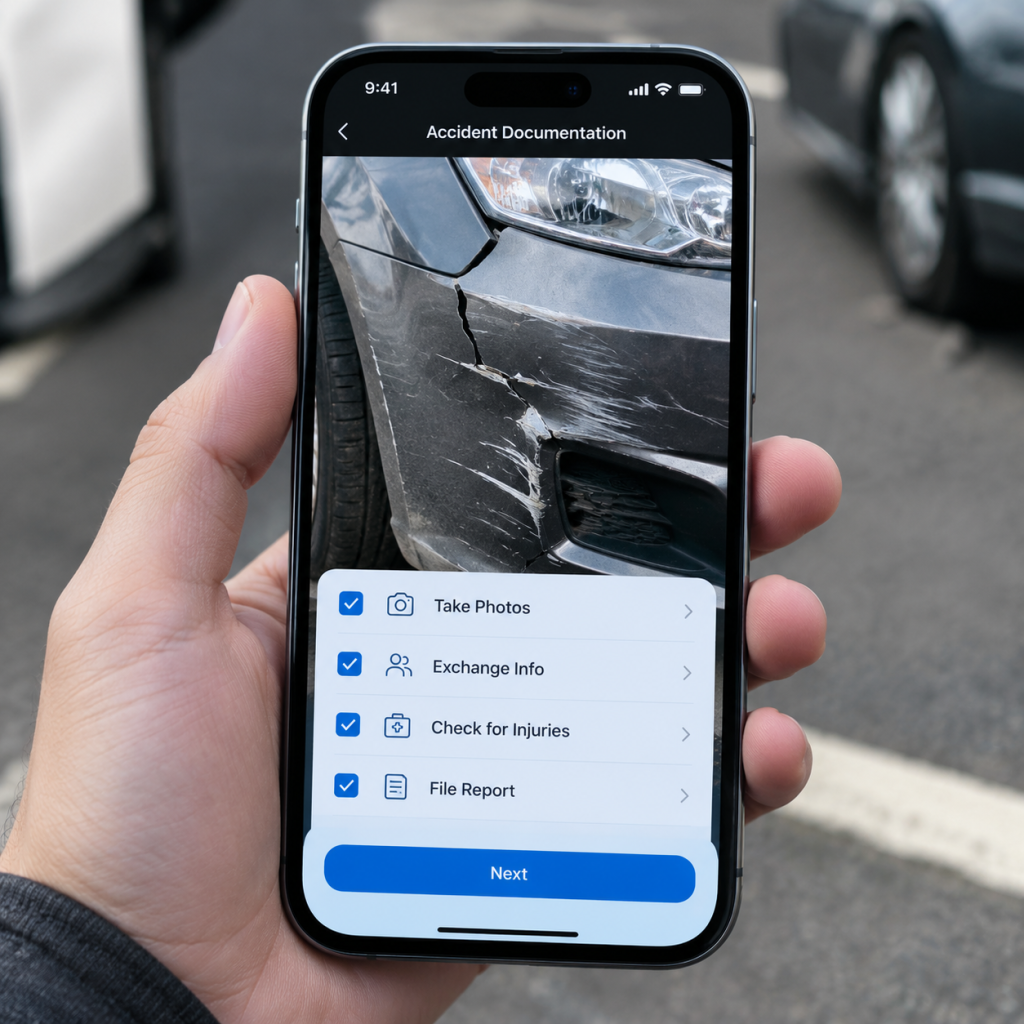
- Photograph both vehicles from far enough back to show their positions, then take close-ups of all damage on both cars.
- Photograph the other driver’s license plate, driver license, and insurance card instead of copying by hand.
- Photograph your dashboard. If warning lights for a sensor, camera, or collision system appear, capture them.
- Capture the surroundings: traffic signals, signs, skid marks, debris, weather, and lighting. Drop a map pin so the location and time are stamped.
- Get witness names and numbers before people leave. Ask if anyone has dashcam footage.
- Record a short voice memo of what happened while it’s fresh: direction of travel, speeds, what you saw, what was said.
- Say nothing about fault. Stick to facts and don’t apologize.
After the scene:
- Photograph bruises and seat belt marks over the next few days.
- Keep a short daily log of any pain, stiffness, headaches, or trouble sleeping.
- Keep the repair estimate, tow receipt, and all insurer correspondence.
- Tell your own insurer about the crash, as your policy requires.

File the FLHSMV Self-Report Within 10 Days
If the crash causes property damage but doesn’t require a law enforcement report, Florida law (§ 316.066(1)(e)) requires you to submit a written report to the state within 10 days of the crash.
- Use the Driver Report of Traffic Crash (Self Report) form from the Florida Department of Highway Safety and Motor Vehicles (FLHSMV).
- It’s for crashes with no injuries, no wrecker, no criminal violation, no hit-and-run, and no commercial vehicle.
- Keep a copy of what you submit.
- Stick to facts. Don’t guess at fault, damage totals, or injuries you can’t know yet. Florida generally keeps crash reports and statements made to an officer out of evidence at trial (§ 316.066(4)), but there’s no reason to hand anyone speculation.
If anyone feels pain, even later, update your records and talk to a lawyer before you assume the self-report path is enough.
How This Fits With Florida’s 14-Day Treatment Deadline
The reporting threshold changed. The 14-day rule did not.
Under Fla. Stat. § 627.736(1)(a), PIP medical benefits are payable only if you receive initial services and care within 14 days of the accident. Miss that window and you can lose those benefits entirely.
- Emergency medical condition: PIP can pay up to $10,000 if a qualified provider determines you had one.
- Otherwise: benefits are limited to $2,500.
- Payment structure: PIP pays 80% of reasonable medical expenses and 60% of lost income.
- No repeal: a 2026 bill to repeal PIP (SB 522) died in committee on March 13, 2026, so the rule is still in force.
Here’s why the reporting change makes the 14-day rule matter more. Without a police report, you hold the timeline. The accident date lives in your photos, your call log, and your self-report. Your first medical visit becomes the next anchor. If a few days slip by because “it was only a fender bender,” the paper trail that proves when the crash happened and when you first sought care is thin, and the insurer will notice.
Go to a doctor, urgent care, or hospital within 14 days, even if you only feel sore, and tell the provider everything that hurts.
The Crash Clock: Every Deadline on One Timeline
| When | What | Why it matters |
|---|---|---|
| Day 0 | Stop, exchange information, call police if the threshold or an injury applies, document everything | Starts your evidence trail |
| Day 0 to 1 | Notify your own insurer | Most policies require prompt notice |
| Day 10 | Submit the FLHSMV self-report if no officer wrote a report | Required by § 316.066(1)(e) |
| Day 14 | Get initial medical care | Required to keep PIP benefits |
| 2 years | File suit for negligence (general rule, Fla. Stat. § 95.11) | Miss it and the claim is generally barred |
Fault matters too. Florida uses modified comparative negligence: if you’re found more than 50% at fault you recover nothing, and below that your recovery is reduced by your percentage of fault. That’s one more reason a clear, early record of what happened is worth having.
When to Call a Car Accident Lawyer or Personal Injury Attorney
You don’t need a lawyer for a clean parking-lot scrape with no injuries and a cooperative insurer. Call a car accident lawyer or personal injury attorney when:
- You or a passenger felt any pain, now or later
- The other driver disputes fault, changes their story, or refuses to share information
- The other driver is uninsured or underinsured, or left the scene
- An insurance adjuster asks for a recorded statement or pushes a fast settlement
- No report exists and you’re unsure what to do next
- A commercial vehicle was involved
- Symptoms are lingering, getting worse, or affecting work
- The 14-day window is closing and you haven’t seen a provider
A short call early is far cheaper than repairing a thin record later.
FAQ
What is Florida’s new crash reporting threshold?
$2,000 in apparent property damage, effective October 1, 2026. It was $500 before. Crashes with injury or death must be reported at any dollar amount.
Do I still need to call the police if the damage is under $2,000?
Not by law if no one is hurt, but it’s smart. Damage is hard to judge at the scene, injuries can appear later, and a report protects your claim.
What if I don’t call the police at all?
If no law enforcement report is made, you must submit a written report to FLHSMV within 10 days. You must also stop and exchange information.
Does the $2,000 rule change the 14-day PIP rule?
No. You still need initial medical care within 14 days to keep PIP medical benefits.
What counts as “apparent” damage?
It’s your reasonable roadside estimate of repair costs. You don’t need a body shop quote, but if it could reach $2,000, treat it as reportable.
Do I have to report a crash if I feel fine but something might hurt later?
Any complaint of pain or discomfort requires a long-form report if an officer investigates. If pain appears after you leave, document it, see a provider within 14 days, and talk to a lawyer.
What if the other driver asks me not to call police?
You can still call. A driver who pushes to skip the report is a good reason to insist.
Get Help From Demesmin & Dover
A minor crash can become a major claim, and the first week usually decides how smoothly it goes. Demesmin & Dover represents crash victims across Florida, and we’re available 24/7 because accidents don’t wait for business hours. This article covers Florida law. If your crash happened in Illinois, the rules are different, so tell us where it happened when you call.
Call now: 866-954-MORE (6673) or Start your free case review.