If you’re reading this from a hospital bed, a rental car, or the passenger seat of someone else’s, we’re sorry you’re here. A crash with an 18-wheeler is not a bad day, it’s a life event, and the trucking company’s insurer is already working on its side of it. Here’s the short version, then the full playbook.
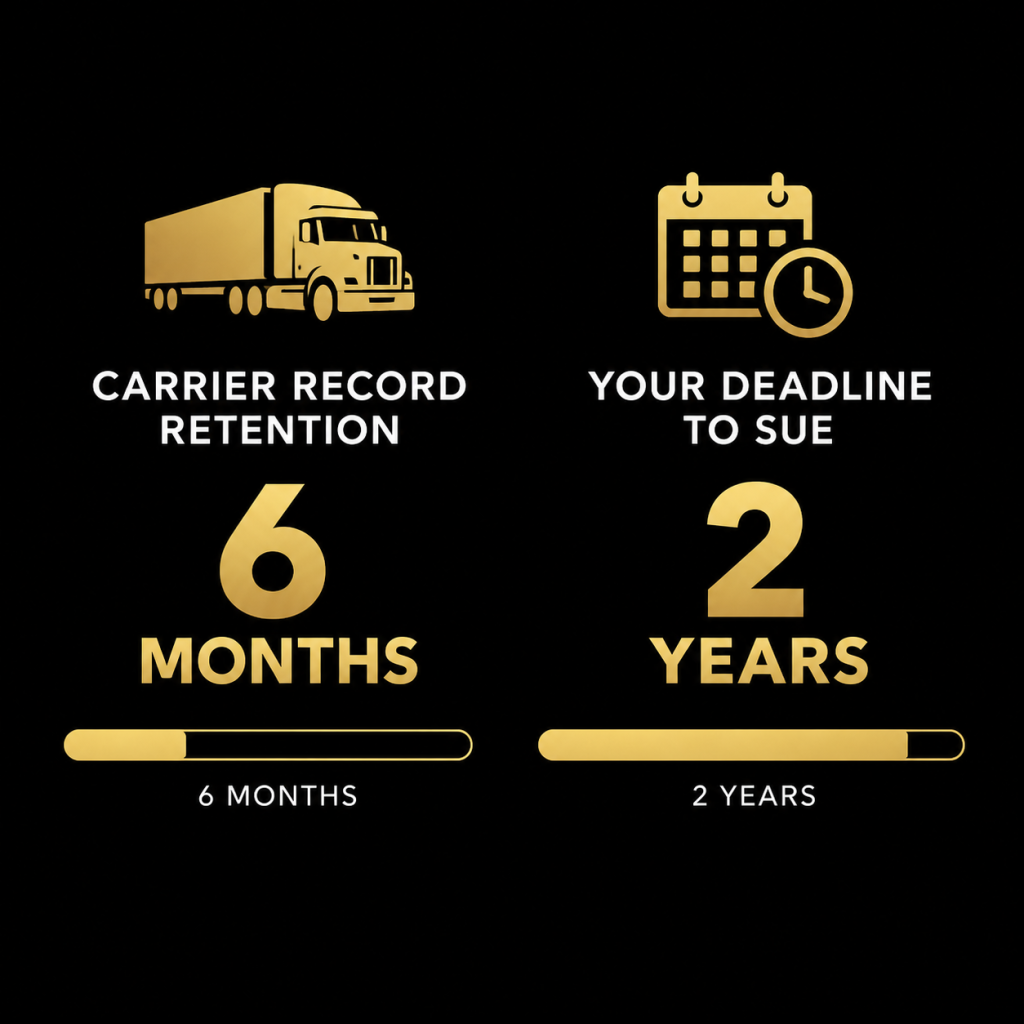
Quick Answer: After a semi-truck crash in Tampa, more than one party can be liable: the driver, the trucking company, the truck’s owner, the shipper or loader, a broker, or a maintenance shop or manufacturer. Federal trucking rules (hours of service, driver qualification, maintenance) often supply the proof. In Florida you generally have 2 years to sue for negligence or wrongful death, but the carrier only has to keep driver logs for 6 months, so evidence can disappear long before your deadline. A truck accident attorney can send a preservation letter early and identify every defendant.
That’s the summary. The rest is the part that decides the case.
Why a Tampa Semi-Truck Crash Is Not a Bigger Car Crash
A loaded tractor-trailer can weigh up to 80,000 pounds. Your sedan weighs about 4,000. Physics does the rest.
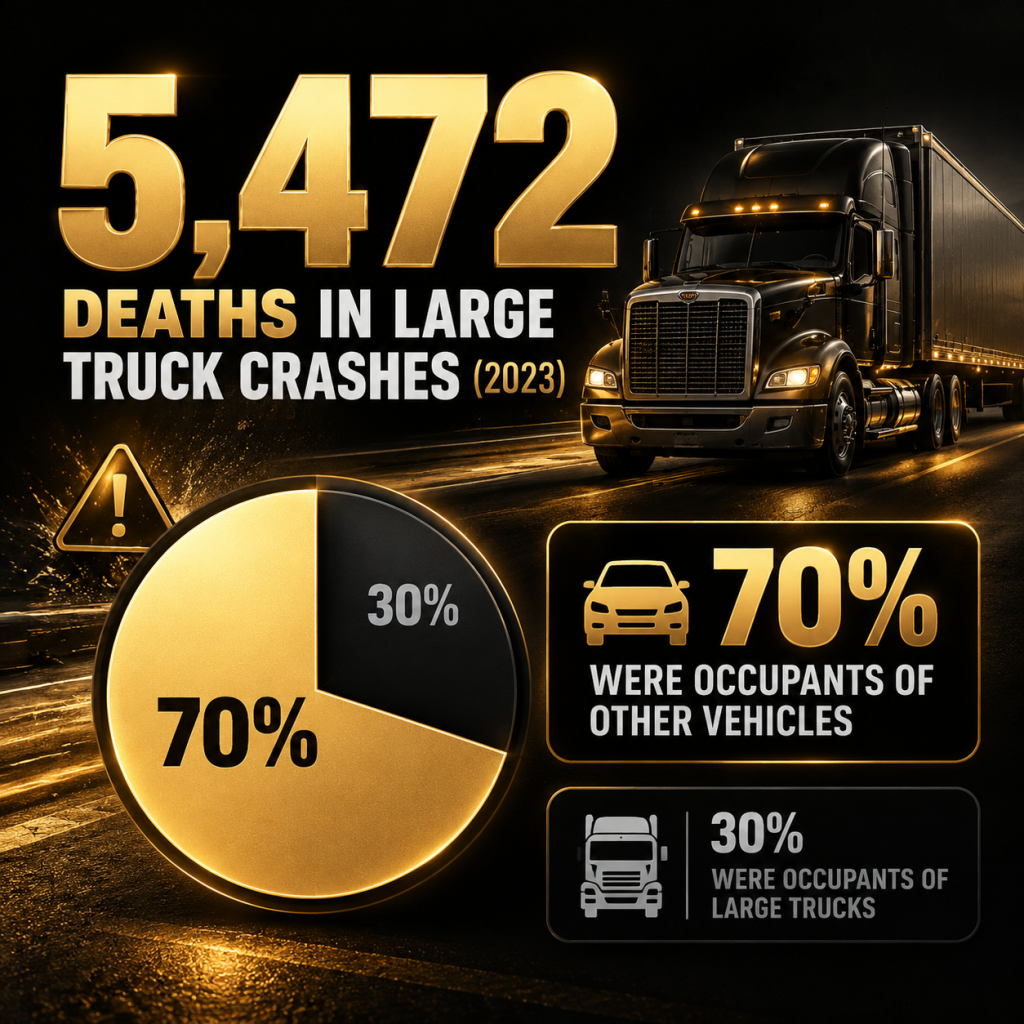
The numbers back it up. In 2023, 5,472 people died in crashes involving large trucks nationwide, and about 153,000 were injured, according to NHTSA. 70% of those who died were occupants of other vehicles, meaning the people in the cars, not the truck.
Truck cases also differ from car cases in three practical ways:
- More defendants. A car crash has two drivers. A truck crash can involve a driver, carrier, owner, shipper, broker, and mechanic.
- Federal rules. The Federal Motor Carrier Safety Regulations (FMCSRs) govern drivers, trucks, and companies.
- Better-funded opponents. Carriers have insurers and rapid-response teams who often reach the scene before you’ve left the hospital.
Who Can Be Liable After an 18-Wheeler Accident in Tampa
An experienced trucking accident lawyer looks past the driver. Here’s the usual cast.
The driver
Fatigue, distraction, speeding, impairment, unsafe lane changes, and driving without proper qualification all point back to the person behind the wheel.
The trucking company
A company can be responsible for its driver’s actions while working (vicarious liability). It can also be liable for its own choices: negligent hiring, poor training, weak supervision, skipped maintenance, or pressure to ignore hours-of-service limits.
The owner or lessor
Florida’s dangerous instrumentality doctrine can make a vehicle’s owner responsible when they allow someone else to operate it and that person drives negligently. In trucking, layered contracts and leases make ownership and control a key question, and an “independent contractor” label doesn’t always settle it.
The shipper, loader, and broker
Overloaded, unbalanced, or poorly secured cargo causes rollovers and lost loads. Whoever loaded or secured it, or arranged the shipment, may share responsibility.
The maintenance shop and manufacturer
A brake failure, tire blowout, or defective component can move blame to the shop that serviced the truck or the company that built the part.

How Federal Trucking Rules Prove Negligence
When a carrier or driver breaks a safety rule and that violation contributes to a crash, the violation can be powerful evidence. Key rules include:
- Hours of service (49 CFR Part 395). Property-carrying drivers generally can’t drive more than 11 hours within a 14-hour window after 10 consecutive hours off duty, must take a 30-minute break after 8 cumulative hours of driving, and are capped at 60 or 70 hours on duty over 7 or 8 days.
- Driver qualification (Part 391). Carriers must keep a qualification file and make sure drivers meet the standards, including the English-proficiency requirement in § 391.11(b)(2). That requirement became an out-of-service violation on June 25, 2025 under the roadside inspection criteria.
- Maintenance and inspection (Part 396). Brakes, tires, and lights are not optional.
- Drug and alcohol testing (Part 382). Post-crash testing rules apply to commercial drivers.
Violations don’t win a case alone, but they tell the story of a company that put schedule ahead of safety.
The Preservation Clock: Six Months vs. Two Years
Here’s the detail most pages skip. Under 49 CFR 395.8, a motor carrier must keep its drivers’ records of duty status, including ELD data and supporting documents, for at least 6 months. In Florida, you have 2 years to file a negligence or wrongful death suit (Fla. Stat. § 95.11(5)). Do the math: a carrier can lawfully clear certain records long before your deadline.
Other evidence disappears even faster: dashcam video, engine control module (black box) data, and GPS or telematics can be overwritten in days or weeks. A preservation (spoliation) letter puts the carrier on notice to keep what it has.
Evidence worth chasing:
- ELD and hours-of-service records
- ECM or black box data and dashcam video (forward and driver-facing)
- Driver qualification and training files
- Maintenance, inspection, and repair records
- Dispatch messages, routes, and delivery schedules
- Bills of lading and loading records
- Post-crash drug and alcohol test results
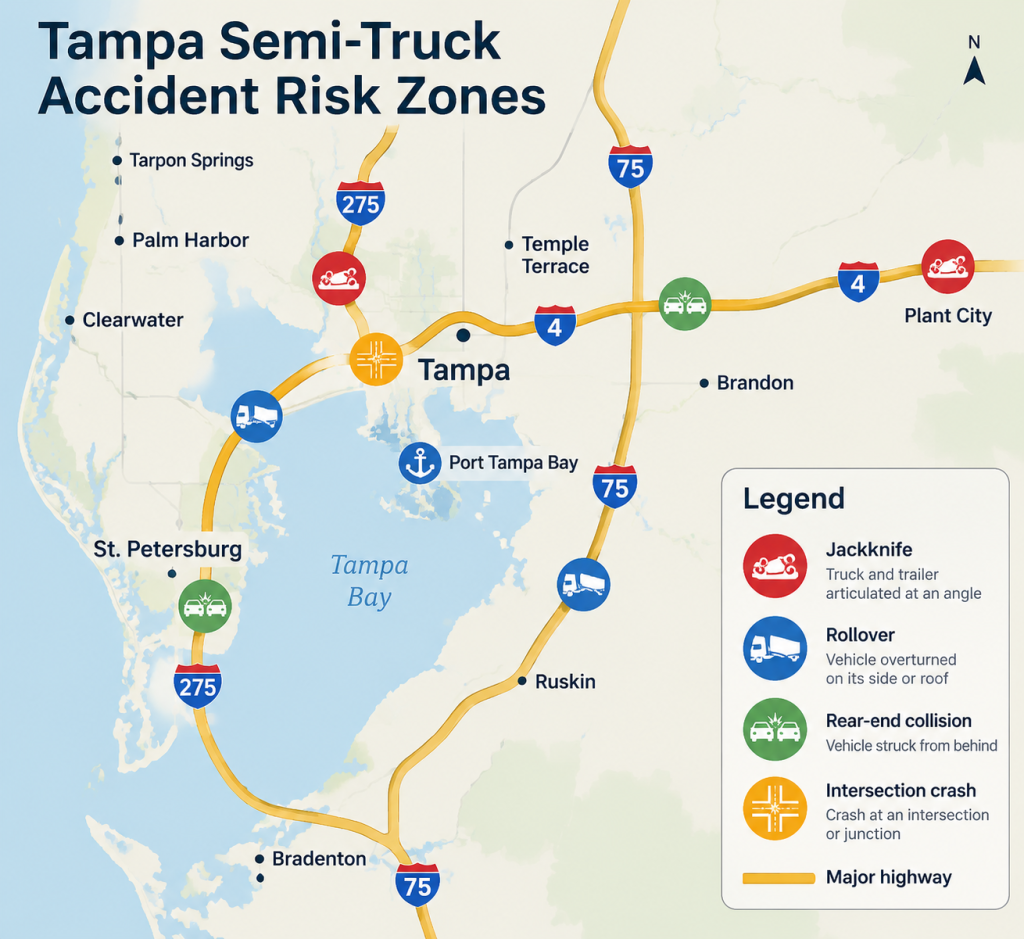
I-75, I-4, and I-275: What Tampa’s Truck Corridors Mean for Your Case
Tampa is a freight crossroads. Interstate 4 and Interstate 75 meet east of the city, I-275 runs through the center, and Port Tampa Bay feeds a steady flow of trucks onto all of them. The crash type often tells you where to look.
| Crash type | Common on | What to chase |
|---|---|---|
| Rear-end or underride | Congested stretches of I-4 and I-275 | Speed and following distance (ECM), driver attention, dashcam, brake maintenance |
| Merge and lane-change collisions | The I-4 and I-75 interchange and on-ramps | Mirror and blind-spot issues, driver’s route and schedule, nearby traffic cameras |
| Rollover or jackknife | Ramps and curves on I-75 and I-275 | Speed, cargo loading and securement, tire and brake condition |
| Wide-turn crash | Surface streets near the port and distribution centers | Driver training, route choice, trailer length and turning data |
A few practical points for any I-75 truck accident or I-4 truck accident:
- Ask which traffic cameras or nearby business cameras cover the spot, and request footage quickly, since it is often overwritten.
- Photograph skid marks, debris, lane markings, signage, and construction zones before they change.
- Get the truck’s USDOT number, company name, and plate, even if the driver says it’s “just a contractor.”
This is why a local truck accident attorney helps: someone who knows the roads can ask better questions on day one.
How to File a Truck Accident Claim in Florida, Step by Step
- Get medical care now. Florida PIP generally requires initial care within 14 days (Fla. Stat. § 627.736(1)(a)) to keep medical benefits, even in a truck crash.
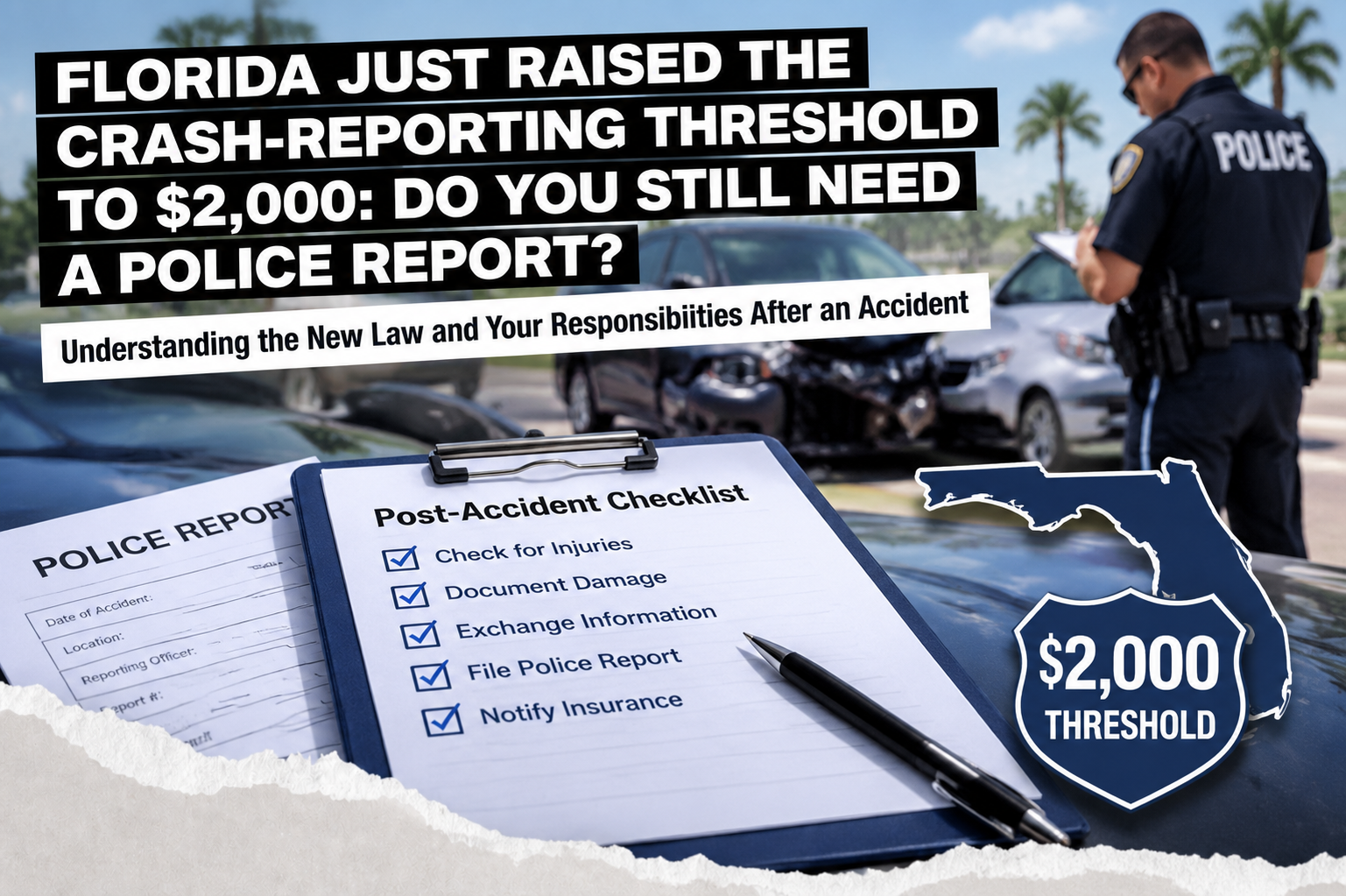
- Call the police. Crashes involving a commercial vehicle are among those that require a long-form crash report in Florida, so the new $2,000 reporting threshold isn’t your concern here.
- Document the scene. Photograph the truck, USDOT number, plates, damage, road, and signage, and collect witness contacts.
- Notify your own insurer, but don’t give the carrier’s insurer a recorded statement before talking to counsel.
- Preserve evidence. Keep your phone photos, medical records, and bills, and get a preservation letter sent.
- Investigate and identify every defendant. This is the step where a lawyer for truck accident cases earns the fee.
- Present the claim, negotiate, and file suit if needed, within 2 years for injury or wrongful death.
Fault matters too. Florida uses modified comparative negligence: if you’re found more than 50% at fault you recover nothing, and below that your recovery is reduced by your percentage of fault. Insurers know this and will try to blame you.
What Compensation and Insurance Look Like
Damages can include medical bills (past and future), lost income and earning capacity, pain and suffering, and, in a wrongful death case, a family’s losses.
On insurance: federal rules set a minimum of $750,000 in liability coverage for most for-hire carriers hauling non-hazardous freight, and higher levels ($1,000,000 and, for certain bulk hazardous materials, $5,000,000). That’s a floor, not a ceiling, and a catastrophic injury can exceed it, which is why identifying every defendant and every policy matters.
When to Hire a Semi Truck Accident Lawyer in Tampa
You don’t need counsel for every fender-bender. You should call a semi truck accident lawyer in Tampa when:
- You or a family member were seriously hurt, or someone died
- A commercial truck, delivery vehicle, or tractor-trailer was involved
- The company or its insurer is calling you, or has already asked for a recorded statement
- Fault is disputed or the carrier is blaming you
- Evidence may be at risk and you aren’t sure what exists
What to ask any truck accident attorney, including us:
- How many truck cases have you handled, and what was the range of results?
- Who will actually work on my case?
- Will you send a preservation letter right away?
- How are fees and costs handled, in writing?
- Do you work with accident reconstructionists and trucking-industry experts?
A good commercial truck accident lawyer answers all five without hesitating.
FAQ
Who is liable in a Tampa semi-truck accident?
Possibly the driver, trucking company, truck owner or lessor, shipper or loader, broker, maintenance shop, or manufacturer, depending on the facts.
Can I sue the trucking company, not just the driver?
Often yes. A company can be vicariously liable for its driver and independently liable for hiring, training, supervision, or maintenance failures.
How long do I have to file a truck accident lawsuit in Florida?
Generally 2 years for negligence and wrongful death under Fla. Stat. § 95.11(5).
What evidence disappears fastest?
Dashcam video, ECM data, and GPS or telematics can be overwritten in days or weeks. Carriers must keep driver logs only 6 months.
Do I still need a police report after a truck crash?
Yes. A crash involving a commercial vehicle requires a long-form report in Florida regardless of the dollar amount.
What if I was partly at fault?
Florida’s modified comparative negligence rule reduces your recovery by your percentage of fault, and bars it if you are more than 50% at fault.
How much insurance does a trucking company have to carry?
Federal law sets a $750,000 minimum for most for-hire carriers of non-hazardous freight, with higher minimums for certain hazardous cargo.
Get Help From Demesmin & Dover
ruck companies move fast after a crash. You should too. Demesmin & Dover represents truck crash victims in Florida from our Tampa office, and we’re available 24/7 because trucks don’t keep business hours. If your crash happened in Illinois, the rules differ, so tell us where it happened when you call.
Call now: 866-954-MORE (6673) or Start your free case review.