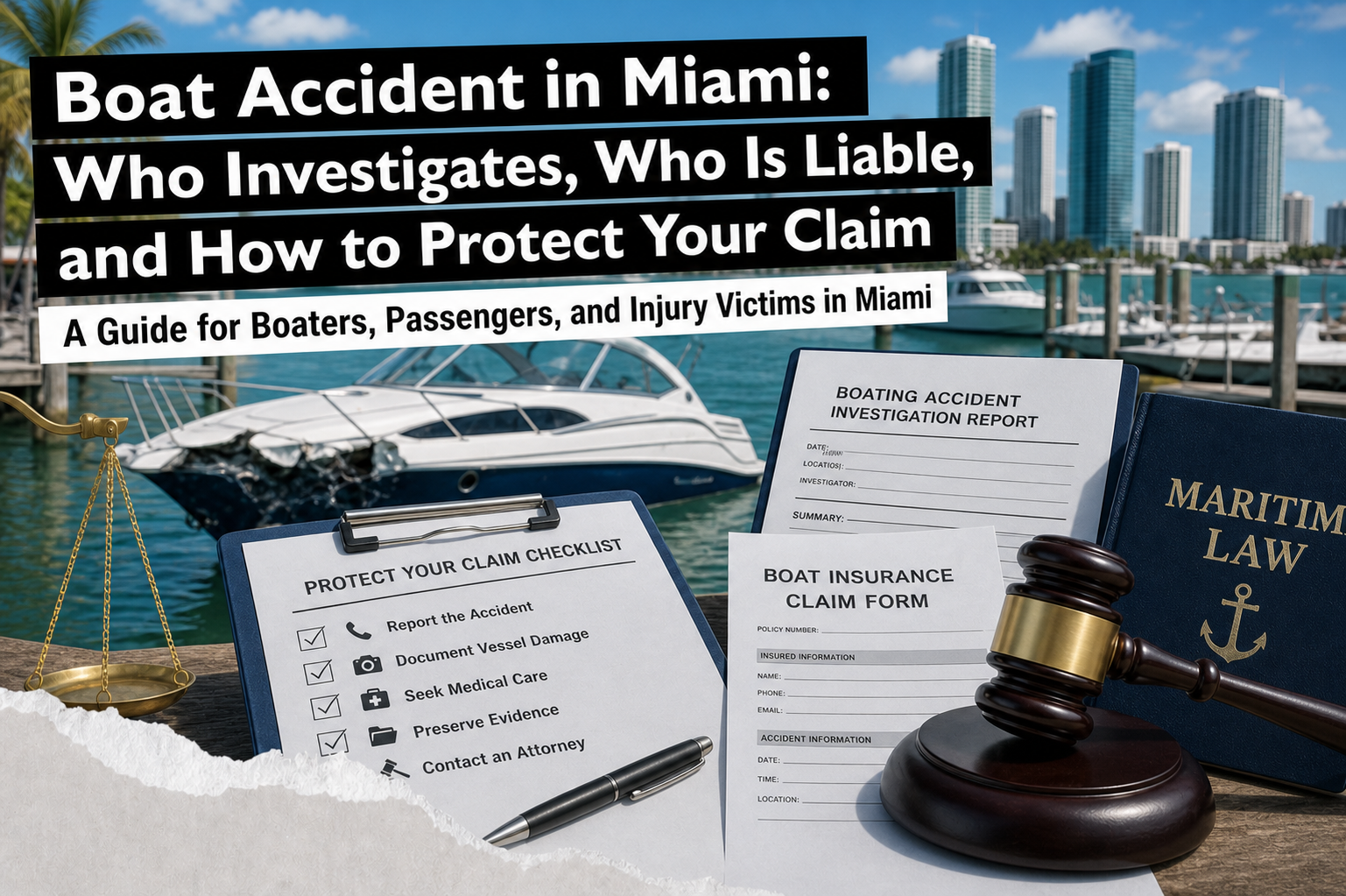
Miami has the water, the weather, the sandbar, and a lot of people who have never had to prove they know how to drive a boat. When it goes wrong, the questions come fast: Who responds? Who writes the report? Who pays? Here are the short answers, then the full picture.
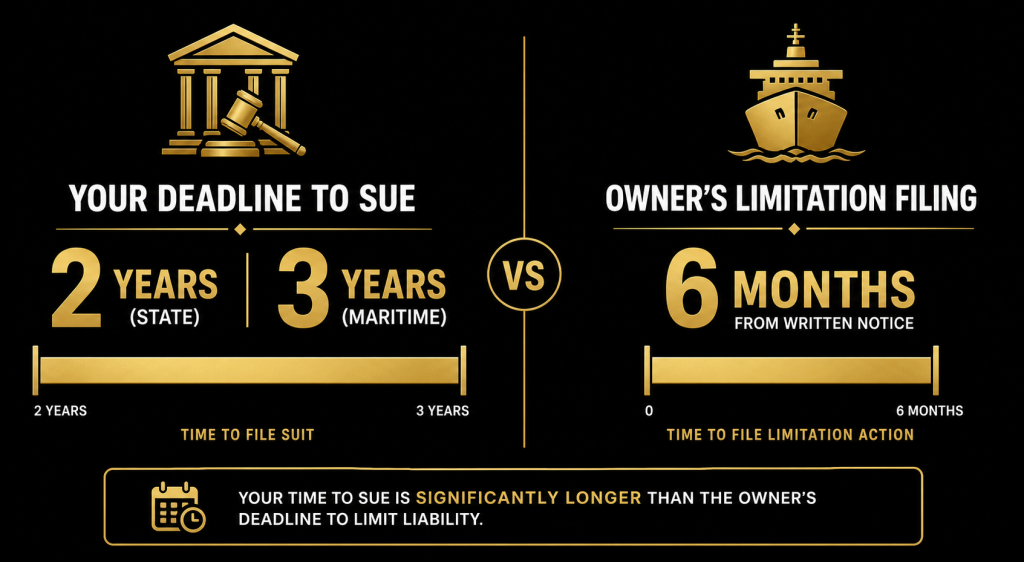
Quick Answer: After a boat accident in Florida, the Florida Fish and Wildlife Conservation Commission (FWC) is the state agency that typically leads the investigation, often with help from local marine patrol units. Operators (or owners, or the rental or charter company) must file an accident report for injuries, deaths, disappearances, or at least $2,000 in damage. For your own claim, you generally have 2 years to sue under Florida law, or 3 years if federal maritime law applies. A vessel owner can also ask a federal court to cap their liability within 6 months of getting written notice of your claim.
That’s the summary. The details below are the part that protects your case.
Why Miami and Broward Waters Produce So Many Boating Claims
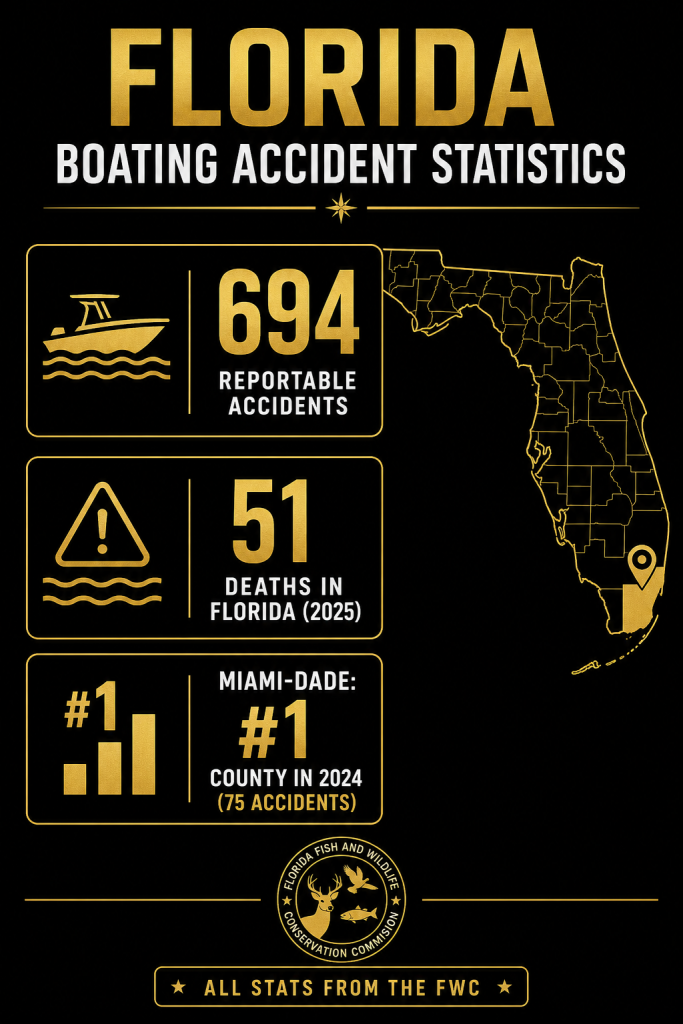
Florida recorded 694 reportable boating accidents in 2025, with 51 deaths and roughly 440 injuries, according to FWC. Personal watercraft made up 17% of registered vessels but 23% of accidents.
Miami-Dade sits at the top of the county rankings. In FWC’s 2024 data, it had 75 reportable accidents, the most in the state, ahead of Monroe County (69) and Palm Beach County (45), as reported by NBC Miami. Broward is a heavy-traffic neighbor with its own marine units, marinas, and miles of Intracoastal.
Add rental boats, sandbar crowds, cruising yachts, jet skis, and night-time boat traffic, and you can see the problem.
Who Investigates a Boating Accident in Florida
This is the question most people ask in the first hours, and most pages never answer it.
The agencies and what each produces
| Who | Role | What it means for you |
|---|---|---|
| FWC (Division of Law Enforcement) | The state’s boating law enforcement agency. Typically takes the lead on accident investigations on state waters and receives the accident reports. | Your main source for the investigation file and report. |
| Local marine units (for example Miami-Dade Police Marine Patrol, and in Broward, the Broward Sheriff’s Office Marine Patrol or Fort Lauderdale Police Marine Unit) | Respond, rescue, assist, and may investigate within their jurisdictions. | Often the first officers you meet. Note the agency and officer name. |
| U.S. Coast Guard | Federal authority on navigable waters. Handles rescue and, for some casualties, investigations. | More likely to matter for larger or commercial vessels. |
| State Attorney’s Office | Decides whether to file criminal charges (reckless operation, boating under the influence, leaving the scene). | A separate criminal case, not your civil claim. |
| Insurers and private investigators | Investigate for the boat’s insurer, rental company, or other parties. | Their goal is to limit what they pay. |
| Your attorney | Investigates for you: preserves evidence, interviews witnesses, retains experts. | The only investigation that is working for you. |
The report, and what it can and can’t do
Under Fla. Stat. § 327.301:
- The operator must file a written report, or the owner if the operator can’t. If the boat was rented or chartered, the rental or charter provider is responsible for compliance.
- It’s required for injury, death, disappearance, or at least $2,000 in damage.
- Federal rules set the timing: generally 48 hours for deaths within 24 hours, serious injuries, and disappearances, and 10 days for other reportable accidents (33 CFR 173.55).
- An investigating officer must forward their report to FWC within 24 hours of finishing the investigation.
One surprise: the statute says an accident report, and statements made to an officer for it, generally cannot be used as evidence at a civil or criminal trial. But breath, urine, and blood test results are not confidential and are admissible. The report is a roadmap, not the final word, which is why your own investigation matters.
Intracoastal Boating Accidents: What Makes Them Different
The Intracoastal Waterway runs through both Miami-Dade and Broward, and it’s a busy, narrow lane for everything from center consoles to yachts to rental jet skis. An Intracoastal boating accident has some specific features:
- Maritime law may apply. The Intracoastal is a navigable waterway, so federal maritime law can govern your claim, which affects deadlines and available remedies.
- Mixed traffic and wakes. Large boats’ wakes toss smaller ones and passengers, a common source of injuries with no collision at all.
- Bridges, docks, and channel markers. Hitting a fixed object is a classic cause of serious injury, especially at night.
- Posted speed zones. No-wake and slow-speed zones are common near marinas and manatee areas, and violating them is evidence of carelessness.
- Rental crowds. Renters with little experience share the water with experienced captains.
If you were hurt on the Intracoastal in Broward or Miami-Dade, note the nearest bridge, marker, or address, and the exact time. It helps pinpoint cameras, witnesses, and records.
Who Can Be Liable After a Miami Boat Accident
Liability rarely stops at the person at the helm:
- The operator: careless or reckless operation, speeding, distraction, or operating under the influence.
- The vessel owner: negligent entrustment, such as lending the boat to someone unqualified.
- Rental and charter companies: failing to verify qualifications or provide required instruction.
- Marinas, docks, and government entities: unsafe docks, unlit pilings, or missing markers, often with shorter notice rules.
- Manufacturers and repair shops: steering, throttle, or fuel-system failures.
- The other boat: in a collision, the other operator and owner.
Lucy’s Law (HB 289, effective July 1, 2025) raised penalties for leaving the scene of a boating accident, up to a first-degree felony with a mandatory minimum when someone dies. The criminal case is separate from your claim, but an operator who flees, refuses testing, or lies creates evidence that shapes how your case is valued.
Two Deadlines: Your Lawsuit Clock and the Owner’s Six-Month Move
Your clock. In Florida, you generally have 2 years to sue for negligence and 2 years for wrongful death (Fla. Stat. § 95.11(5)(a), (e)). If federal maritime law applies, the deadline for a maritime tort is generally 3 years. Some older websites still say four years. That was the old rule, before 2023.
The owner’s clock. Under the federal Limitation of Liability Act (46 U.S.C. § 30529), a vessel owner can file in federal court within 6 months after receiving written notice of a claim to try to cap liability at the value of the boat. It applies to recreational boats, too, and the owner must show they lacked “privity or knowledge.” Some small vessels carrying passengers for hire were carved out in 2022. Once filed, it can pause other cases against the owner and force everything into federal court.
Two practical lessons:
- A casual text or email can count as written notice.
- This is a good reason to have an attorney handle communications from the start.
What to Do in the First 72 Hours
- Get medical care now. Adrenaline and cold water mask injuries.
- Confirm an accident report is being filed, and get the agency name, officer name, and case number.
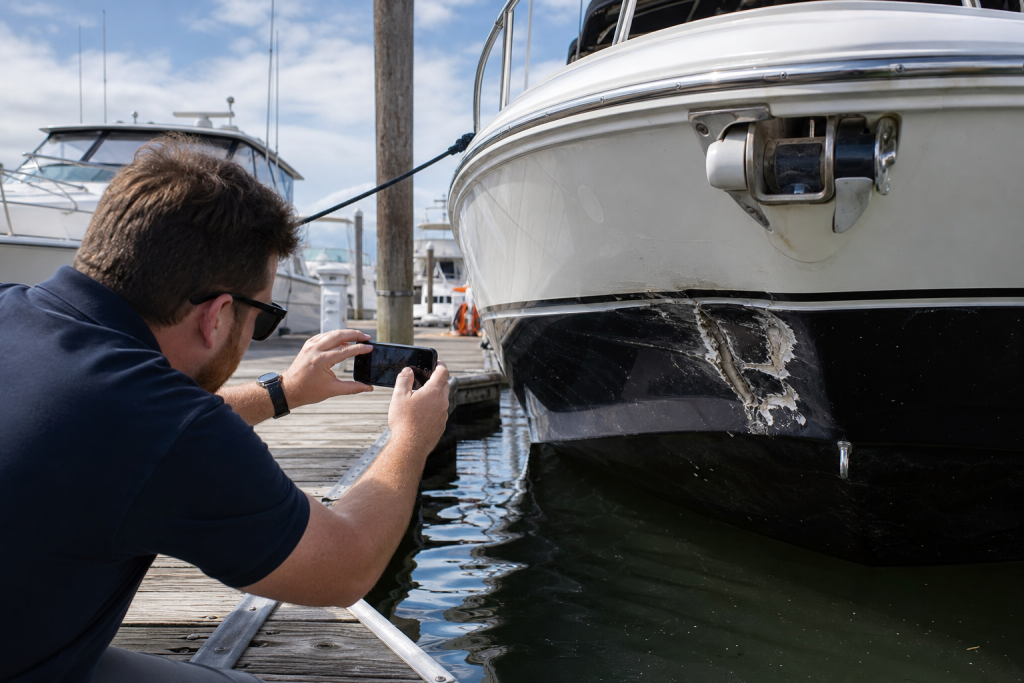
- Photograph the vessels before they’re repaired: damage, throttle position, registration numbers, safety gear.
- Collect names and numbers for everyone aboard, and ask witnesses not to delete photos or video.
- Find out if the boat was rented or chartered, and get the agreement.
- Write down the exact location (bridge, marker, address), time, weather, and wake conditions.
- Don’t give a recorded statement to any insurer before speaking with a lawyer.
- Don’t send or sign notice letters without counsel, because of the six-month rule.
Remember that boats get repaired and sold quickly, and electronics like GPS and chartplotters hold track data.
Insurance and Compensation: What to Expect
A boat accident is not a car accident. Florida’s no-fault PIP system covers motor vehicles, not boats, and most recreational boat owners aren’t required to carry liability insurance, so identifying every responsible party and every policy matters.
Compensation can include medical expenses (past and future), lost income, pain and suffering, and, in a wrongful death case, a family’s losses. Your health insurer may have a right to repayment from a settlement, so that should be addressed early.
How to Choose a Boat Accident Lawyer in Miami or Broward
You’re looking for a boat accident lawyer in Miami who can handle both state and maritime law. Ask:
- How many boat and maritime cases have you handled?
- Will you send preservation letters right away, and handle the six-month limitation issue?
- Who actually works on my case?
- How do you communicate, and in what languages?
- How are fees and costs handled, in writing?
Demesmin & Dover represents boat accident victims across South Florida, including as a Broward County boat accident lawyer from our Fort Lauderdale office.
FAQ
Who investigates a boating accident in Florida?
FWC typically leads investigations on state waters, often with local marine units. The Coast Guard handles rescue and some casualties, and the State Attorney decides on criminal charges.
Do I have to report a boating accident?
Yes, for injury, death, disappearance, or at least $2,000 in damage. The operator files, or the owner if the operator can’t, and rental or charter providers are responsible for rented boats.
How long do I have to sue after a Miami boat accident?
Generally 2 years in Florida, or 3 years if federal maritime law applies.
What is the owner’s six-month deadline?
A vessel owner can ask a federal court to cap liability within 6 months of written notice of a claim under 46 U.S.C. § 30529.
Can I use the accident report in court?
Generally no. The report and statements made for it are typically not admissible at trial, though breath, urine, and blood test results are.
What if the boat was a rental?
The rental company may be responsible for reporting and may be liable for failing to qualify or instruct the renter.
What if I was partly at fault?
Florida’s modified comparative negligence rule reduces your recovery by your percentage of fault, and bars it if you are more than 50% at fault.
Get Help From Demesmin & Dover
Boat accident evidence disappears fast, and deadlines can start before you know they exist. Demesmin & Dover represents boating accident victims in Miami-Dade and Broward from our Fort Lauderdale office, and we’re available 24/7.
Call now: 866-954-MORE (6673) or Start your free case review.