Last updated November 4, 2026. This is a developing situation, and facts may change.
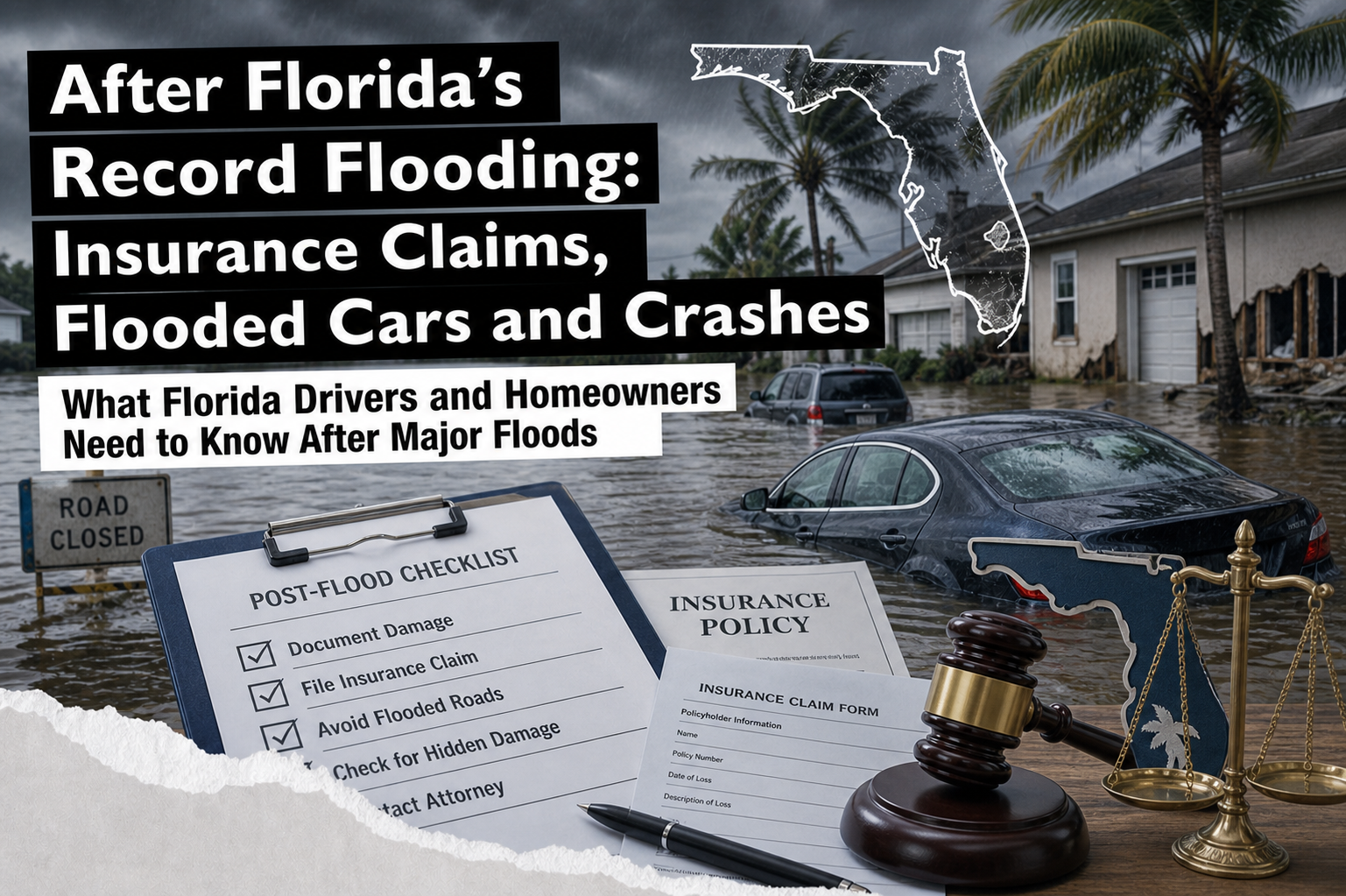
If you live in Palm Beach, Broward, or the Treasure Coast, the first week of November 2026 may have felt like a hurricane without the hurricane. Streets became rivers, parking lots turned into lakes, and cars that were fine at dinner were underwater by midnight. This guide covers how to file a flood damage claim in Florida, what happens with flooded cars, and how the flooding can change a crash claim.
Quick Answer: A standard Florida homeowners policy does not cover flood damage. Flood is covered by a separate policy, either through the National Flood Insurance Program (NFIP) or a private insurer. If you have one, report the loss right away, document everything, and, for an NFIP claim, submit a Proof of Loss within 60 days. Florida law gives you 1 year to report a new claim and 18 months for a supplemental claim on a private policy. Your car is covered for flood damage only if you carry comprehensive coverage. And if you were in a crash in the flooding, the usual rules still apply, including the 14-day PIP treatment deadline.
That’s the summary. Here’s the situation, then the steps.
What Happened: South Florida’s Record Flooding in Brief
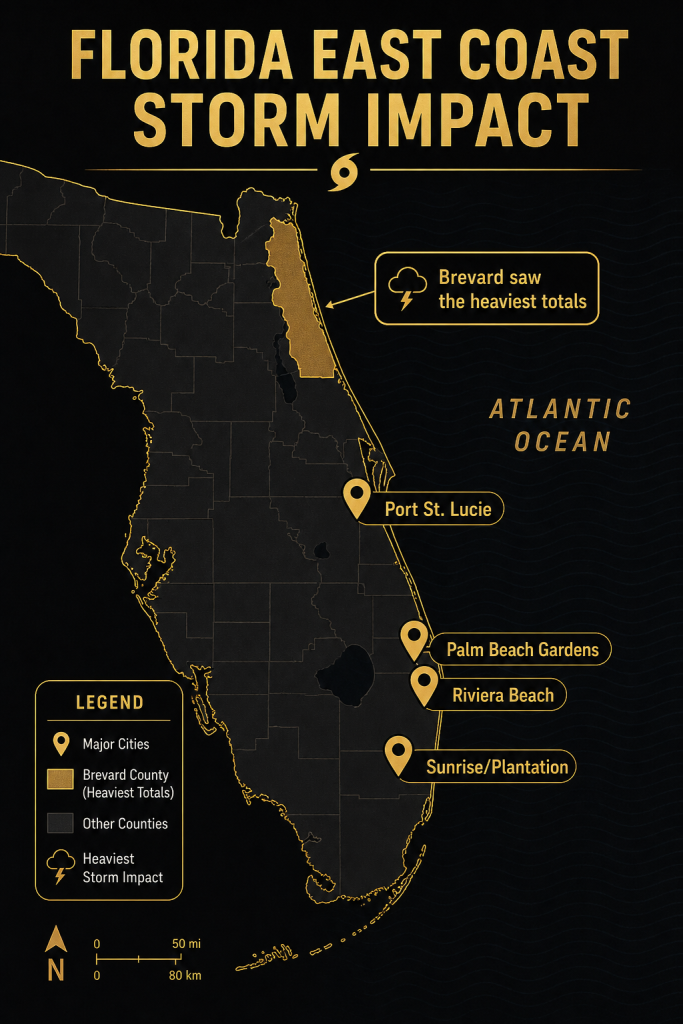
A stalled weather pattern dumped extraordinary rain on Florida’s east coast over November 1 and 2. The worst totals fell farther north in Brevard County, where up to about 24 inches fell and Melbourne had its wettest day in 89 years. But South Florida was hit hard too:
- Palm Beach County. Flooding entered some homes in Palm Beach Gardens on November 1, where an estimated 17 inches fell in six hours. Riviera Beach declared a local state of emergency, with residents stranded and wastewater backing up into homes.
- Treasure Coast. Port St. Lucie saw stranded vehicles and road closures, and police were responding to cars stuck in high water.
- Broward County. About 8 inches fell in some areas. Cars were stranded at Sawgrass Mills in Sunrise and outside Amerant Bank Arena after Monday night’s Panthers game, where the water was nearly knee-high and some fans left their vehicles behind. Dozens of blocks in Plantation Acres were underwater.
- Miami-Dade. The county was under a flood watch.
The Governor declared a state of emergency for seven counties on November 2, and on November 4 expanded it to include Palm Beach, Glades, Hendry, Lake, Okeechobee, Seminole, and Volusia counties. Two flooding-related deaths were reported in Palm Bay, including one person trapped in a car.
Flood, Rain, or Wind? What Your Policy Actually Covers
This is where claims get confusing.
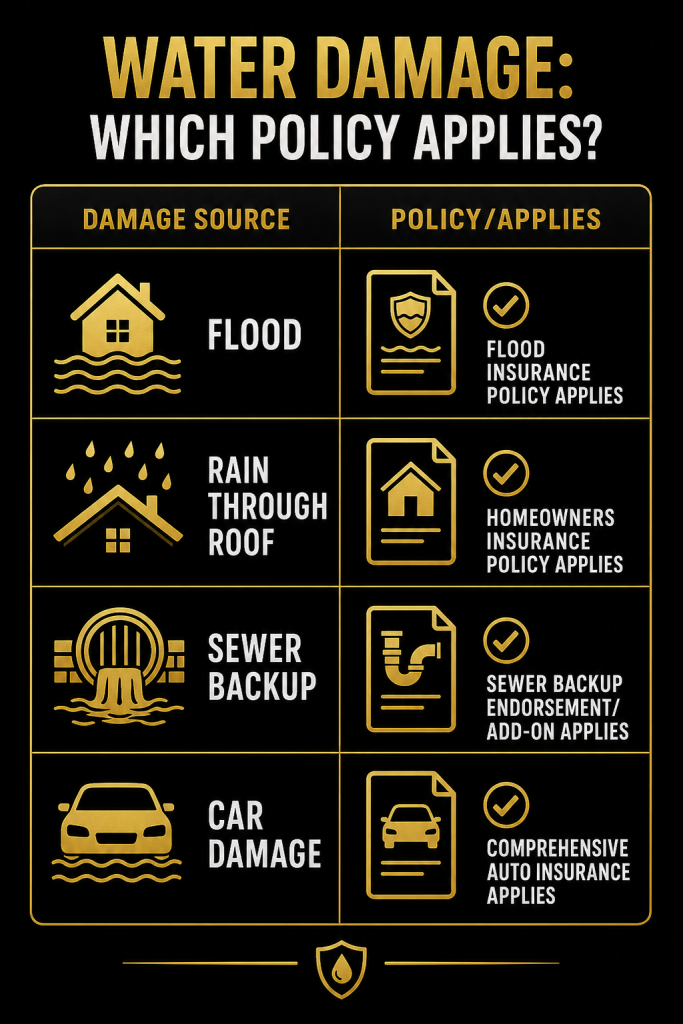
| What happened | What usually covers it |
|---|---|
| Rising or standing water entering your home from the ground (flood) | A flood policy (NFIP or private). A standard homeowners policy excludes it. |
| Rain coming through a damaged roof or opening created by wind | Often covered by your homeowners policy. |
| Sewer or drain backup | Depends on your policy. Many homeowners policies require a water backup endorsement, and flood policies have their own rules. Check yours. |
| Your car flooded | Comprehensive auto coverage. Liability-only does not pay. |
The NFIP covers up to $250,000 for a building and $100,000 for contents (FloodSmart). Private flood policies may offer higher limits. New NFIP policies generally have a waiting period before coverage begins, so a policy bought after the rain started won’t cover this event.
How to File a Flood Damage Claim in Florida, Step by Step
- Stay safe first. Don’t enter flooded areas with power on, and don’t wade through floodwater, which can carry contamination.
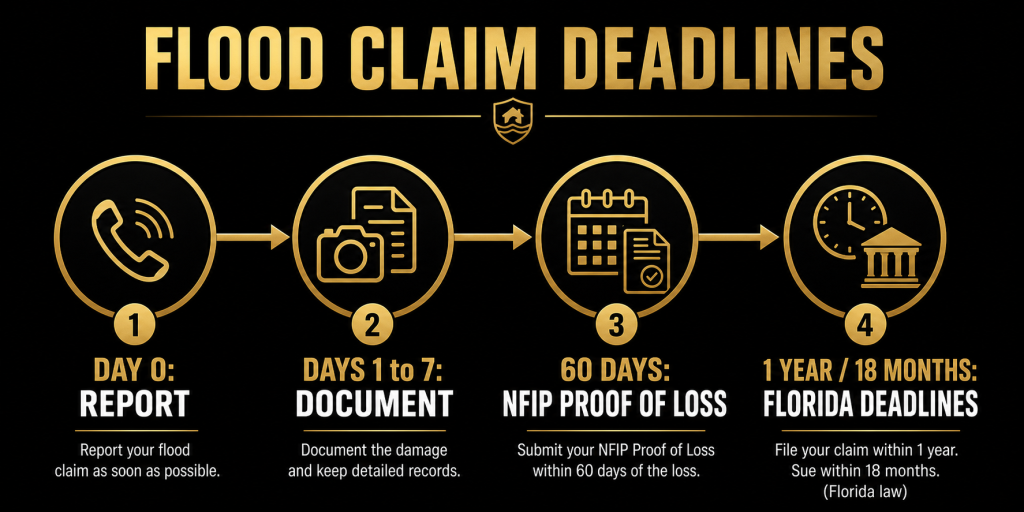
- Report the loss to your flood insurer right away, by phone and in writing, and get a claim number. If you have both flood and homeowners coverage, notify both.
- Document everything before you clean up. Take photos and video of the water line, damaged rooms, and belongings. Keep damaged items until the adjuster has seen them.
- Prevent more damage, within reason: move items to dry areas, shut off utilities if safe, and keep receipts for emergency measures.
- Make a detailed inventory with receipts, serial numbers, and dates where you can.
- Submit your Proof of Loss on time. For an NFIP claim, FEMA says to submit the Proof of Loss form within 60 days of the loss, even if you disagree with the adjuster’s estimate. You can file a supplemental claim later for missed items.
- Know your clock. For a private policy, Florida law (§ 627.70132) gives you 1 year to report an initial claim and 18 months for a supplemental claim. For a non-hurricane weather event, the date of loss is the date NOAA verifies. Don’t wait.
- Track the insurer’s deadlines. For Florida-regulated policies, the insurer generally must acknowledge your claim within 7 days and pay or deny within 60 days (§ 627.70131).
If You Don’t Have Flood Insurance
You may still have options, so don’t assume the worst:
- Check for other coverage. Rain that entered through a wind-damaged roof or window may be covered, and some policies include water backup endorsements. Read your declarations page.
- Check for federal help. Federal assistance generally requires a federal disaster declaration. As of November 4, I found no federal declaration for this event. Watch DisasterAssistance.gov and FEMA.
- Document everything anyway. Photos and receipts matter for any claim, any insurer, and any aid program.
- Ask a lawyer about your policy. Insurers sometimes label rain damage as “flood” to avoid paying. A coverage review can tell you whether the label is right.
Flooded Cars: Coverage, Total Losses, and Used-Car Traps
Flooded cars are the part of this disaster that most guides skip, and in Broward and the Treasure Coast it’s a big one.
Is your car covered?
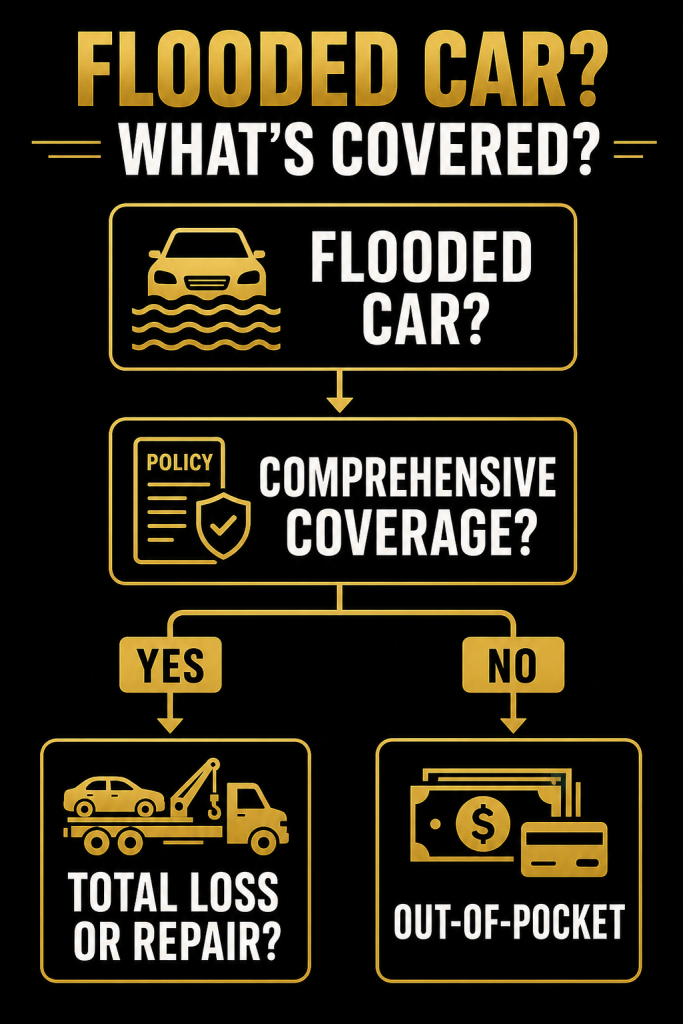
- Comprehensive coverage (the optional “other than collision” coverage) pays for flood damage to your car. Liability-only coverage does not. A homeowners policy won’t cover it either.
- Check your declarations page, then report the claim quickly and document the water line, interior, and dashboard.
Before you do anything else:
- Avoid restarting a vehicle that sat in water until a mechanic has inspected it, because water in the engine or electrical system can cause more damage.
- Take photos of the flood line and any debris or mud.
- Ask your insurer about towing and storage.
If your car is declared a total loss: under Florida’s claims practices statute (§ 626.9743), an insurer using a cash settlement generally bases it on the actual cost to buy a comparable vehicle, including sales tax where applicable. Ask to see the comparable vehicles or valuation report, and dispute low numbers with your own comparables.
Watch for used-car traps. The National Insurance Crime Bureau warns that flooded vehicles, especially uninsured ones, are often cleaned up and sold without disclosing the damage. If you’re shopping for a car in the coming months, check the vehicle’s history, inspect for water or mud in the carpet and spare tire well, and use NICB’s free VINCheck tool.
Flood Crashes: Dark Signals, Standing Water, and Who Is at Fault
Flooding doesn’t just damage cars. It causes crashes. And when you’re hurt in a crash during or after a flood, the usual claim rules still apply, with a few wrinkles.
Dark traffic signals. Storms knock out power, and signals go dark. Under Fla. Stat. § 316.1235, a driver approaching an intersection with an inoperative signal must stop as at a stop sign. A driver who blew through a dark signal may be at fault.
Speed for conditions. Florida law (§ 316.183) says no one may drive faster than is “reasonable and prudent under the conditions.” In standing water and heavy rain, the safe speed is much lower than the posted limit.
Safety facts. The National Weather Service says more than half of flood deaths are vehicle-related, and that a few inches of water can cause loss of control or stalling, while a foot or two of moving water can carry away a vehicle. Don’t drive through flooded roads.
If you’re in a crash:
- Call 911 if anyone is hurt.
- Call the police. Florida’s new threshold, effective October 1, 2026, requires you to report a crash with injury or apparent damage of at least $2,000. Flooded roads are exactly where damage is hard to judge, so call anyway.
- Document the water, the signals, the road, the lighting, and the weather.
- Get medical care within 14 days to protect your PIP benefits (Fla. Stat. § 627.736).
- Don’t give a recorded statement to the other driver’s insurer before getting advice.
- Remember fault can be shared. Under Florida’s comparative negligence rule, you’re barred from recovering if you’re found more than 50% at fault, so the evidence about speed and conditions matters.
What about the mass stranding? If your car was stranded after a crowded event or a flooded lot, your own comprehensive coverage is the likely source of payment for water damage, not the venue’s. A premises claim would depend on specific facts, such as whether a property owner ignored an obvious hazard.
Denied or Underpaid? Your Options
If your insurer denies or lowballs your flood claim:
- Get the denial in writing, with the policy provisions and facts it relies on.
- Compare the estimate with a licensed contractor’s.
- Request a reinspection and give the insurer your evidence.
- Use state resources. Florida’s Department of Financial Services offers a free mediation program for many residential property disputes, and a pre-suit notice process applies before you sue (§ 627.7015, § 627.70152).
- Don’t sign a “full and final” release or cash a check marked that way until you know what you’re giving up.
Protect Yourself From Repair Scams and Lowball Offers
Disasters attract bad actors. Florida’s Homeowner Claims Bill of Rights advises you to confirm a contractor is licensed, ask for references and proof of insurance, and read carefully any contract that requires payments or a fee based on insurance proceeds.
If you hire a public adjuster, Florida caps their compensation at 10% of claim payments for claims based on events under a declared state of emergency, within one year of the declaration (Fla. Stat. § 626.854). A public adjuster can’t give legal advice or file a lawsuit.
When to Call a Flood Damage Claim Lawyer or Car Accident Lawyer
You don’t need a lawyer for a claim that’s paid promptly and fairly. A flood damage claim lawyer is worth a call when:
- Your claim is denied, or the insurer says “it’s flood” when it may be wind-driven rain
- The payment is far below your contractor’s estimate
- The insurer misses deadlines or stops responding
- You’re asked to sign a release or accept a “final” check
- Your car was totaled and the valuation looks low
A car accident lawyer in Florida is worth a call when you or a passenger were hurt in a crash during the flooding, when fault is disputed, or when the other driver’s coverage is unclear.
Demesmin & Dover represents injured people and policyholders across Florida, including from our Fort Lauderdale office.
FAQ
How do I file a flood damage claim in Florida?
Report the loss to your flood insurer right away, document the damage with photos, video, and an inventory, protect the property from further damage, and for an NFIP claim submit a Proof of Loss within 60 days.
Does homeowners insurance cover flood damage in Florida?
No. A standard homeowners policy excludes flood. You need a separate flood policy through the NFIP or a private insurer.
How long do I have to file a flood claim?
For a private policy, Florida gives you 1 year to report an initial claim and 18 months for a supplemental claim (§ 627.70132). For an NFIP claim, FEMA says to submit a Proof of Loss within 60 days.
Is my flooded car covered?
Only if you have comprehensive coverage. Liability-only policies don’t cover flood damage to your own car.
What if my car is a total loss?
The insurer’s settlement is generally based on the cost of a comparable vehicle. Ask for the valuation and compare it with similar cars.
What if I was in a crash during the flooding?
Call 911 and the police, document the conditions, get medical care within 14 days for PIP, and talk to a lawyer before giving a recorded statement.
Is there a federal disaster declaration for this flooding?
As of November 4, 2026, I found none. Check FEMA and DisasterAssistance.gov.
Get Help From Demesmin & Dover
If the flooding left you with a denied claim, a flooded car, or a crash, you don’t have to sort it out alone. Demesmin & Dover represents Florida policyholders and injured drivers, and we’re available 24/7.
Call now: 866-954-MORE (6673) or Start your free case review.
Lorem ipsum dolor sit amet, consectetur adipiscing elit. Ut elit tellus, luctus nec ullamcorper mattis, pulvinar dapibus leo.