
Last updated November 13, 2026.
If you think a doctor or hospital hurt you, the first question is usually “what went wrong?” The second one should be “how long do I have?”
That second question has a different answer in Florida than in Illinois. It also has more than one answer in each state, depending on when you found out, your age, who the provider is, and whether the injury led to a death.
This guide covers the medical malpractice statute of limitations in Florida and the medical malpractice statute of limitations in Illinois, plus the steps that have to happen before you can even file.
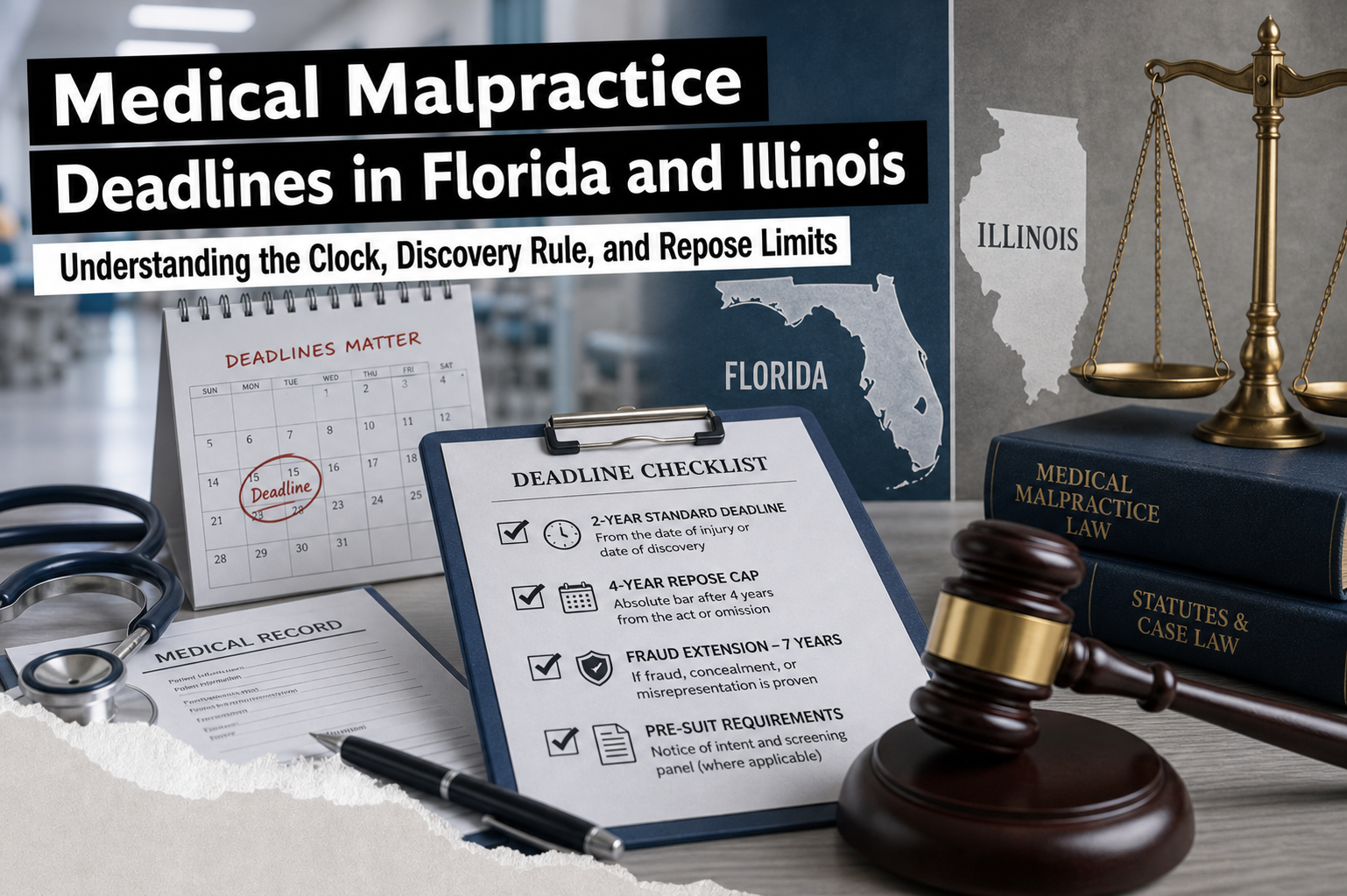
Quick Answer: In both states the general rule is 2 years from the injury or from when you discovered (or should have discovered) it, with an outer cutoff of 4 years from the negligent act. Exceptions exist for minors, fraud and concealment, and wrongful death. Florida requires a pre-suit investigation and a 90-day notice period before filing. Illinois requires a health professional’s written report filed with the complaint. Public hospitals, the VA, and federal clinics can follow different rules.
Medical Malpractice Statute of Limitations Florida: The 2, 4, and 7-Year Rules
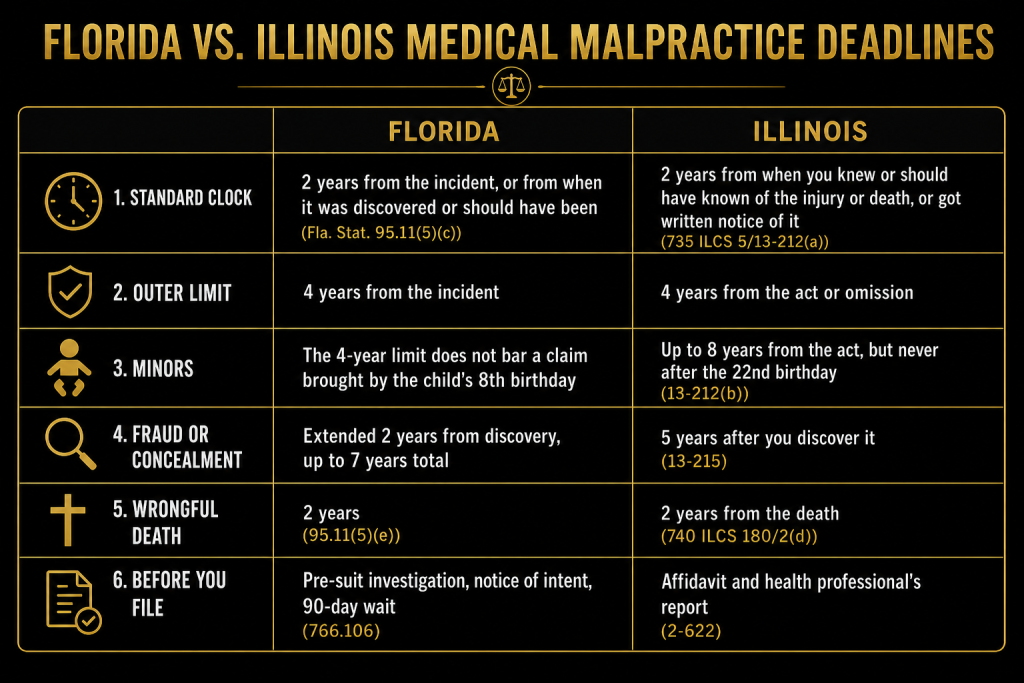
Florida’s rule sits in Fla. Stat. 95.11(5)(c). It has four parts:
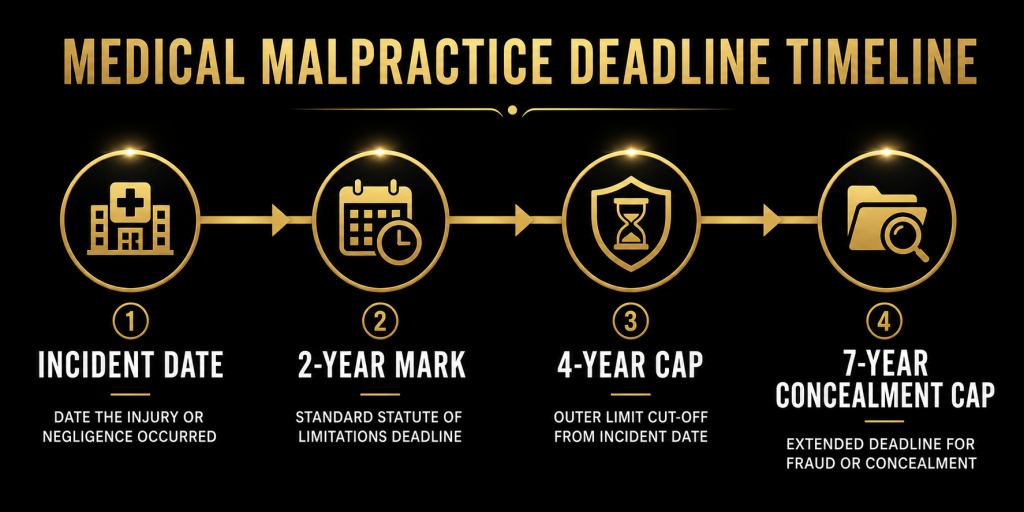
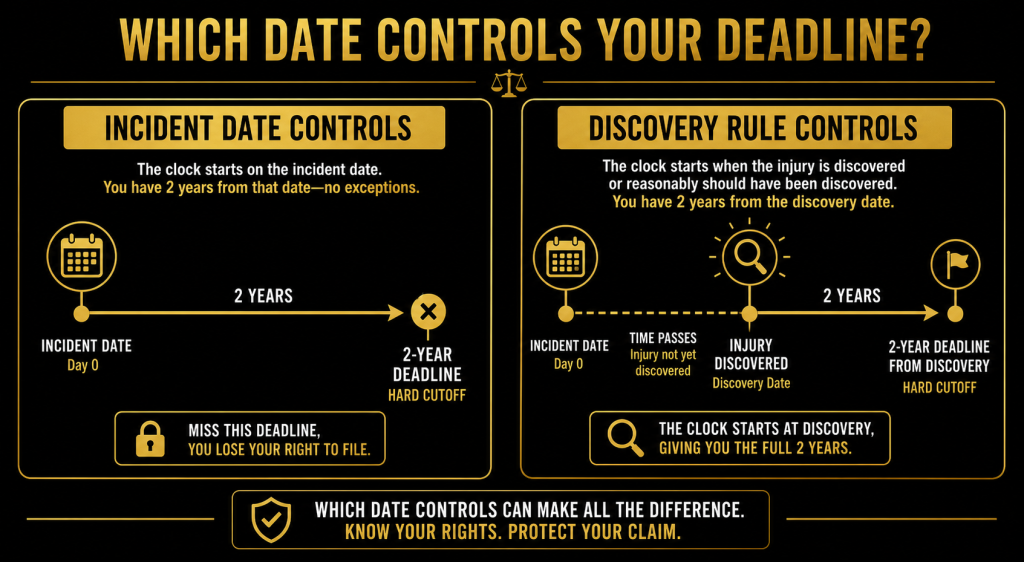
- 2 years from the date of the incident, or 2 years from when the injury was discovered or should have been discovered with reasonable diligence.
- 4 years, no matter what. No action can be started more than 4 years after the incident, even if the injury was only found later.
- Minors. The 4-year cap does not bar a claim brought on a child’s behalf on or before the child’s 8th birthday.
- Fraud, concealment, or intentional misrepresentation. If the provider hid the injury, the period is extended 2 years from when it is discovered, up to 7 years from the incident.
The statute also says it does not apply to claims where the birth-related neurological injury compensation plan (Fla. Stat. 766.301 to 766.316) is the exclusive remedy. If a case involves a newborn’s brain injury, a lawyer needs to check this early.
Wrongful death. A Florida wrongful death action must be commenced within 2 years (95.11(5)(e)). When the death traces back to medical negligence, the pre-suit rules still apply, and the timing can get tangled. Do not guess.
Florida’s Pre-Suit Process and How It Changes Your Clock
You cannot just file a lawsuit in Florida. Chapter 766 requires steps first, and they interact with the deadline.
- Investigation. Before suing, the claimant’s side must do a reasonable investigation, and the complaint must include a certificate that counsel has a good faith belief the care was negligent (Fla. Stat. 766.104). In practice that means a medical expert reviews the records.
- Notice of intent. After the presuit investigation, each prospective defendant must be notified of the intent to sue, by certified mail, tracked mail, a commercial carrier, or a process server (766.106(2)).
- The 90-day wait. No suit can be filed for 90 days after the notice is delivered. During that time the defendant’s insurer investigates (766.106(3)).
- Tolling. The statute of limitations and repose are tolled during the pre-suit period, starting when service is properly made (766.106(4)). Parties can also agree to extend the 90 days, and the clock stays tolled. If negotiations end during an extension, the claimant has 60 days or the remaining time, whichever is greater.
- The $42 extension. A separate rule lets a claimant petition the clerk of court, pay a filing fee not to exceed $42, and get an automatic 90-day extension of the limitations period to finish the investigation. No court order is needed. It adds to other tolling, but it cannot revive a claim that has already expired (766.104(2)).
The practical takeaway: the notice has to go out before the deadline, not on it. Waiting until month 23 to start is a risky plan.
Medical Malpractice Statute of Limitations Illinois: The 2 and 4-Year Rules
Illinois puts it in 735 ILCS 5/13-212. It applies to claims against physicians, dentists, registered nurses, and hospitals that arise out of patient care.
- 2 years after you knew, or through reasonable diligence should have known, of the injury or death, or received written notice of it, whichever comes first.
- 4 years after the act or omission, as an outer limit.
- Minors under 18. Up to 8 years after the act or omission, but never after the person’s 22nd birthday (13-212(b)).
- Disability. If the person had a legal disability other than being a minor when the claim arose, the clock does not start until the disability ends (13-212(c)). If a disability begins before the period runs out, the clock is stayed, but the repose limit is not erased (13-212(d)).
- Fraudulent concealment. If the provider fraudulently conceals the cause of action, a claim can be filed within 5 years after discovery (735 ILCS 5/13-215).
The “written notice” trigger matters. A letter from a hospital, a records summary, or a second doctor’s report can start the 2-year clock on the day it arrives.
Wrongful death. An Illinois wrongful death action must be filed within 2 years after the death (740 ILCS 180/2(d)). It is brought by the personal representative, and punitive damages are not available in healing art malpractice cases. A beneficiary under 18 can bring the action within 2 years after turning 18.
llinois Filing Requirements: The Affidavit and Refiling
The affidavit. Under 735 ILCS 5/2-622, a medical malpractice complaint must come with an affidavit from the plaintiff’s attorney (or the plaintiff, if representing themselves) and a written report from a qualified health professional saying there is a reasonable and meritorious cause for the lawsuit. A separate report is needed for each defendant.
There is a safety valve. If a lawyer could not get the consultation before the statute of limitations ran out, the complaint can be filed with an affidavit saying so, followed by 90 days after filing to supply the report. A similar 90-day window applies if the provider fails to produce records within 60 days of a request. Missing the filing can lead to dismissal, so treat it as a deadline, not a formality.
Refiling. Illinois law lets a plaintiff who voluntarily dismisses a case refile within 1 year or the remaining limitations period, whichever is greater (735 ILCS 5/13-217). It is not a license to dismiss and refile indefinitely.
Three Deadline Examples (Illustrative Only)
These are hypotheticals to show the math, not predictions for any particular case.
| Scenario | The math | Result |
|---|---|---|
| Florida: surgery on March 3, 2024. A retained instrument is found on February 10, 2027. | 2 years from discovery is February 10, 2029, but the 4-year cap is March 3, 2028. | The cap controls unless fraud or concealment applies (then up to 7 years). The notice of intent must go out well before March 2028. |
| Illinois: a missed finding on a scan on June 15, 2025. The patient learns of it December 1, 2025. | 2 years from knowing is December 1, 2027. The 4-year cap is June 15, 2029. | The earlier date controls. |
| Illinois: an infant is injured at birth on January 10, 2020. | Up to 8 years from the act, so January 10, 2028, and never after the 22nd birthday. | A parent should not wait for |
Public Hospitals, the VA, and Federal Clinics
If the provider works for the government, the rules can change. This is where many people get caught.
Florida. Claims against the state or its agencies and subdivisions follow Fla. Stat. 768.28. A written claim must be presented to the agency and the Department of Financial Services (3 years from accrual, or 2 years for wrongful death). In medical malpractice and wrongful death cases, the agency has 90 days to act, after which silence is treated as a denial, and the statute of limitations is tolled while the claim is pending. The statute also says medical malpractice actions must still be commenced within the limits in 95.11(5). Do not rely on the 3-year notice window. Treat the 2-year limit as the working date. [CONFIRM with attorney.]
Illinois. For local public entities and their employees (for example, a county or municipal hospital), 745 ILCS 10/8-101 splits the rules:
- Claims arising out of patient care get the same 2-year and 4-year limits as private providers (subsection (b)).
- Other claims against local entities must be filed within 1 year (subsection (a)).
State-run facilities may be handled in the Illinois Court of Claims with their own rules. [CONFIRM with attorney.]
Federal. Under 28 U.S.C. 2401(b), a tort claim against the United States is barred unless it is presented in writing to the federal agency within 2 years after it accrues, or suit is begun within 6 months after a final denial is mailed. That can matter for VA hospitals and some federally funded health centers. [CONFIRM which providers qualify.]
Did Anything Change in 2025 to 2026?
Not in the limitations periods themselves. The 2025 and 2026 Florida statutes carry identical medical malpractice text in 95.11(5)(c). Here is what did and did not change:
- Florida HB 145 (2026) would have changed the rules for claims against the government (including 768.28). It passed both chambers, and the Governor vetoed it on June 30, 2026, so the current rules above still apply.
- Florida SB 1700 and its House companion (2026) would have removed a provision that bars some people from recovering damages in medical negligence death cases. SB 1700 died in committee on March 13, 2026. It did not change filing deadlines.
- Illinois: No 2025 or 2026 amendment to 13-212 turned up as of November 2026.
What to Do Now
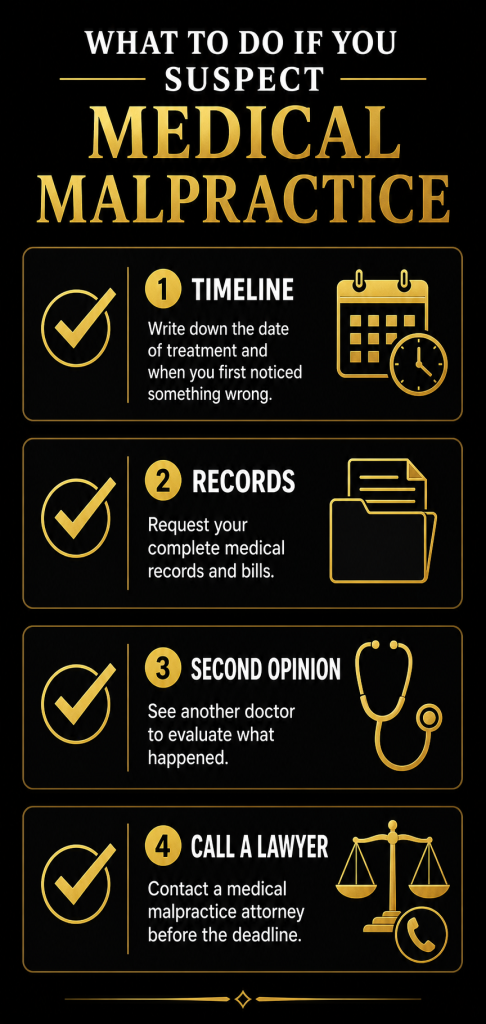
- Write down your timeline: dates of treatment, what you were told, and when you first suspected a problem. That “when did you know” date matters.
- Request your records, including imaging, lab results, nursing notes, and discharge papers.
- Save letters and portal messages. In Illinois, a written notice of the injury can start the clock.
- Do not sign anything from the hospital or an insurer without advice.
- Get the injury treated, even if that means switching providers.
- Call a lawyer early, because expert review takes time.
- Do not wait to “feel sure.” The deadline does not.
When to Call a Medical Malpractice Lawyer
Call as soon as you suspect harm, and especially if:
- It has been more than a year since the treatment or since you learned of the problem
- A family member died after treatment
- The injury involved a child or newborn
- The provider is a public hospital, VA, or clinic
- You received a letter or report that explains what happened
- You are being asked to sign a release or accept a payment
Demesmin & Dover represents injured people in Florida and Illinois, with offices in Fort Lauderdale, Tampa, and Chicago. We can review your dates, identify which deadline controls, and make sure the notice, affidavit, and filing steps are done on time.
FAQ
What is the medical malpractice statute of limitations in Florida?
Generally 2 years from the incident or from when it was discovered or should have been, with a 4-year outer limit. Exceptions include minors, fraud, and wrongful death.
What is the medical malpractice statute of limitations in Illinois?
Generally 2 years from when you knew or should have known of the injury or death, with a 4-year outer limit from the act or omission.
Does the discovery rule always help?
No. In both states a 4-year outer limit applies, with limited exceptions.
How long do minors have?
In Florida, the 4-year limit does not bar a claim brought by the child’s 8th birthday. In Illinois, up to 8 years from the act, but never after the 22nd birthday.
How long do I have for a wrongful death claim?
Two years in both states (from the death in Illinois). Do not wait.
Do I have to do anything before filing?
In Florida, a pre-suit investigation and a notice of intent, followed by a 90-day wait. In Illinois, an affidavit and a health professional’s report.
What if the doctor works for a public hospital or the VA?
Different notice and timing rules may apply. Get advice early.
Talk to Demesmin & Dover About Your Deadline
Deadlines in medical malpractice cases are strict, and they are different in Florida and Illinois. If you think a medical mistake hurt you or someone you love, do not wait to find out where you stand. Demesmin & Dover represents injured people in Florida and Illinois, and we are available 24/7.
Call now: 866-954-MORE (6673) or Start your free case review.