Last updated November 16, 2026.
A semi-truck crash produces more evidence than almost any other collision. The truck logged speed and braking. The carrier recorded hours. Dispatch traded messages with the cab. A safety file holds the driver’s history.
All of it exists on day one. Then the clocks start.
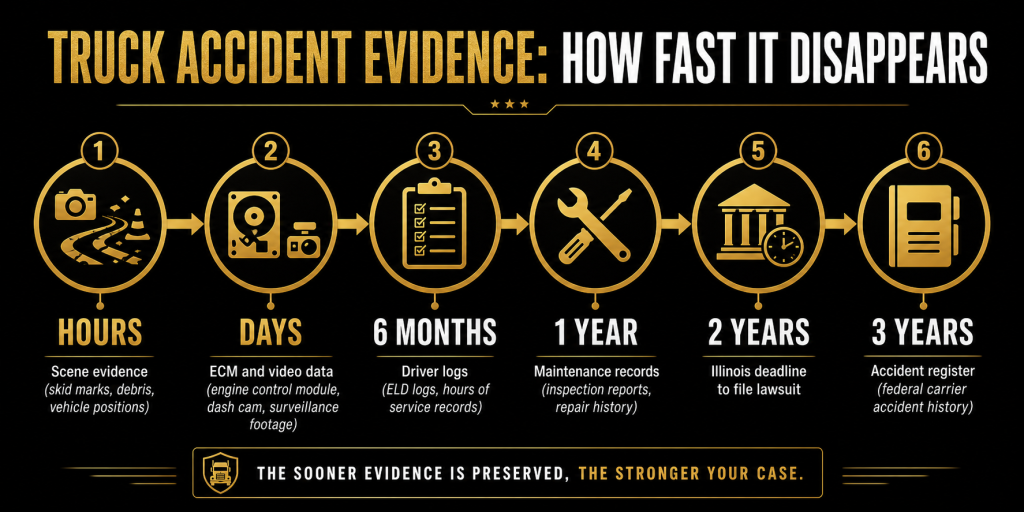
Some evidence is gone in hours. Some is gone in days. Some federal record rules let carriers clear files in six months, which is far shorter than the time most injury families need to recover, find answers, and hire counsel. This guide explains what evidence wins Chicago truck accident cases, how long each piece may last, and why a truck accident lawyer in Chicago moves on it first.
Quick Answer: Federal rules require carriers to keep driver logs and supporting documents for only 6 months (49 CFR 395.8(k)(1)), maintenance records for 1 year and 6 months after the vehicle leaves the carrier’s control (396.3(c)), and the accident register for 3 years (390.15(b)). Engine data and dashcam video have no federal retention rule of their own and can be overwritten when the truck goes back to work. Illinois gives most injury victims 2 years to sue (735 ILCS 5/13-202). A specific preservation letter, sent in the first days, is the best tool for keeping the proof alive.
Why Evidence Decides Chicago Truck Cases
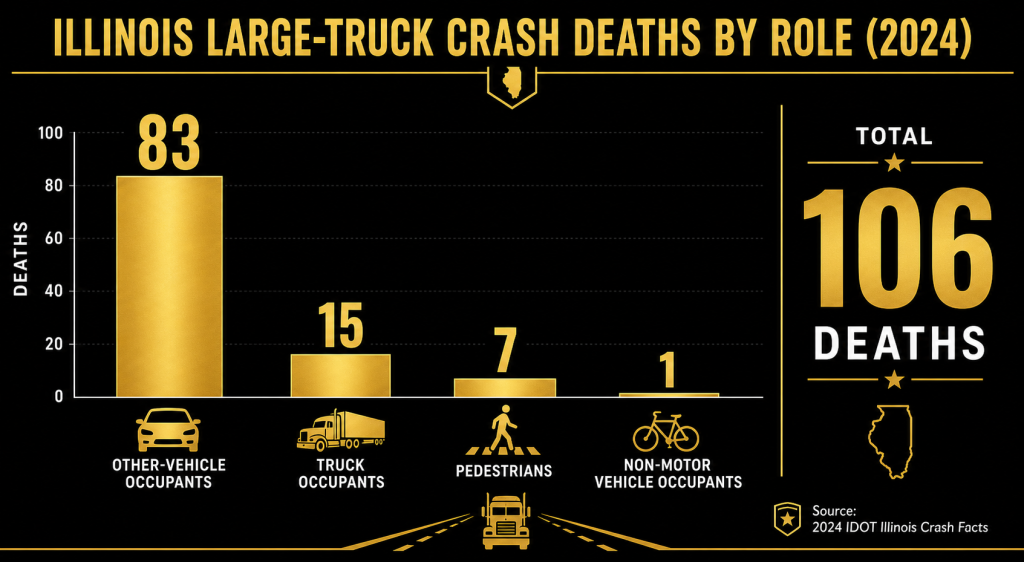
Large trucks are a real part of Illinois crash risk. NHTSA’s 2023 data show 190 people died in Illinois crashes involving large trucks, and 132 of them were occupants of other vehicles. Another 25 were pedestrians, cyclists, or other non-occupants.
Illinois’ 2024 Crash Facts report that tractor-trailer fatalities fell about 13% from 2023 to 2024. Fewer deaths are good news. They do not make a single crash less devastating for the family living through it.
Trucking companies and their insurers know what wins cases, and they know how fast it can vanish. The side that moves first on proof usually shapes the case.
The Evidence That Wins, and How Long It May Last
| Evidence | What it can prove | How long it may last |
|---|---|---|
| Driver logs (ELD) | Hours of service violations, driver fatigue | 6 months minimum (49 CFR 395.8(k)(1)) |
| Supporting documents (bills of lading, dispatch records, fuel receipts, fleet messages, settlement sheets) | Whether the log matches reality | 6 months (395.11), capped at 8 documents per driver per 24 hours |
| Engine control module (black box) | Speed, braking, throttle before impact | No federal retention rule. May be overwritten when the truck returns to service. |
| Dashcam and telematics video | What the driver and road looked like | Depends on the carrier and the vendor. Often overwritten. |
| Maintenance and inspection records | Brake, tire, or steering defects | 1 year, plus 6 months after the vehicle leaves the carrier’s control (396.3(c)) |
| Drug and alcohol tests | Impairment | Test windows are short: 2 hours (alcohol record), 8 hours (alcohol cutoff), 32 hours (drugs) (382.303) |
| Accident register | A pattern of crashes across the fleet | 3 years (390.15(b)) |
| Scene evidence (skid marks, gouges, debris, final rest positions) | How the crash unfolded | Hours to days |
| Witness memory and nearby camera footage | Who did what | Fades or gets overwritten quickly |
The pattern is clear. The most revealing records sit under the shortest clocks.
Federal Retention Rules vs. the Illinois Deadline
Illinois gives most personal injury plaintiffs 2 years to file (735 ILCS 5/13-202). A wrongful death claim also has a 2-year deadline from the date of death (740 ILCS 180/2(d)).
Now set that beside the 6-month log rule.
Picture a driver hurt in a crash in January 2027. Surgeries and rehab take months. The family reaches a lawyer in the fall. By July 2027 the carrier may legally clear the duty-status records for the crash week. The suit deadline is still more than a year away.
That gap is why so many trucking cases turn on speed.
Two more details matter:
- The 6-month clock starts at receipt, not creation. For logs and supporting documents, retention runs “from the date of receipt” (395.8(k)(1)).
- No destruction of an existing document. Federal rules bar a carrier or driver from obscuring, defacing, destroying, mutilating, or altering information in a supporting document (395.11(f)). But after the retention period ends, ordinary clean-up can happen.
Evidence Inside the Truck: Black Box, Video, and Logs
The black box. Most modern tractors carry an engine control module that can store speed, throttle, braking, and hard-braking events. Many keep only a small number of the most recent hard-brake events, and a newer event can replace an older one. If the truck keeps driving after a crash, the crash record can be lost. Battery disconnection and power loss can also cause problems.
Nothing in the federal hours-of-service rules requires a carrier to preserve what the engine recorded. A written demand has to name the module and the underlying data, not just a printout.
Video. Many fleets use forward-facing or driver-facing cameras. Retention depends on the carrier’s settings and the vendor’s storage plan. If a subscription lapses or a system overwrites, the footage can be gone.
Logs. An electronic log shows when the truck moved and when the driver rested. By itself it proves little. Supporting documents test it. A fuel receipt stamped at 2:40 a.m. in Indiana contradicts a log showing the driver asleep in Illinois. A pay record showing payment by the mile can explain why a driver skipped rest.
Chain of custody. The truck, the tractor, the trailer, and any parts that came off in the crash should be documented, stored, and tracked. A neutral inspection protocol for downloading the module protects everyone, and it prevents later fights about whether data was changed.
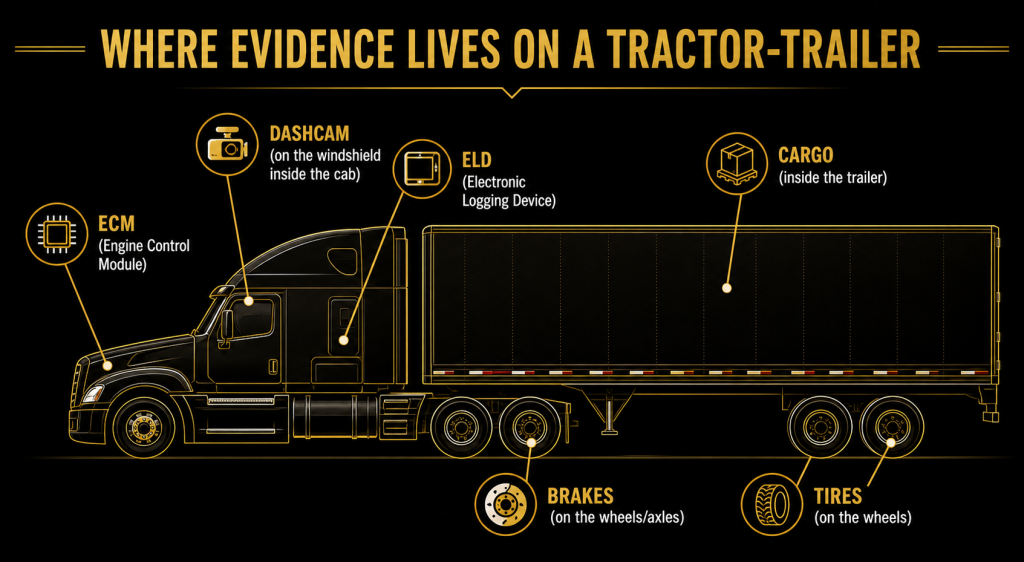
Evidence at the Scene: What Disappears in Hours
Scene evidence is the first to go.
- Tire marks and gouges fade under weather and traffic.
- Debris and fluids get cleared by road crews. That is their job, and it still removes proof.
- Vehicle positions change when tow crews move cars.
- Traffic and business cameras often overwrite footage on a short cycle. Nearby cameras can show the signal, the speed, and the lane change.
If you are able, safely take photos and video of the whole scene, the truck’s USDOT number and plates, damage, road markings, and the weather. Ask for names and phone numbers of witnesses.
In Illinois, a driver involved in a crash that causes injury or death, or property damage above $1,500, must give notice to the local police, the county sheriff, or the Illinois State Police if no officer is present (625 ILCS 5/11-407). Make sure a report is made. Expressway crashes in the Chicago area may be handled by a different agency than city street crashes, so confirm which agency responded.
Evidence About the Company
A truck crash is rarely just a driver mistake. These records can show how the company hired, trained, scheduled, and maintained its fleet:
- The driver qualification file: employment history, driving record checks, road test, and medical certification
- Hiring and training records
- Dispatch messages and delivery schedules, which can show pressure to rush
- Maintenance, repair, and inspection paperwork for the tractor and the trailer
- Post-accident drug and alcohol testing records
- The accident register, which lists each recorded accident for 3 years and can show a pattern across the fleet
Federal rules require post-accident alcohol and drug tests in certain situations, such as a fatality or a citation along with injury or a tow-away. If a test is not given within 2 hours, the carrier must write down why. After 8 hours, attempts to test for alcohol stop. After 32 hours, attempts to test for drugs stop (49 CFR 382.303). The window is short, and an untested driver is a missing piece of evidence.
The Preservation Letter: What It Should Demand
A generic “please preserve evidence” letter invites routine deletion. A specific, itemized demand does not.
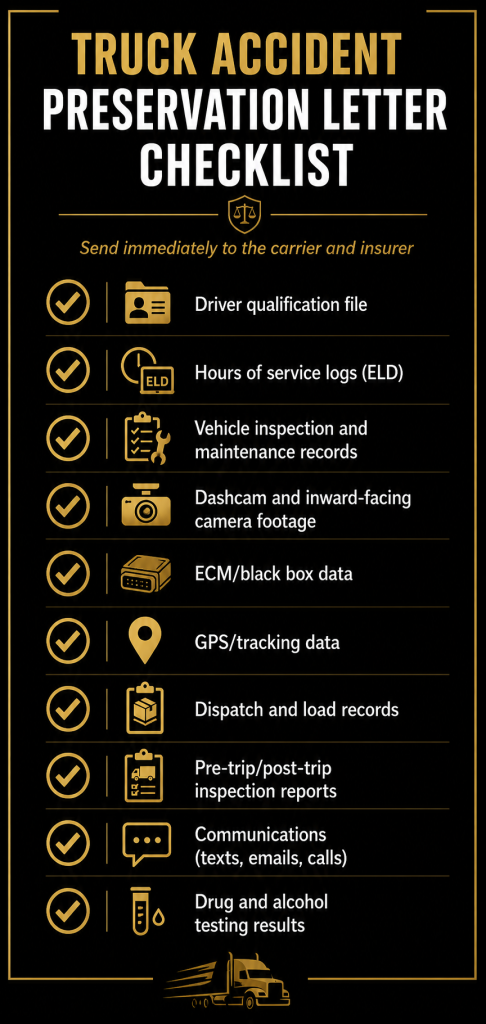
A strong letter to the trucking company and its insurer should list:
- The truck, trailer, and tires in the condition they were in after the crash
- The engine control module and the underlying data, not just a printout
- Dashcam and onboard video, including any driver-facing footage
- Electronic logs and their backups, for the days around the crash
- Supporting documents: bills of lading, dispatch records, fuel and expense receipts, fleet messages, and pay records
- GPS and telematics records
- The driver qualification file
- Maintenance and inspection records for both tractor and trailer
- Post-accident drug and alcohol test records
- The accident register
- The driver’s cell phone and carrier-issued devices, plus phone records
- Dispatch communications
Sending it in week one costs almost nothing. Waiting until month eight can cost the case.
What Illinois Law Says About Destroyed Evidence
Illinois does not treat destroyed evidence the way many people expect. Illinois does not recognize a separate tort for spoliation. In Boyd v. Travelers Insurance Co., the Illinois Supreme Court held that a plaintiff can bring a negligent spoliation claim under ordinary negligence principles.
In general, a party has no automatic duty to preserve evidence. A duty can arise from an agreement, a contract, a statute, or another special circumstance, or when a party takes on the duty through its own conduct.
Two practical points follow:
- A written preservation demand that names specific records helps establish that the company was on notice.
- A carrier that pulls the engine data for its own defense team may take on a duty to keep it for everyone.
Courts can also sanction a party that destroys evidence once a case is underway.
Shared fault. Evidence matters for one more reason. Under Illinois law, a plaintiff more than 50% at fault is barred from recovering damages, and a plaintiff 50% or less at fault has damages reduced by that percentage (735 ILCS 5/2-1116). Logs, video, and braking data are how fault gets sorted out.
What to Do in the First 72 Hours
- Get medical care. Health comes first, and records tie injuries to the crash.
- Call 911 and make sure police respond.
- Photograph everything if you are able, including the truck, the USDOT number, plates, and the scene.
- Keep your own vehicle. Do not let a tow yard, salvage buyer, or insurer scrap or sell it. Many newer vehicles also record pre-crash speed and braking.
- Save your phone, photos, messages, and any dashcam video.
- Do not give a recorded statement to the trucking company’s insurer before getting advice.
- Do not post about the crash on social media.
- Write down what you remember while it is fresh.
- Call a truck accident lawyer in Chicago so a preservation letter can go out right away.
When to Call a Truck Accident Lawyer in Chicago
Call as soon as possible if:
- A commercial truck hit you or a family member
- Someone was seriously hurt or killed
- The truck is still on the road or in a repair yard
- The trucking company or its insurer is already calling you
- You are being asked to sign a release or accept a quick settlement
- More than one company may be involved, such as a carrier, a shipper, and a maintenance vendor
A truck accident lawyer in Chicago can send preservation letters, arrange a neutral download of the black box, hire reconstruction and trucking safety experts, and file a lawsuit if the evidence calls for one.
Demesmin & Dover represents injured people in Illinois and Florida, including from our Chicago office.
FAQ
How long do trucking companies have to keep driver logs?
At least 6 months from the date they are received (49 CFR 395.8(k)(1)). Some keep them longer. Others do not.
Do trucks have a black box?
Many tractors have an engine control module that records speed, braking, and hard-brake events. No federal retention rule covers it, so it must be named in a preservation letter.
How long is there to file a truck accident lawsuit in Illinois?
Most personal injury claims have a 2-year deadline (735 ILCS 5/13-202). Wrongful death claims also have a 2-year deadline from the date of death.
What is a preservation letter?
A written demand telling a trucking company and its insurer to keep specific evidence, such as the truck, the engine data, video, and records.
What if the company destroys evidence anyway?
Illinois recognizes a negligent spoliation claim under ordinary negligence principles, and courts can impose sanctions in pending cases. A lawyer can explain the options.
Can an injured person still recover if partly at fault?
Yes, if they are 50% or less at fault. Damages are reduced by their share (735 ILCS 5/2-1116).
Talk to a Truck Accident Lawyer in Chicago
Evidence in a truck crash does not wait. If a commercial truck hurt you or someone you love, the first week matters. Demesmin & Dover represents injured people in Chicago and across Illinois, and we are available 24/7.
Call now: 866-954-MORE (6673)or Start your free case review.