
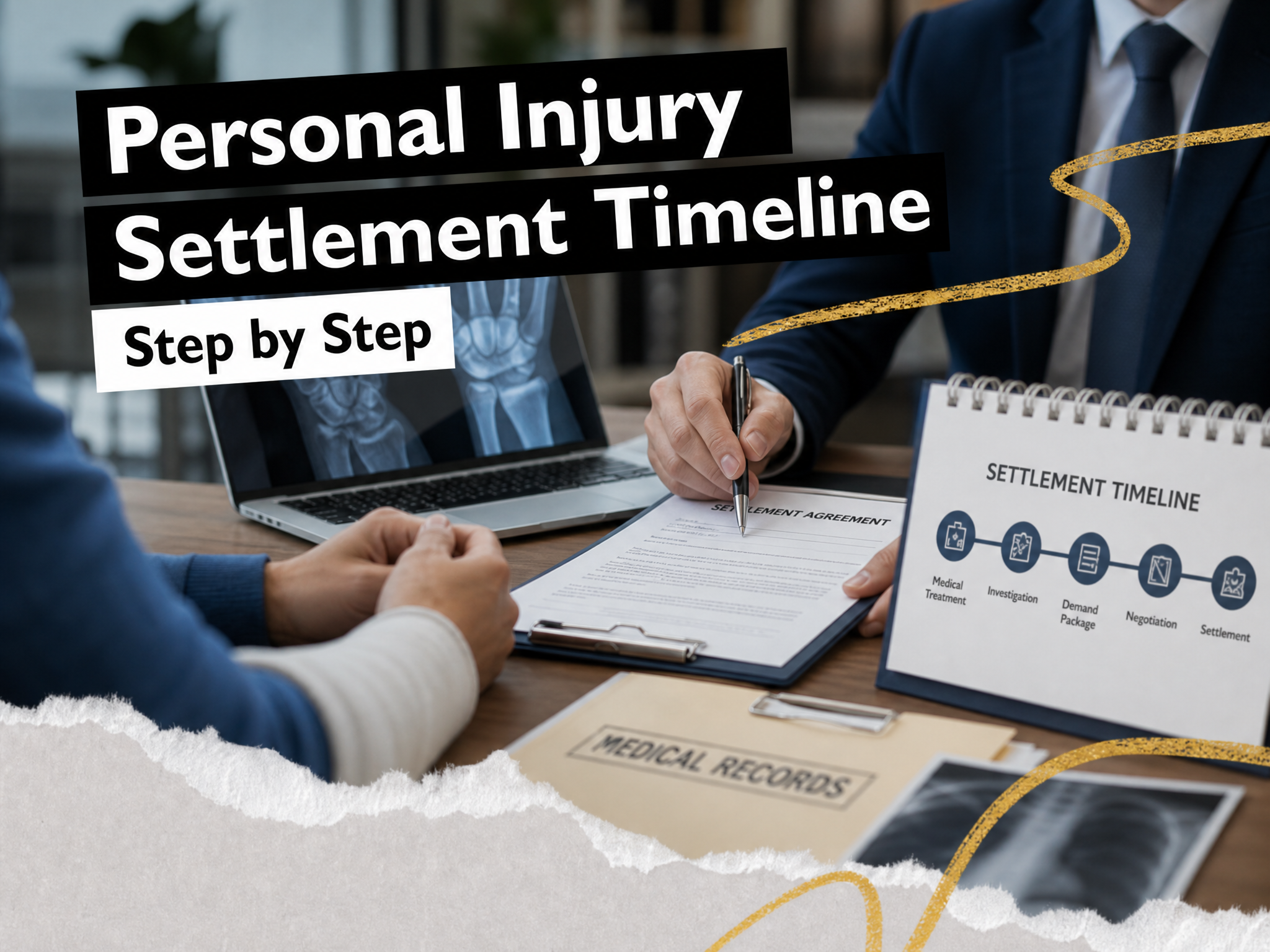
Let’s be honest about the question you actually want answered: “How long is this going to take?”
You didn’t ask for any of this. One accident, and suddenly you’re managing doctor visits, missed paychecks, and a stack of paperwork you never wanted to see. On top of all that, nobody can give you a straight answer about when it ends. So let’s walk through it together, step by step, the way it really plays out, including a few things that work differently depending on whether you’re in Illinois or Florida.
Right After It Happens: The First 72 Hours
Everything starts here, and what you do in these first few days matters more than people realize.
Get medical care first. Always. Even if you feel “okay,” some injuries (whiplash, concussions, soft tissue damage. etc.) don’t show symptoms right away. The adrenaline your body feels post the accident sometimes can hinder you from truly feeling where the pain is in your body. Additionally a same-day medical record also does something practical: it ties your injury to the accident in a way that’s hard to argue with later.
While you’re at it, start collecting the small stuff that turns into big evidence later: photos of the scene, eye witness names and numbers, police report number, etc. Keep in mind none of this needs to be perfect, it just helps if it exists.
The First Few Weeks: Treatment and Talking to a Personal Injury Lawyer
This is usually when things start feeling less chaotic and more like a process. It is also the best time to contact a personal injury attorney, even if it is just to review if you have a case. It is a great way to get some advice, figure out what options are available to you, and most importantly, help you get things somewhat back to how they were before the accident. An attorney can also step between you and the insurance company, which takes a surprising amount of pressure off.
Speaking of insurance companies: it helps to understand who you’re actually dealing with. The National Association of Insurance Commissioners, the organization that coordinates insurance regulation across all 50 states, notes that the adjuster assigned to your claim is the one who investigates what happened and determines how much the insurance company should pay. This is useful knowledge going in because their job is to protect their employer’s bottom line, not yours. Studies have found that an injured person who hires a lawyer often recovers about 3.5 times more money in settlements.
Months Two Through Six: Building the Case
This stretch is the quiet part. Not much looks like it’s “happening,” but it’s the most important phase for your eventual payout.
Your medical treatment continues until you reach what’s called maximum medical improvement, or MMI. That’s the point where your doctors have a clear picture of your recovery, including whether you’ll need future surgeries, ongoing therapy, or long-term care. This part can’t really be rushed. Settling before you reach MMI means guessing at your own future, and that guess is almost always too low.
Behind the scenes, your legal team is gathering records: documentation of medical expenses, lost wages, and other financial losses, along with therapy notes and related records that help prove your damages.
The Demand Letter: Putting a Number on Medical Expenses
Once you’ve reached MMI, it’s time to add up your compensation, including both economic damages and non-economic damages.
A demand letter lays out what happened, who’s at fault, and what you’re asking for, backed by your medical records, bills, and lost income. It should show that economic damages cover actual out-of-pocket costs, while non-economic damages account for pain and suffering and emotional distress. Think of it as the opening move in a negotiation, not the final word. Pain and suffering is often undervalued if it is not thoroughly documented in the demand package.
Negotiation: The Back-and-Forth
Here’s where patience gets tested. The insurance company will typically respond with a lowball number. This isn’t personal. It’s standard practice. Their opening offer is designed to see if you’ll take less than the case is worth.
From there, it’s a back-and-forth: they counter, you counter, and so on, until you land somewhere both sides can agree to, or you decide it’s time to escalate. You’re in the driver’s seat at every step. No offer gets accepted without your sign-off.
If Talks Stall, its Time to File a Personal Injury Lawsuit
Most cases never get here, but if negotiations hit a wall, filing a lawsuit is the next move, and it’s worth knowing that filing doesn’t mean you’re locked into a trial. It just means you’re applying real pressure and keeping your options open.
Once a suit is filed, the case enters discovery: both sides exchange documents, write questions, and start depositions. Mediation is often tried during this stage too, and a lot of cases that reach this point still settle before ever seeing a courtroom.
That’s not just a hunch, there is data that backs it up. According to Justia, “of the 41,696 tort cases that were terminated in U.S. district courts in fiscal year 2000, only 3 percent were decided in trials.” Thus proving more cases are settled before trial than ever before.
If It Does Happen to Go to Trial
While extremely rare, if your case reaches trial, both sides present their evidence, and a judge or jury decides the outcome. This path takes longer and carries more uncertainty than settling, but for some cases, especially where the insurance company won’t offer a fair number, it’s the right move.
What This Looks Like in Illinois and Florida
The general shape of the timeline is the same everywhere, but a couple of details change depending on where your accident happened. If you’re in Illinois or Florida, here’s what’s specific to you.
Illinois. You generally have two years from the date of your injury to file a lawsuit, under 735 ILCS 5/13-202. If a city, county, or other government body is involved, that window shrinks to just one year under 745 ILCS 10/8-101, so it’s worth finding out early whether a government entity or government agency is part of your case. Illinois also uses modified comparative negligence: you can still recover damages as long as you’re found 50% or less at fault, but if a jury finds you 51% or more responsible, you can’t recover anything under 735 ILCS 5/2-1116. That threshold makes early evidence collection, the photos, the witness names, the police report, more important than it might seem in the moment.
Florida. Florida’s rules changed in a big way in 2023. Under Florida Statute § 95.11(4)(a), the deadline to file most personal injury lawsuits is now two years from the date of the accident, down from the four years it used to be, for anything that happened on or after March 24, 2023. Florida also moved from “pure” comparative negligence to a modified system with a 51% bar under Florida Statute § 768.81(6): if you’re found more than half at fault, you’re barred from recovering anything. Medical malpractice cases are the one exception and still follow the older, more forgiving rule. Because that filing window is now half as long as it used to be, getting your case moving early matters even more than it did a few years ago.
In both states, the core idea is the same: the earlier your case gets documented and the sooner you understand your deadline, which can vary depending on the circumstances, the more options you have down the road. This is why it is so important to reach out to a personal injury lawyer early on so they can ensure your case gets handled way before the statute of limitations are up.
So… How Long Does This Actually Take?
Here’s the honest range:
- Straightforward cases that settle without a lawsuit: often anywhere from 3 to 6 months or longer
- Cases that require filing a lawsuit: typically between 12 to 24 months or longer
- Cases that go all the way through trial: commonly 2 to 4 years from the date of injury or longer
Nobody can promise you exactly where your case will land on that spectrum. There is no exact science that says the case will move from point a to point b by x time because there are so many pieces at play. Plainly put, every case moves at its own pace, shaped by things like how serious the injury is, whether fault is disputed, and how many parties are involved, etc. But now you know the shape of the road ahead, and that alone tends to make the wait a little easier to carry.
What You Can Do to Keep Things Moving
A few things are generally in your control:
- Go to every medical appointment that is part of your treatment and healing
- Get documents to your legal team that may help your case, including records that support property damage, costs, etc.
- Think twice before posting about your accident or your recovery online
- Stay in touch with your attorney so you can follow up on your case and know what is going on
Thorough proof can also support claims for lost earning capacity in serious cases and, in rare situations involving gross negligence, punitive damages.
You Don’t Have to Figure This Out Alone
If you’re in the middle of this right now, take a breath. You don’t need to know every step today. That’s what we’re here for.
At Demesmin & Dover, you’re more than a file. You’re a person whose life just got interrupted, and our job is to help you get it back. We handle the insurance companies and the paperwork so you can focus on healing.
Reach out today for a free, no-pressure consultation. Tell us what happened, we’ll listen, and we’ll tell you how we can help. If we take your case, you don’t pay us a dime unless we win.
Call 866-954-MORE (6673) or fill out our online form to get started. With offices in Fort Lauderdale, Tampa, and Chicago, we’re ready to fight for you in both Florida and Illinois. You’ve carried enough on your own. Let’s carry the next part together.