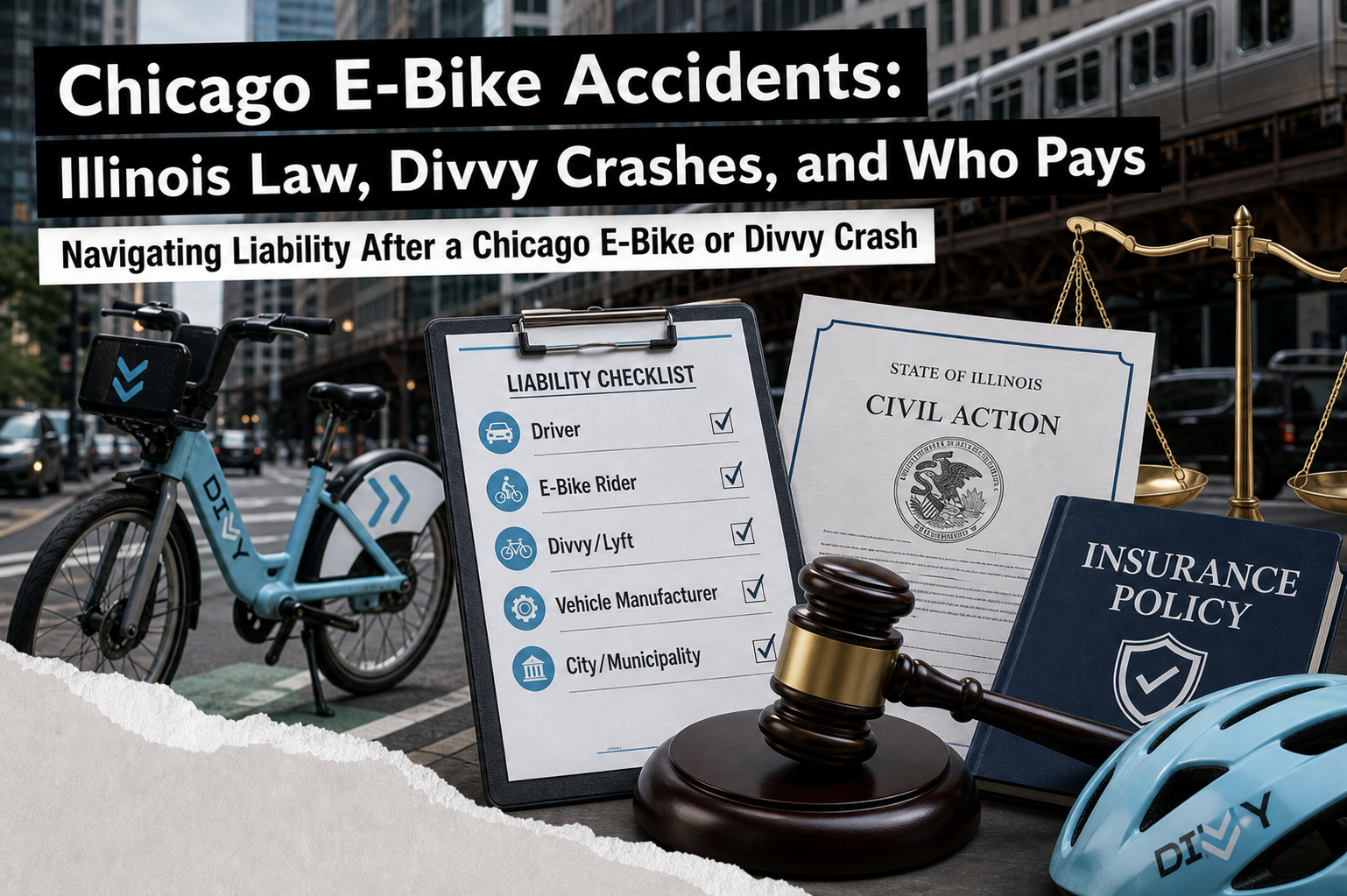
Chicago has bike lanes, a lakefront, and roughly one million cars that did not see you. If you were hit while riding an e-bike (yours or a Divvy), the questions come fast: What’s the law? Who’s at fault? Who pays? Here’s the short version, then the details.
Quick Answer: In Illinois, most e-bikes are “low-speed electric bicycles” (motor under 750 watts, three classes) and follow the same rules as bicycles: you can ride in roads and bike lanes, not on sidewalks, and Class 3 riders must be 16 or older. If a driver hit you, their auto liability policy is the usual first source of payment, and your own uninsured motorist coverage may help if they have no insurance or flee. You generally have 2 years to sue, but only 1 year if a local government entity is involved. And the law changes on January 1, 2027.
That’s the summary. The detail that matters most is below.
Why This Is Happening More
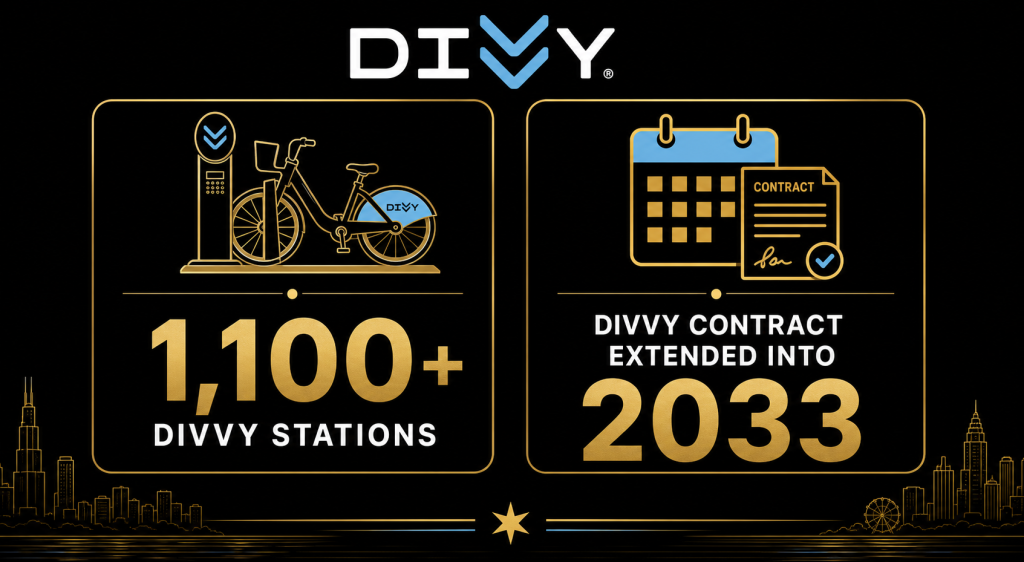
Divvy’s e-bike and scooter fleet keeps growing. The city and Lyft announced a five-year contract extension in September 2026, running Divvy into 2033, with more than 1,100 stations and thousands more e-bikes and scooters planned. Block Club Chicago reported record summer ridership in 2026, with more than 3.5 million trips since June 1.
Nationally, the Consumer Product Safety Commission’s report covering 2017 to 2024 says injuries and deaths tied to e-bikes and other micromobility products are rising, and that motor vehicle collisions and loss-of-control crashes are among the leading hazards.
Illinois E-Bike Laws Today: Classes, Where You Can Ride, and Who Can Ride
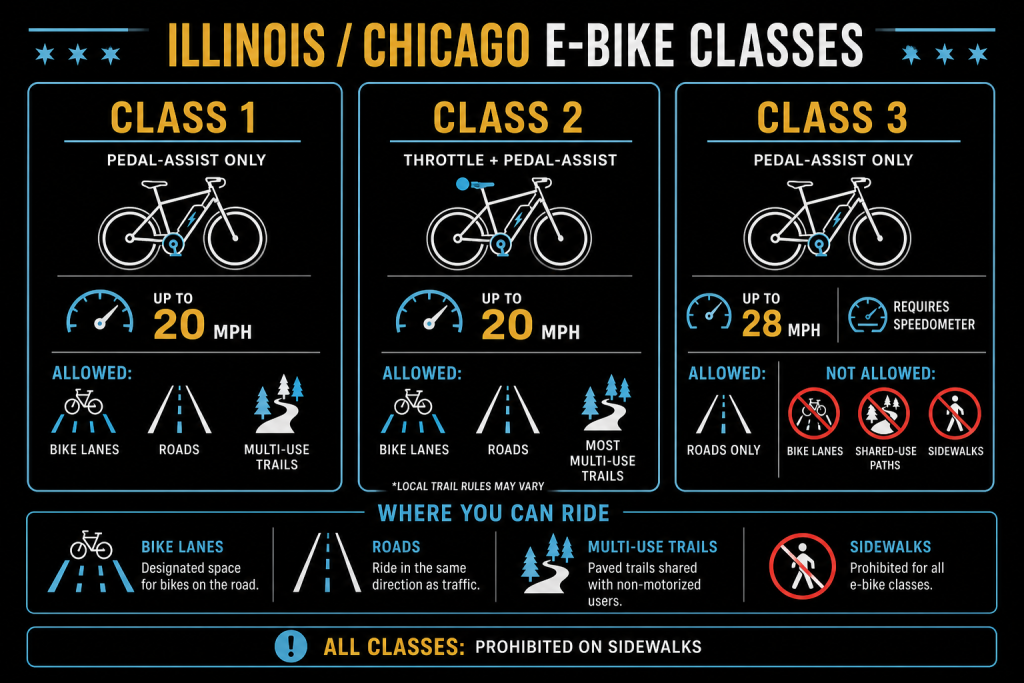
Illinois law (625 ILCS 5/1-140.10) defines a low-speed electric bicycle as a bicycle with fully operable pedals and a motor under 750 watts, in one of three classes:
| Class | How the motor works | Assist stops at |
|---|---|---|
| Class 1 | Helps only while you pedal | 20 mph |
| Class 2 | Can propel the bike on its own (throttle) | 20 mph |
| Class 3 | Helps only while you pedal | 28 mph |
A low-speed e-bike is not a moped or a motor driven cycle, and generally follows the bicycle rules in the Illinois Vehicle Code (625 ILCS 5/11-1517):
- Roads and bike lanes: allowed wherever bicycles are.
- Bike paths: allowed unless the local authority prohibits e-bikes or a class on that path.
- Sidewalks: not allowed.
- Class 3 age: riders must be at least 16, and Class 3 bikes must have a speedometer.
- Labels: manufacturers must permanently label the class, top assisted speed, and motor wattage.
On the driver’s license question: Some sites say you need a driver’s license to ride an e-bike. The statute text I reviewed does not impose one, and treats low-speed e-bikes like bicycles.
What Changes on January 1, 2027
Public Act 104-854 takes effect January 1, 2027. According to the statute text, it:
- Sets minimum ages: Class 1 and Class 2 riders must be 15 or older (Class 3 stays 16). A bike built for passengers can’t carry one if the operator is under 18, unless the passenger is a sibling, child, or step-relative.
- Lets park, forest, and transit districts regulate e-bike use on paths under their jurisdiction by ordinance.
- Limits local regulation otherwise: units of local government, including home rule units, generally can’t regulate low-speed e-bikes beyond what the statute allows.
- Reclassifies fast e-bikes: any electric bicycle that is not “low-speed” is treated as a motor driven cycle under the Vehicle Code.
WTTW reported on September 30, 2026 that the law also bars e-motos and e-bikes capable of going faster than 28 mph from bike paths, and that the Chicago Park District is weighing stricter speed limits. The district plans to bring proposed ordinance amendments to its board in November, with a 45-day comment period and possible approval in January.
What this means for you: the rules for e-bike riders on Chicago’s trails are in flux. If a crash happens on a path, ask which rules applied on that date.
Hit by a Car on an E-Bike: How Fault Works in Illinois
Because Illinois treats e-bikes like bicycles, drivers owe riders the same duty of care they owe cyclists. Common crash patterns include:
- Right hooks and left turns across a bike lane
- Opening a car door into a rider’s path
- Parked or stopped vehicles blocking a bike lane, forcing riders into traffic
- Drivers who “didn’t see you” at intersections
Fault matters more than most people expect. Under 735 ILCS 5/2-1116, you’re barred from recovering if you’re found more than 50% at fault, and below that your recovery is reduced by your percentage. Insurers look for anything that puts blame on the rider:
- Riding on a sidewalk
- Riding a Class 3 bike under 16
- Speeding or ignoring signals
- A bike that was modified past its labeled speed
That’s why early evidence matters: photos, video, witnesses, and the bike itself.
Who Pays for an E-Bike Accident? The Insurance Stack
There is rarely one answer. Think in layers:
| Source | What it is | Notes |
|---|---|---|
| The driver’s liability insurance | Pays for injuries the driver caused | Illinois minimums are $25,000 per person, $50,000 per crash for bodily injury (625 ILCS 5/7-203). Many serious injuries exceed that. |
| Your uninsured and underinsured motorist coverage | Applies if the driver has no insurance, flees, or has too little | Illinois requires uninsured and hit-and-run coverage in auto policies (215 ILCS 5/143a). Whether it applies to you on a bike depends on your policy. |
| Medical payments coverage and health insurance | Pays bills while the claim is pending | Your health insurer may seek repayment from a settlement. |
| Other responsible parties | A negligent employer, a vehicle owner, a bike or battery maker | Depends on the facts. |
| A government entity | If a road defect or unsafe design caused the crash | Strict one-year limit, covered below. |
| Divvy or another operator | If equipment failure or a rental contract is involved | See the next section. |
If you were riding for work (delivery, for example), other coverage may apply.
Divvy E-Bike Accidents: What You Agreed To
If you were on a Divvy e-bike, you accepted a rental agreement before unlocking it. According to the current Divvy Rental Agreement (issued by Motivate International Inc., governed by Illinois law):
- Assumption of risk and release. You agree that riding involves many risks, including other vehicles, potholes, and bike or component malfunction, and you accept responsibility for them. The release language also refers to negligent acts of the “Released Persons.”
- Helmets. Divvy recommends but doesn’t provide helmets, and says wearing one is your sole responsibility.
- Mandatory arbitration. Disputes go to binding JAMS arbitration, not court, with a class-action waiver. The agreement says you can opt out within 30 days of first use, and carves out small claims court.
Three practical points:
- The agreement is between you and Divvy. It doesn’t release the driver who hit you, so a claim against the driver is a separate matter.
- Whether a release holds up is a legal question that depends on the facts and how the clause is worded. Don’t assume it ends your claim.
- Report the crash to Divvy and keep your ride record, but don’t give a recorded statement without advice.
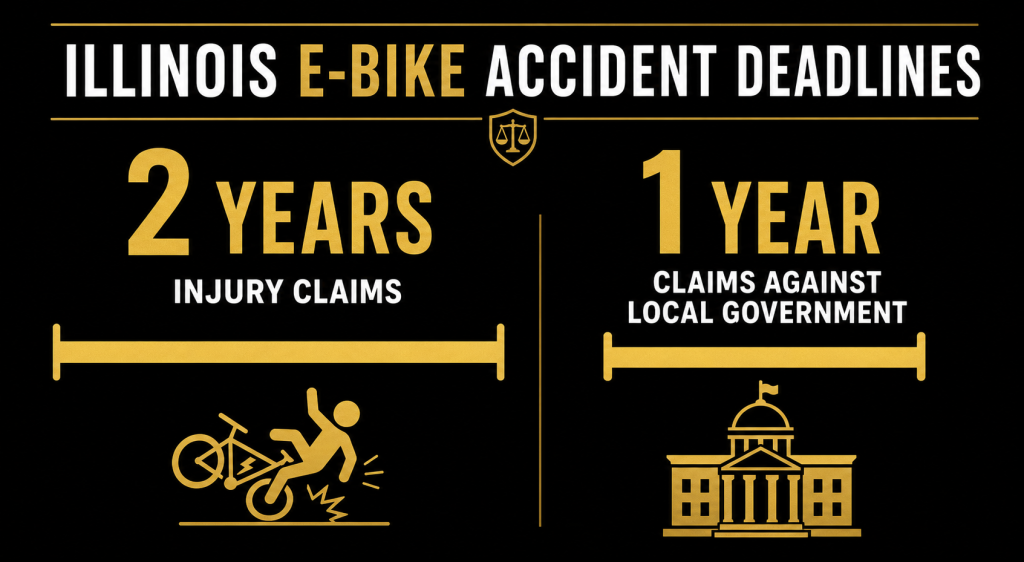
Deadlines: Two Years, and One Year Against the City
- General injury claims: 2 years from when the cause of action accrued (735 ILCS 5/13-202).
- Claims against a local government entity or its employees: 1 year (745 ILCS 10/8-101). That matters if a pothole, a defective bike lane, or unsafe design contributed to the crash. Other notice rules may also apply, so ask counsel quickly.
- UM or UIM claims: your policy may have its own notice and arbitration rules.
If someone died, wrongful death claims have their own rules.
What to Do After an E-Bike Crash in Chicago
- Call 911 and get medical care. Adrenaline hides injuries.
- Get a police report and the officer’s name and case number.
- Photograph everything: the scene, the vehicle, the driver’s plate and insurance, the bike lane markings, your injuries.
- Keep the bike. Don’t repair, charge, or sell it, and keep the helmet. Battery and equipment issues can matter.
- Get witness contacts and ask nearby businesses about cameras quickly.
- Save your Divvy ride record if you were on a rental.
- Don’t give a recorded statement to the driver’s insurer before getting advice.
- Notify your own insurer, as your policy requires, and mention uninsured motorist coverage.
How to Choose a Bike Accident Lawyer in Chicago
You want a bicycle accident lawyer in Chicago who understands e-bike law, rental terms, and the insurance layers. Ask:
- How many bike and e-bike cases have you handled?
- How do you handle a rental agreement or arbitration clause?
- Will you check uninsured and underinsured coverage and every responsible party?
- Who will work on my case, and how will you communicate?
- How are fees and costs handled, in writing?
Demesmin & Dover represents injured riders from our Chicago office, and our team also serves Florida.
FAQ
Are e-bikes legal in Illinois?
Yes. Low-speed electric bicycles are legal and generally follow bicycle rules, with three classes defined in 625 ILCS 5/1-140.10.
Where can I ride an e-bike in Chicago?
On roads and bike lanes, and on bike paths unless the local authority prohibits it. Not on sidewalks. Park District rules for trails may change.
What is the Illinois e-bike age limit?
Class 3 riders must be at least 16. Starting January 1, 2027, Class 1 and 2 riders must be at least 15.
Who pays if a car hits me on an e-bike?
Usually the driver’s auto liability insurance, with your own uninsured or underinsured motorist coverage, medical coverage, and other responsible parties as additional sources.
What if the driver has no insurance or drove off?
Your own auto policy’s uninsured and hit-and-run coverage may apply. Check your policy and call a lawyer.
What if I was on a Divvy e-bike?
You agreed to a rental agreement with a release and mandatory arbitration, but it doesn’t release the driver. A lawyer can review it.
How long do I have to file a claim?
Generally 2 years in Illinois, and 1 year if a local government entity is involved.
Do I need a lawyer for an e-bike crash?
Not for minor incidents with no injury. If you were hurt, fault is disputed, or insurance is unclear, it’s worth a call.
Get Help From Demesmin & Dover
An e-bike crash can leave you with medical bills, lost work, and an insurance company that’s already building its story. Demesmin & Dover represents injured riders in Illinois from our Chicago office, and we’re available 24/7.
Call now: 866-954-MORE (6673) or Start your free case review.