Your teen wants the keys. You want a sedative. Before anyone drives anywhere, here’s what Florida actually requires, what changed recently, and the part most parents don’t hear until after a crash: who pays when a teen driver causes one.
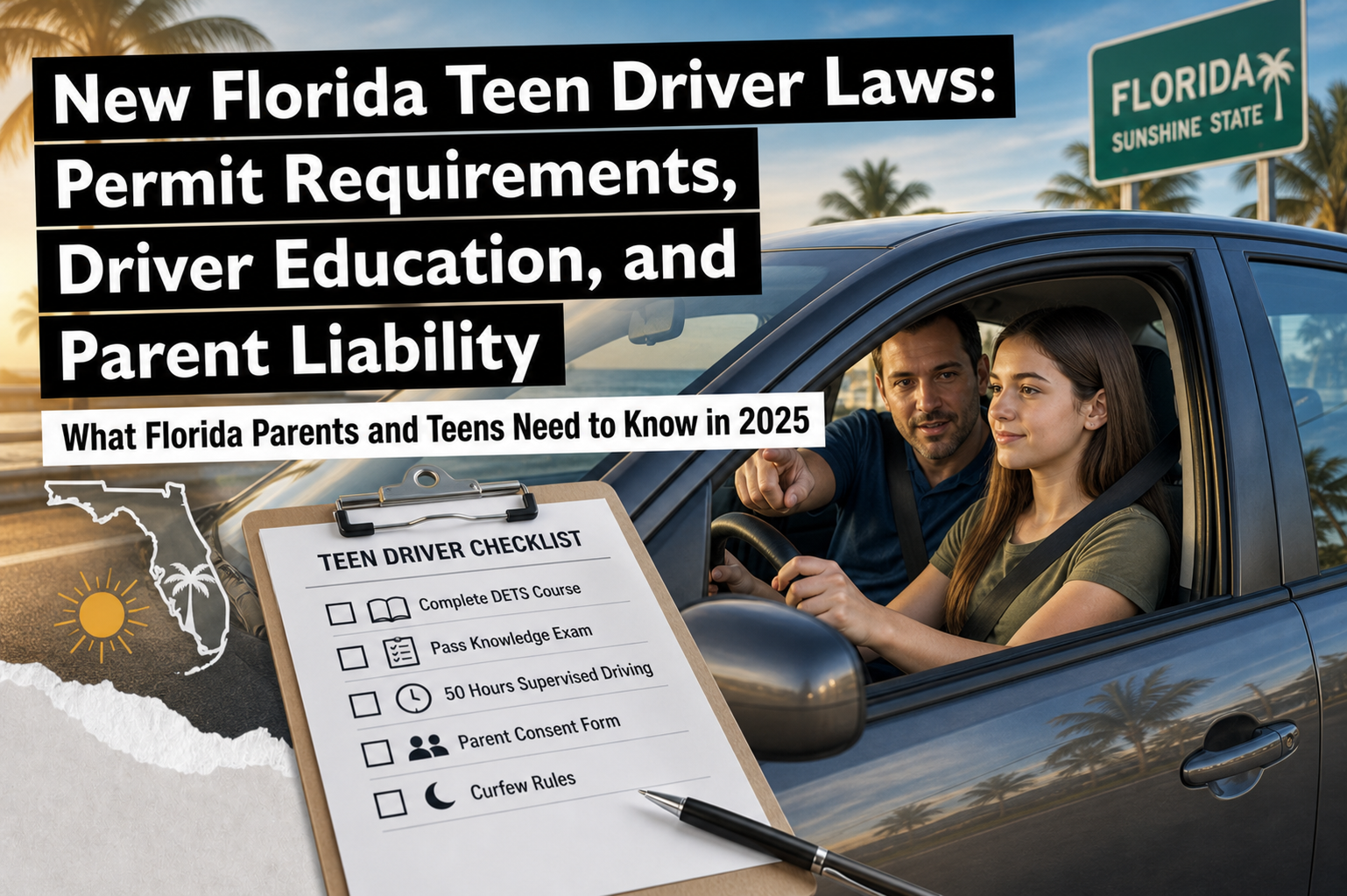
Quick Answer: Florida’s newest teen licensing change is the 6-hour Driver Education Traffic Safety (DETS) course, required for first-time applicants under 18 since August 1, 2025 (SB 994). A teen must be at least 15 to get a learner’s license, pass the written and vision and hearing exams, and have a parent or guardian sign the application. Whoever signs is jointly and severally liable with the teen for damages the teen causes while driving (Fla. Stat. § 322.09). One note on the “2026” in the search results: I found no new 2026 teen-licensing rules. The 2026 change that affects every driver is the $2,000 crash-reporting threshold that took effect October 1, 2026.
That’s the summary. Let’s sort out what’s new and what’s just old news with a fresh headline.
Why This Matters
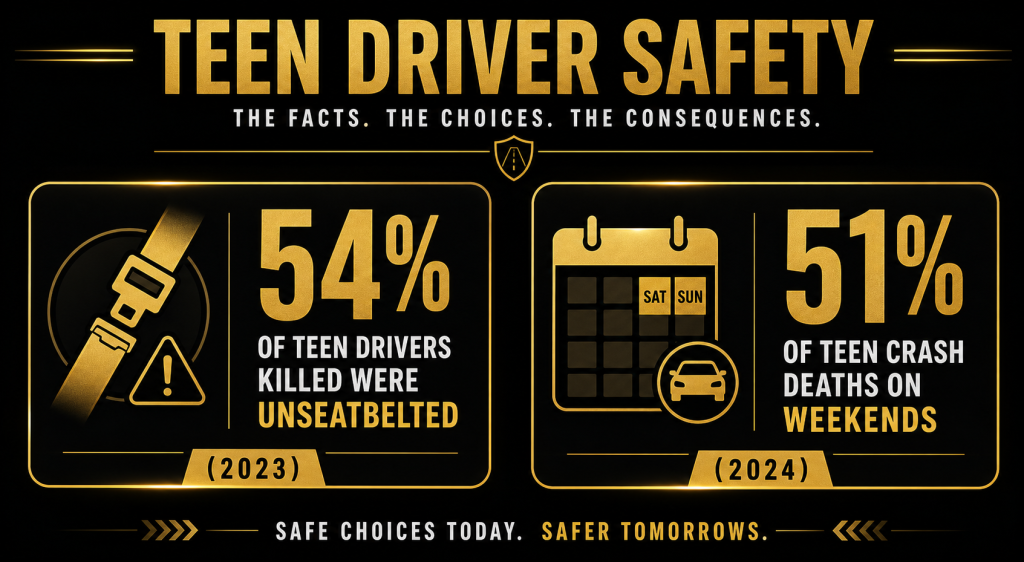
Teen drivers are a small share of licensed drivers and a large share of serious crashes. Nationally, 2,148 drivers ages 15 to 20 died in traffic crashes in 2023, and among the passenger-vehicle drivers killed whose restraint use was known, 54% were not wearing a seat belt, according to NHTSA. IIHS reports that in 2024, 51% of teen crash deaths happened on a Friday, Saturday, or Sunday, and 35% happened between 9 p.m. and 3 a.m. Weekends and nights are exactly where the curfew rules are aimed.
What’s Actually New: The 2025 Teen Driver Education Law and What Changed in 2026
| Date | What happened | Who it affects |
|---|---|---|
| May 30, 2025 | SB 994 (Chapter 2025-104) signed | Teen and adult license applicants |
| July 1, 2025 | Law took effect, with a transition month | Under-18 applicants |
| July 2025 | Either the old 4-hour TLSAE or the new DETS accepted | Under-18 applicants |
| August 1, 2025 | 6-hour DETS course required for first-time applicants under 18 | Under-18 applicants |
| October 1, 2026 | SB 488: crash-reporting threshold rises from $500 to $2,000 | All drivers |
What did not change in 2025:
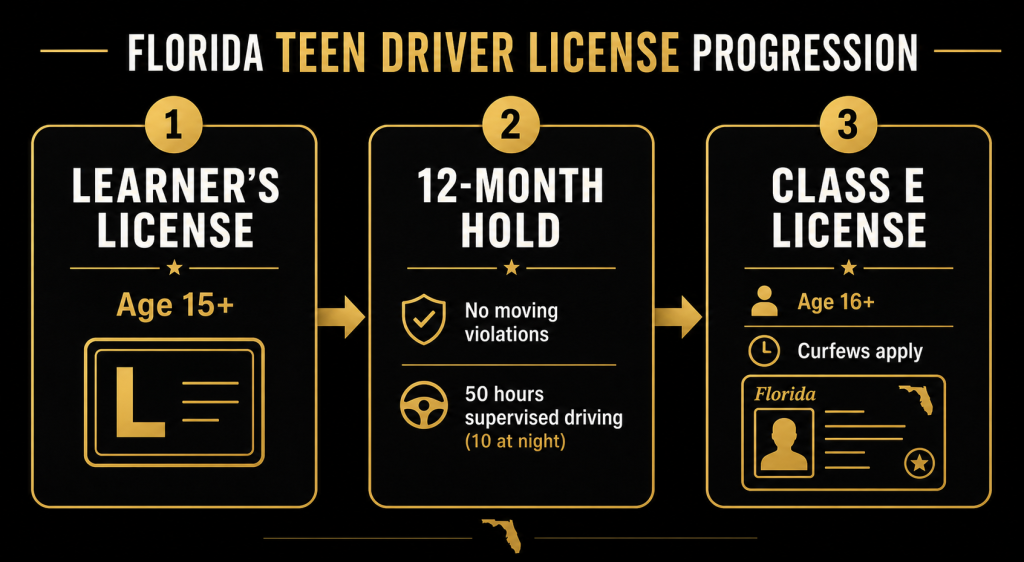
- The 50 hours of supervised driving (10 at night). That certification already appears in § 322.05(3) in the 2024 statutes.
- The 12-month learner’s license hold.
- The curfews and supervision rules.
What about adults? Applicants 18 and older still take the Traffic Law and Substance Abuse Education (TLSAE) course, with exceptions, not DETS.
Florida Learner’s Permit Requirements, Step by Step
Florida’s official term is “learner’s license,” though everyone says permit. To get one, a teen must:
- Be at least 15 years old.
- Complete a department-approved driver education course (the DETS course, or an approved school course).
- Pass the written Class E knowledge exam (40 of 50 correct) and the vision and hearing test.
- Have a parent or guardian sign the application, notarized. Step-parents generally can’t sign unless they’ve legally adopted the teen.
Driving rules with a learner’s license:
- A licensed driver age 21 or older must be in the closest seat to the right of the driver at all times.
- Daylight hours only for the first three months, then until 10 p.m.
- Violating the supervision or time limits is a moving violation.
Teen Driver Education in Florida: The DETS Course
- What it is: a 6-hour course that meets or exceeds the Florida Department of Education’s Traffic Safety classroom standard, taken online or in a classroom.
- Who needs it: first-time applicants under 18 who haven’t held a license elsewhere.
- Grandfathering: teens who finished the 4-hour TLSAE before August 1, 2025 can use that certificate for one year from completion. After that, they take DETS.
- Exemptions: teens who already had a Florida learner’s license before August 1, 2025, and teens transferring a valid out-of-state license.
- School courses: certain Florida school driver education courses can substitute.
From Permit to License: The 50 Hours and the 12-Month Hold
To move to a Class E license:
- Hold the learner’s license for 12 months with no moving-violation convictions (or until age 18).
- Be at least 16.
- 50 hours of behind-the-wheel practice, including 10 at night, certified by a parent, guardian, or other responsible adult using the state’s Certification of Minor Driving Experience form.
- Pass the driving skills test.
One detail worth knowing: the statute says that certification does not create a private cause of action and is inadmissible in a civil proceeding. Sign it honestly anyway. It’s a promise about your teen, not a formality.
Curfews and Restrictions
Once licensed, teens aren’t fully unleashed:
- Age 16: driving allowed only between 6 a.m. and 11 p.m.
- Age 17: only between 5 a.m. and 1 a.m.
- Exceptions for both: driving to or from work, or driving with a licensed driver age 21 or older.
Remember those IIHS numbers about nights and weekends. The curfews exist for a reason.
Parent Liability for a Teen Driver Accident in Florida
Here’s the part nobody mentions at the DMV counter.
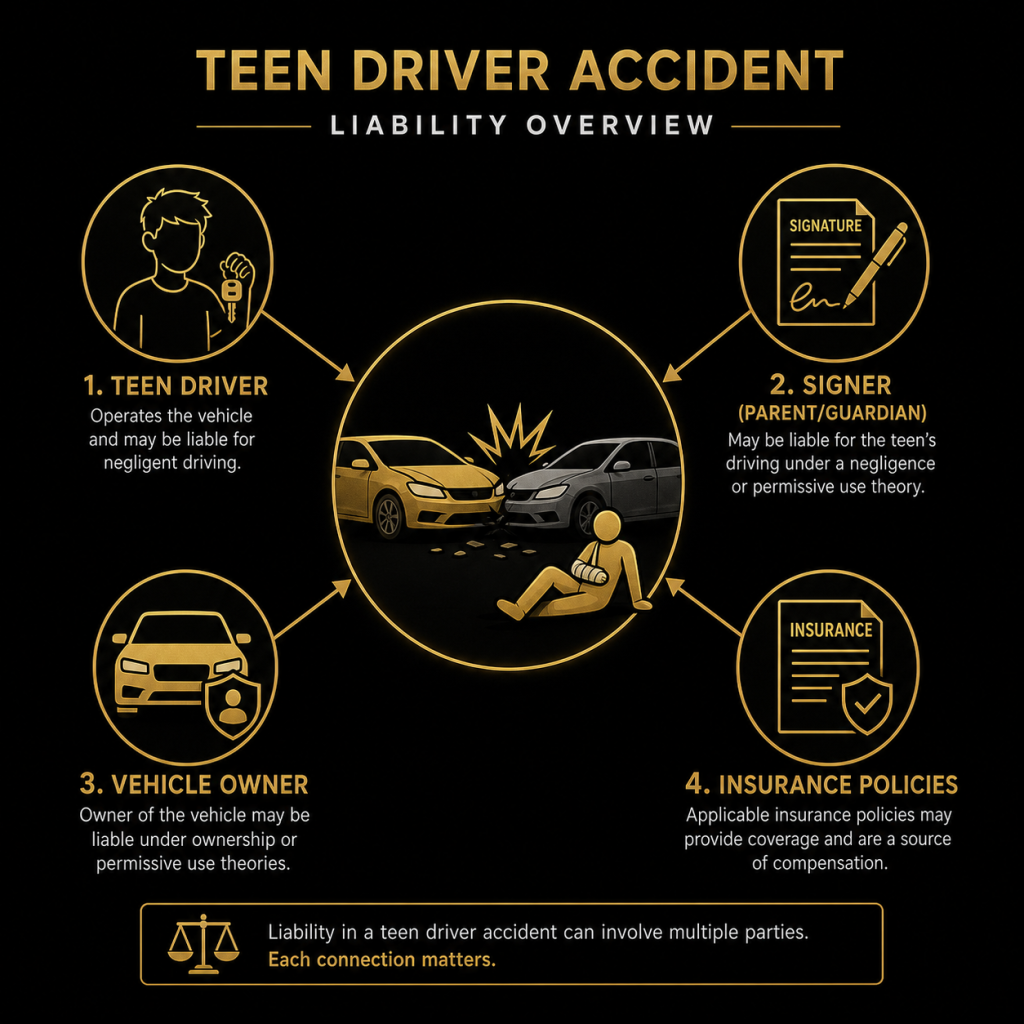
The signer is on the hook. Under Fla. Stat. § 322.09, a minor’s negligent or willful misconduct while driving is attributed to the person who signed the license application, and that signer is jointly and severally liable with the teen for the damages. The statute sets no dollar cap. “Jointly and severally” means an injured person can pursue the signer for the full amount, not a share.
Signing is not the only path to liability.
- Vehicle owner. Florida’s dangerous instrumentality doctrine can make an owner responsible when they let someone else drive and that person drives negligently.
- Negligent entrustment. Handing keys to a driver you know is unfit or unready can create its own claim.
You can withdraw, but not backward. Under § 322.10, a signer can file a verified request to cancel the minor’s license. That relieves the signer of liability for the minor’s later driving, not for earlier crashes.
Your insurance may be thinner than you think. Florida’s minimum is $10,000 in property damage liability (§ 324.022), plus $10,000 in PIP. The state does not require standalone bodily injury liability coverage for most drivers. A serious crash can exceed the policy, and then the signer’s personal assets matter. Ask your insurance agent about higher limits and an umbrella policy before your teen drives.
If you were hurt by a teen driver, this matters to you too. It often means more than one party and more than one policy may be responsible, and a car accident lawyer can identify them.
If Your Teen Is in a Crash, or a Teen Hit You
The first hours look the same either way:
- Check for injuries and call 911 if anyone is hurt. A complaint of pain means a long-form crash report.
- Call the police anyway. The new $2,000 reporting threshold means some officers may not respond to a no-injury, minor crash, but damage is hard to judge and a report protects everyone.
- Document the scene: photos of both vehicles, plates, insurance cards, road conditions, and witnesses.
- Get medical care within 14 days. Florida PIP generally requires initial treatment within 14 days (Fla. Stat. § 627.736(1)(a)), and teens often brush off pain.
- Don’t give a recorded statement to the other side’s insurer before getting advice.
- Report to your own insurer, as your policy requires.
For more on the reporting change, see our guide: “Do You Still Need a Police Report After a Minor Crash?”
When to Call a Car Accident Lawyer
You don’t need a lawyer for a clean fender-bender. A car accident lawyer becomes important when:
- Someone was injured, including a teen passenger or driver
- A teen driver was at fault and the insurance limits look too small
- The insurer is blaming your teen, or disputing fault
- You’ve received a recorded-statement request or a quick settlement offer
- You’re not sure who the responsible parties are
Demesmin & Dover represents injured people. If you’re a parent facing a claim over your teen’s crash, notify your own insurer right away, since they typically provide your defense.
FAQ
Is there a new Florida driving law for teens in 2026?
Not that I found. The recent teen change is the 6-hour DETS course, required since August 1, 2025. The 2026 change affecting all drivers is the $2,000 crash-reporting threshold, effective October 1, 2026.
What are Florida’s learner’s permit requirements?
Age 15 or older, a department-approved driver education course (DETS), the written exam, the vision and hearing test, and a notarized parent or guardian signature if under 18.
Do teens have to take driver’s ed in Florida?
First-time applicants under 18 must complete the 6-hour DETS course or an approved school course.
Are parents liable if their teen causes a crash?
The person who signed the minor’s license application is jointly and severally liable for the minor’s negligent driving under § 322.09. Owners can be liable too.
Can I cancel my teen’s license to avoid liability?
You can request cancellation under § 322.10, but it only relieves liability for later conduct, not past crashes.
How much insurance does Florida require?
$10,000 in property damage liability and $10,000 in PIP. Standalone bodily injury liability isn’t required for most drivers.
Do I need to call the police if my teen has a minor crash?
If anyone is hurt, yes. If not, a report is only required at $2,000 or more of apparent damage, but we recommend calling anyway.
How long do I have to sue after a crash?
Generally 2 years for negligence (Fla. Stat. § 95.11(5)(a)).
Get Help From Demesmin & Dover
Whether your teen is just learning to drive or someone else’s teen has already hurt you, we can help sort out who’s responsible. Demesmin & Dover represents injured people in Florida, and we’re available 24/7.
Call now: 866-954-MORE (6673) or Start your free case review.