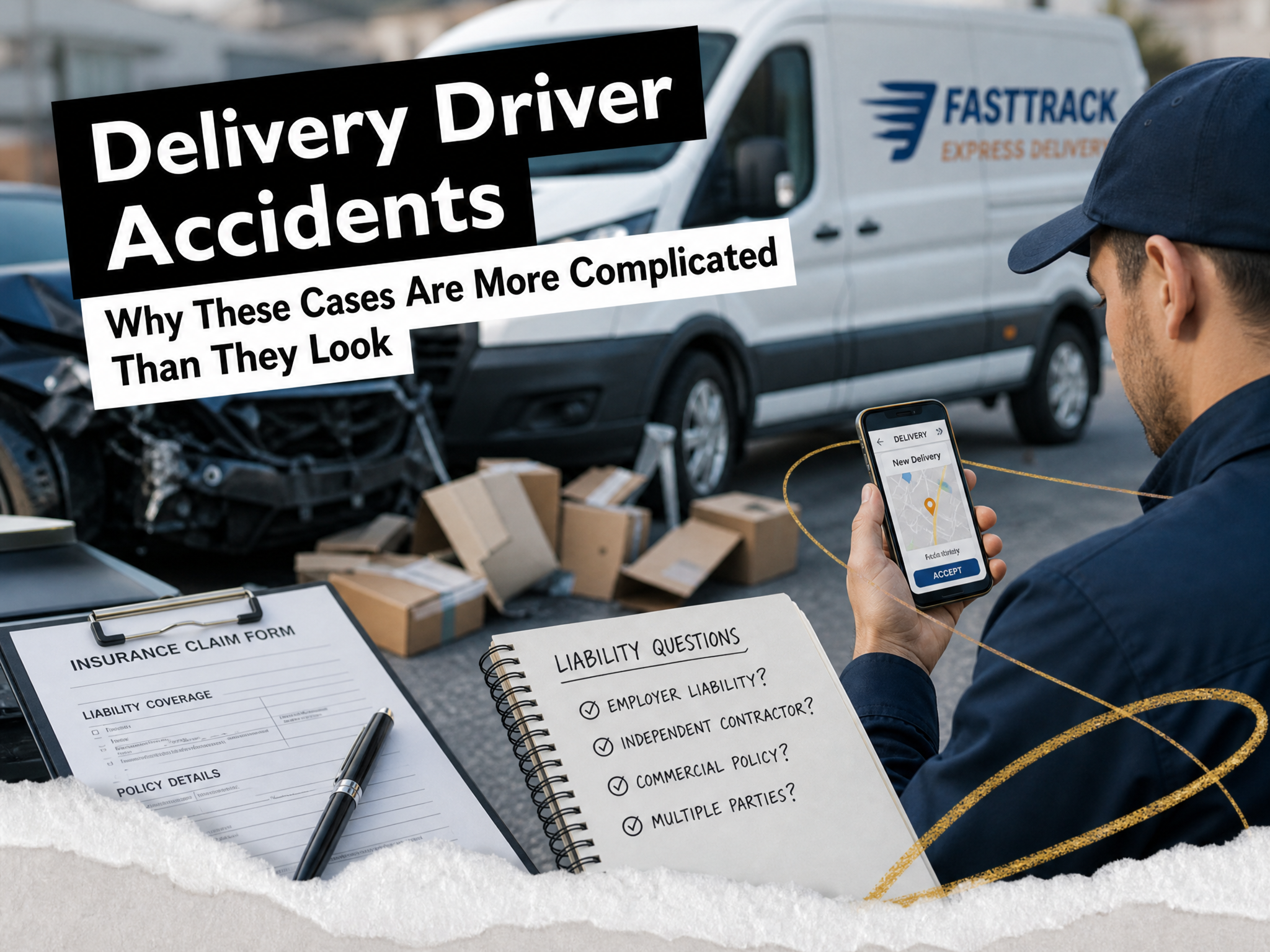
It’s a Tuesday afternoon. A delivery driver is running behind on three orders, checking the app for the next drop off address while merging into traffic. In a split second, she rear ends a car that stopped short at a light. Nobody is badly hurt, but the driver in front now has a sore neck, a damaged bumper, and a lot of questions. Who pays for this? Is it the delivery driver’s own insurance? The company she was driving for? Something else entirely?
If this sounds familiar, you’re not alone. With more packages, groceries, and takeout orders being delivered than ever before, accidents involving delivery drivers have become a lot more common on our roads. That’s exactly why we want to walk you through what actually happens after one of these crashes, because the honest answer is that these cases are rarely as simple as a normal car accident claim. There are extra layers of insurance, extra parties who might share the blame, and rules that change depending on which state the accident occurred in.
Why Delivery Driver Accidents Often Involve Complex Liability
A regular fender bender usually involves two drivers and two insurance companies. Delivery driver accidents usually involve a lot more moving parts. You might be dealing with the driver’s personal auto insurer, the delivery company’s insurance, a staffing agency, or even the business that hired the delivery company in the first place.
Part of the problem comes down to how delivery work is structured today. Many delivery drivers are independent contractors rather than employees, which changes who can be held legally responsible when something goes wrong. On top of that, personal auto insurance policies are typically written for everyday, non-commercial driving. The moment someone flips on a delivery app and starts working for pay, they may be stepping into a coverage gap that neither their personal policy nor the delivery company’s policy fully closes. Insurance industry sources have pointed out that a coverage gap is a time when one policy may not fully apply while another has not started yet, and this can happen during certain stages of gig delivery or rideshare work. That gap is exactly where a lot of these disputes end up.
There’s also the pressure of the job itself. Delivery apps often push drivers to complete a certain number of stops in a limited window, which can push some drivers toward risky habits like speeding, rolling through stop signs, or checking a phone screen for the next address. When that pressure comes from the company’s own routing system or deadlines, it can raise the question of whether the company shares some responsibility for the crash too.
Who May Be Responsible?
Because so many parties can be involved, figuring out who is actually on the hook takes some digging. Depending on the facts of your case, responsibility could fall on:
The delivery driver if they were speeding, distracted, fatigued, or otherwise driving carelessly.
The delivery or courier company if it failed to properly screen or train the driver, pushed unsafe delivery quotas, or misclassified an employee as a contractor to avoid liability.
A vehicle owner or leasing company if a mechanical failure or poorly maintained vehicle contributed to the crash.
A third party, such as another driver who cut off the delivery vehicle or a business that created a hazardous loading or parking situation.
Multiple parties at once, since more than one person or company can share fault under most state laws.
Big delivery operations add another road block. Amazon, for example, uses a mix of its own branded vehicles along with independent Amazon Flex drivers using their personal cars, which can make it genuinely hard for someone hit by one of these vehicles to even figure out who they’re dealing with.
Why These Cases Are Complex
Beyond just figuring out who’s responsible, several other factors make delivery driver accident cases harder to resolve than a typical crash:
Layered insurance coverage: Delivery apps often only provide coverage during specific “periods,” such as when the app is on and a delivery has been accepted, but not necessarily before an order is picked up.
Employment classification disputes: Whether a driver is an employee or an independent contractor (otherwise known as a 1099) can change which insurance policy applies and whether the company can be held liable at all.
Evidence: App data, GPS logs, and delivery timestamps can be extremely useful, but they aren’t always easily accessible.
Multiple insurance companies: Each one often trying to shift blame toward another party to reduce what they have to pay.
Florida and Illinois Law: What You Need to Know
Because Demesmin & Dover handles cases in both Florida and Illinois, it’s worth breaking down how each state handles fault, since it can directly affect what you’re able to recover.
Florida switched from a pure comparative negligence system to a modified one back in March 2023. Under current Florida law, if you’re 50% or less at fault in an accident, you can still recover damages, but your payout is reduced by your percentage of fault, and if you’re 51% or more at fault, you get nothing. That single percentage point can be the difference between a real settlement and no recovery at all, which is exactly why insurance companies push so hard during negotiations to shift blame onto the injured person.
Illinois follows a similar modified comparative negligence approach. Under Illinois law, fault in a car accident is shared between the parties involved, and if you’re found to be 51% or more at fault for the accident, you cannot recover damages, though if you’re less than 50% at fault, you can still file a claim with your compensation reduced based on your percentage of fault. Illinois also generally gives injured people two years from the date of the crash to file a personal injury lawsuit, so timing matters.
In both states, the company or companies involved will often try to argue that you share some of the blame, sometimes just enough to push you over that 50% line. That’s part of why it helps to have someone in your corner who understands exactly how these state specific rules apply to your situation.
What Evidence May Make for a Strong Case
The stronger your evidence, the easier it is to determine fault and damages after the crash. Useful evidence in a delivery driver accident case can include:
Police accident reports: which document the scene, statements from other drivers, and the initial collision assessment.
Delivery app data: this will have timestamps showing whether the driver was actively on a delivery, the GPS location history, and the route information.
Photos and video: dashcam footage (if available), nearby surveillance or doorbell cameras (if approval is given), and photos of vehicle damage and the accident scene.
Witness statements: anyone who saw the crash happen.
Cell phone records: this can show whether a driver was on their phone at the time of the crash.
Employment or contractor records: this will help establish who the driver was working for and under what terms.
Medical records: connecting your injuries directly to the crash and documenting medical expenses and other related expenses.
Evidence like delivery app logs and dashcam footage can disappear or get overwritten quickly, so acting fast after a crash really does make a difference in how strong your case can be.
Why You Should Contact an Attorney
Delivery driver accident cases involve more insurance policies, more potentially responsible parties, and more legal nuance than a standard fender bender. Add in state specific rules like Florida’s and Illinois’s 51% fault bar, and it becomes clear why trying to handle one of these claims alone can put you at a real disadvantage. An experienced attorney can help identify every responsible party, gather and preserve time sensitive evidence, and push back when an insurance company tries to pin excess blame on you.
If you or someone you love was hurt in an accident involving a delivery driver in Florida or Illinois, Demesmin & Dover is ready to help. We care more, and we’re here to fight for the compensation you deserve. Fill out our online contact form for a free consultation, or call us anytime at866-954-MORE (6673).